Skip to content
Expanding an ecommerce store into new countries is not just a translation task. Without the right international SEO setup, stores often rank the wrong pages, attract unqualified traffic, and see conversions drop.
International and multilingual SEO ensures search engines show the correct language and country version of your store to the right shoppers.
This guide explains how to structure, localize, and optimize ecommerce sites for global growth, step by step, without breaking search visibility.
International SEO Basics: Language vs Country (And Why The Difference Matters)
Before choosing URLs, adding hreflang, or translating pages, ecommerce teams need to understand one core concept: search engines treat language and country as two separate targeting signals. Most international SEO mistakes happen because these two get mixed together.
At a high level, international ecommerce SEO works on two axes:
- Language targeting: who can read and understand the content
- Country (regional) targeting: where the shopper is located and how they buy
Search engines use both to decide which version of a page should appear in search results. If you don’t define them clearly, search engines will guess, and guesses often go wrong.
Language Targeting: Who The Content Is Written For
Language targeting answers one simple question:
Which language is this page written in?
Examples:
- English
- French
- German
- Spanish
This matters because search engines want to show content users can actually read. A French-speaking user searching in French expects French-language pages, not English pages that “kind of apply.”
However, language alone is not enough for e-commerce.
Two shoppers can speak the same language but behave very differently when buying.
Country Targeting: Where The Buying Context Changes
Country targeting answers a different question:
Which country is this page intended to serve?
Country affects:
- Currency
- Taxes (VAT vs sales tax)
- Shipping eligibility and delivery times
- Return policies
- Sizing standards
- Product availability
- Payment methods
For ecommerce SEO, this is critical because purchase intent is shaped by country, not just language.
The Three Real-World Scenarios Ecommerce Stores Face
Most ecommerce sites fall into one (or more) of these setups:
1) One Language, Multiple Countries
Example: English for the US, UK, Canada, Australia.
Even though the language is the same, the pages should not always be identical.
Why:
- “Sneakers” vs “trainers”
- USD vs GBP vs CAD
- Different shipping timelines and return expectations
- Different search behavior and modifiers
If all English-speaking countries share one page, search engines may rank it—but conversions often suffer because the page feels “foreign” to the user.
2) Multiple Languages, One Country
Example: English and French in Canada.
Here, the country stays the same, but the language changes.
Why this matters:
- Both versions must be indexable
- Both versions must be clearly connected
- Users should land on the version they understand, not be forced to switch
This setup is common in regulated or bilingual markets and requires clean language targeting without duplicating country logic.
3) Multiple Languages, Multiple Countries
Example: French for France and French for Canada.
This is where international SEO becomes more complex, and where many stores fail.
Even though both pages are in French:
- Terminology differs
- Shipping rules differ
- Legal and tax expectations differ
- Search intent differs
From an SEO perspective, these are distinct pages, not duplicates.
Why Search Engines Need Explicit Signals (Not Assumptions)
Search engines like Google Search are good at detecting language automatically. They are not good at guessing which country version you intended when multiple similar pages exist.
Without clear signals:
- The strongest page (usually the original or English version) may rank everywhere
- Local versions may remain indexed but invisible
- Rankings can fluctuate between versions unpredictably
This is why international SEO relies on explicit mapping, not inference.
How Language And Country Combine In Practice (Locale Targeting)
In ecommerce SEO, language and country are often combined into a locale.
Examples:
- en-US → English for the United States
- en-GB → English for the United Kingdom
- fr-FR → French for France
- fr-CA → French for Canada
Each locale represents a unique search and shopping experience, even when products overlap.
Thinking in locales helps you:
- Design clean URL structures
- Implement hreflang correctly
- Localize content intentionally instead of duplicating pages
- Measure performance accurately by market
Common Beginner Mistake: Treating Country As A Secondary Detail
A frequent mistake is to:
- translate content first,
- then “figure out” country differences later.
This leads to:
- mixed currencies on the same URL,
- inconsistent shipping messages,
- canonical and hreflang conflicts,
- and poor conversion performance even when traffic increases.
The correct order is the opposite:
- Define which languages and countries you are targeting
- Map each to its own URL version
- Localize content based on buying context
- Then scale content and SEO signals
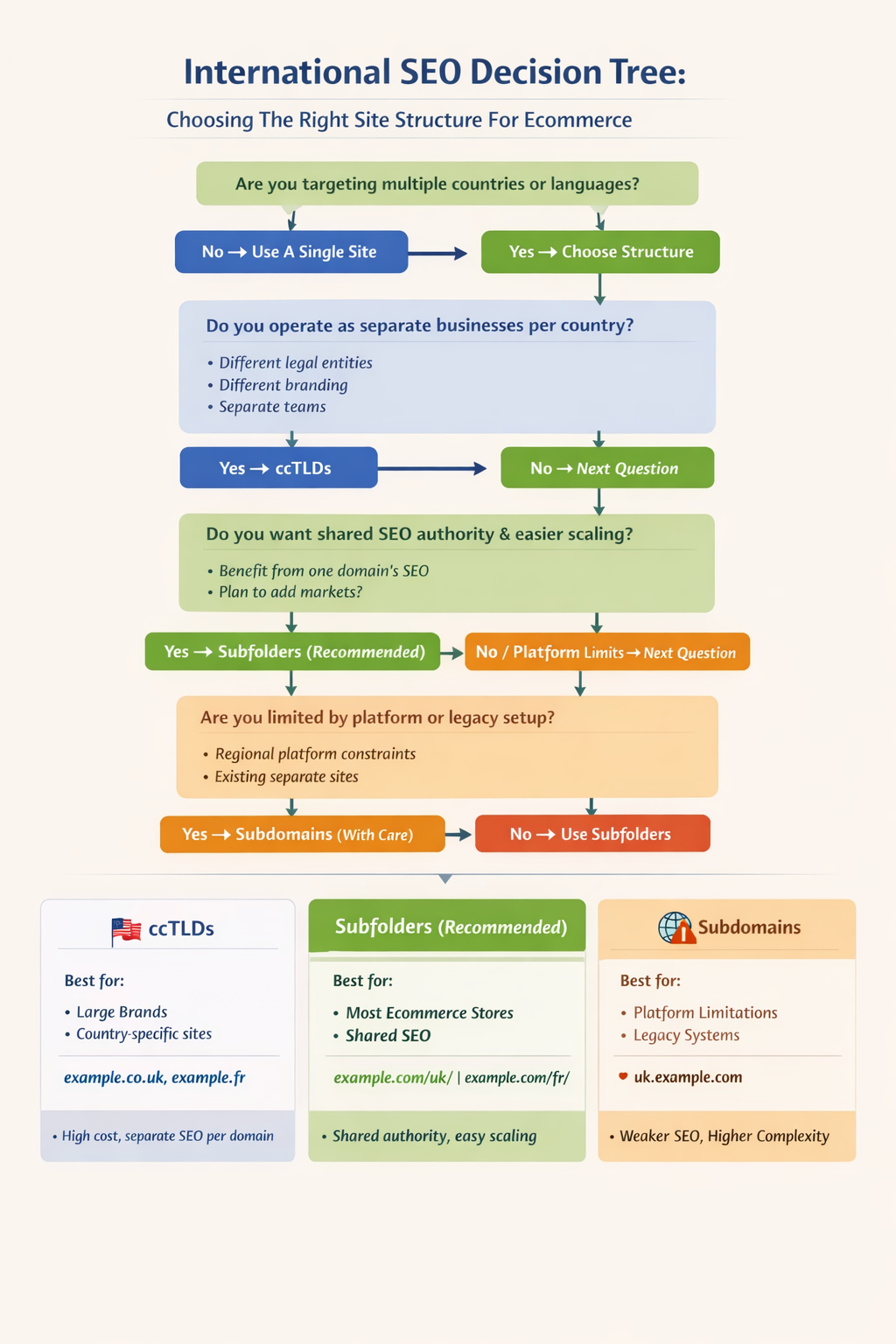
Choosing The Right International Site Structure (ccTLDs vs Subfolders vs Subdomains)
Once you’ve defined which languages and countries you’re targeting, the next decision is where those versions should live on your site. This is not just a technical choice. Your international site structure affects indexation, authority distribution, scalability, analytics clarity, and long-term maintenance.
There are three standard structures used in international ecommerce. Each works, but only when it matches your resources and growth goals.
The Three Supported International Structures
Search engines support all three of the following models. The difference lies in how much effort they require and how cleanly they scale.
Option 1: Country-Specific Domains (ccTLDs)
Example
- example.com (US)
- example.co.uk (UK)
- example.fr (France)
What this structure signals
A country-code top-level domain (ccTLD) sends the strongest possible country signal. The domain itself tells search engines and users which market the site is for.
Where this works best
- Large brands with dedicated teams per country
- Businesses with country-specific legal or branding requirements
- Markets where local trust is strongly tied to domain endings
Advantages
- Clear geographic targeting
- Strong user trust in local markets
- No ambiguity about which country the site serves
Limitations
- Each domain starts with its own SEO authority
- Higher cost and operational complexity
- Separate analytics, tracking, and maintenance
- Slower to scale if launching many markets
For most growing ecommerce stores, ccTLDs are powerful but heavy. They’re rarely the best starting point unless international presence is already mature.
Option 2: Subfolders (Recommended For Most Ecommerce Stores)
Example
- example.com/us/
- example.com/uk/
- example.com/fr/
What this structure signals
Subfolders keep all international versions under a single root domain, while clearly separating each locale.
Why this is the default recommendation
For most ecommerce teams, especially those using platforms like Shopify or WooCommerce, subfolders offer the best balance of SEO strength and operational simplicity.
Advantages
- All locales benefit from shared domain authority
- Easier to manage at scale
- Cleaner analytics and reporting
- Simpler internal linking across markets
- Faster to launch new countries or languages
Things to watch
- Each subfolder must still be treated as a distinct locale
- Content, hreflang, and canonicals must be precise
- Avoid mixing languages or currencies within the same folder
For Cartiful-style ecommerce growth, where SEO, paid, and UX need to work together, subfolders provide the most flexibility without sacrificing performance.
Option 3: Subdomains
Example
- us.example.com
- uk.example.com
- fr.example.com
What this structure signals
Subdomains separate locales technically, but not as clearly as ccTLDs, and not as cohesively as subfolders.
Where this sometimes appears
- Legacy systems
- Platform limitations
- Regional teams operating semi-independently
Advantages
- Clear separation of environments
- Can support different tech stacks if needed
Limitations
- Authority sharing is weaker than subfolders
- More complex tracking and maintenance
- Often misunderstood and misconfigured
- Rarely chosen intentionally today for ecommerce SEO
Unless you have a specific technical constraint, subdomains usually introduce more complexity than benefit.
How To Choose: A Practical Decision Framework
Instead of guessing, use this logic:
- If you’re launching international SEO for the first time:
→ Start with subfolders - If you operate as separate businesses per country:
→ Consider ccTLDs - If your platform forces it:
→ Use subdomains, but plan carefully
For most ecommerce brands focused on scalable growth, subfolders win because they:
- reduce SEO fragmentation,
- simplify localization,
- and allow faster experimentation across markets.
One Critical Rule Regardless Of Structure
No matter which option you choose, each locale must have its own stable URL.
Avoid:
- changing language or currency dynamically on the same URL
- relying only on pop-ups or selectors without URL changes
- auto-redirecting users without allowing search engines to crawl all versions
Search engines index URLs, not interface states. If there’s no unique URL, there’s no reliable international SEO.
Hreflang Explained: How Search Engines Choose The Right Locale Page
Once your international site structure is in place, hreflang becomes the system that connects all your localized pages together. It does not improve rankings directly, but it decides which version of a page is eligible to rank for a given user.
Most international SEO issues are not caused by missing hreflang but by incorrect or incomplete hreflang implementation.
What Hreflang Actually Does (And What It Does Not)
Hreflang is a signal that tells search engines:
“These URLs are different regional or language versions of the same page. Show the most appropriate one based on the user’s language and location.”
Important clarifications:
- Hreflang does not boost rankings
- Hreflang does not replace good content
- Hreflang does not fix weak localization
What it does do is prevent:
- the wrong country page ranking,
- multiple versions competing against each other,
- search engines guessing when they shouldn’t.
Search engines like Google Search already detect language automatically. Hreflang exists because language detection alone is not enough when similar pages target different markets.
When Ecommerce Stores Need Hreflang
You need hreflang if any of the following are true:
- You serve the same content in multiple languages
- You serve the same language across multiple countries
- You have localized versions with similar products and layouts
- You want to control which market sees which version
If you have:
- /en-us/
- /en-gb/
- /fr-fr/
…hreflang is not optional. Without it, search engines will decide which version ranks, and they often choose the wrong one.
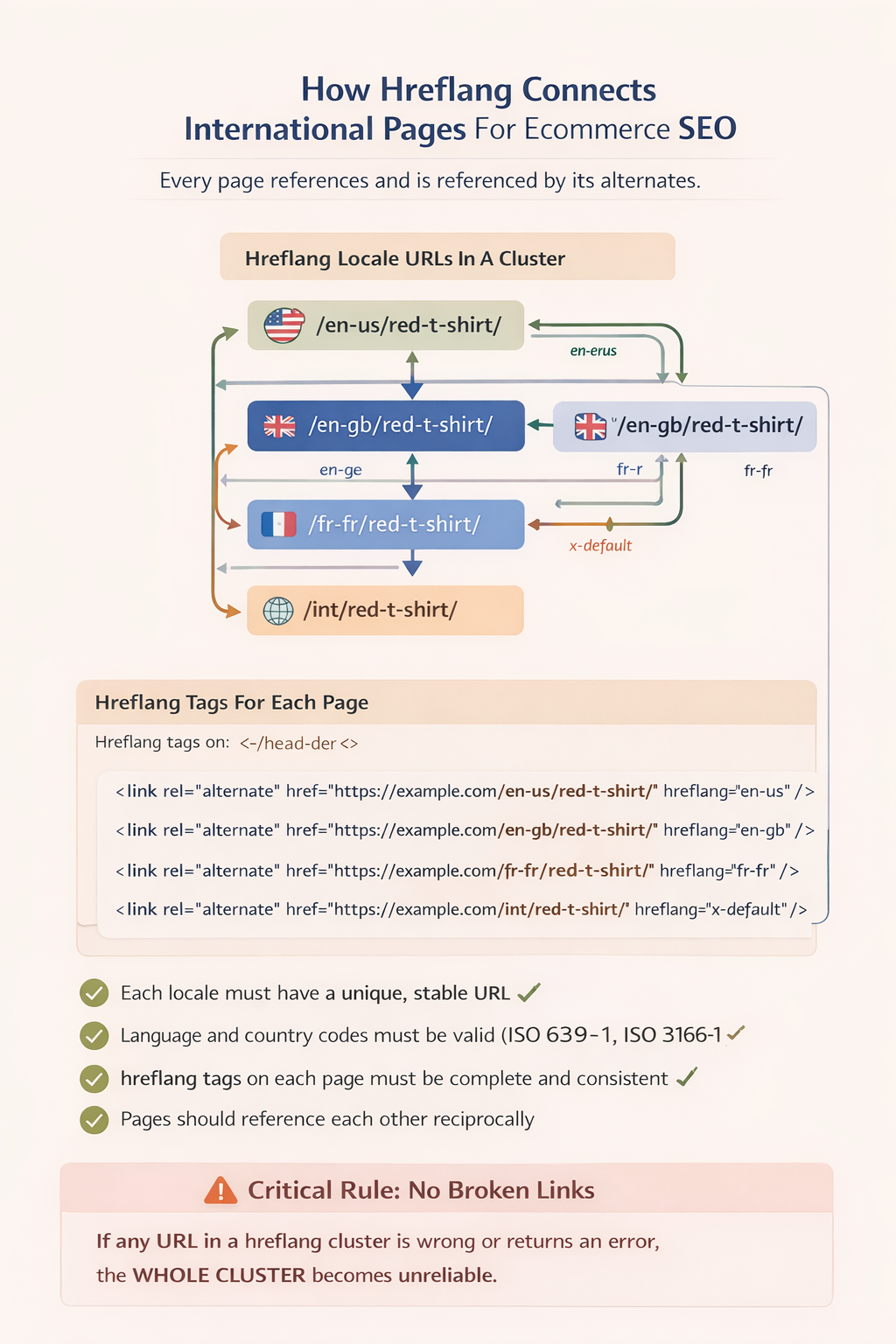
How Hreflang Works Conceptually (Think In Clusters)
Hreflang works in clusters, not single links.
Each page must:
- Reference all alternate versions, and
- Be referenced back by those versions
This creates a closed loop.
Example cluster for a product page:
- en-US → links to en-GB, fr-FR, x-default
- en-GB → links to en-US, fr-FR, x-default
- fr-FR → links to en-US, en-GB, x-default
If one page is missing from the loop, the entire cluster becomes unreliable.
Language Codes vs Country Codes (This Is Where Mistakes Start)
Hreflang values use standardized codes:
- Language: ISO 639-1 (two-letter codes like en, fr, de)
- Country: ISO 3166-1 (two-letter codes like US, GB, FR)
Correct examples:
- en-US
- en-GB
- fr-FR
- fr-CA
Incorrect examples:
- en-UK (UK is not a valid country code)
- fr-EU (EU is not a country)
- en-EN (language ≠ country)
If the code is wrong, search engines ignore the tag completely.
The Role Of x-default (And When To Use It)
x-default is used when a page is not tied to a specific language or country.
Common use cases:
- Global homepage
- Country/language selector page
- “Choose your region” landing page
x-default should:
- exist as a real, crawlable URL
- be included in every hreflang cluster
- not replace real language or country versions
It acts as a fallback, not a shortcut.
Where Hreflang Can Be Implemented (And Which Scales Best)
There are three supported implementation methods:
1) HTML <link> Tags
Placed in the <head> of each page.
Best for:
- small sites
- limited number of pages
Limitations:
- hard to maintain at scale
- easy to introduce mismatches
2) HTTP Headers
Used for non-HTML content like PDFs.
Relevant only if:
- you localize downloadable assets
- those assets are indexed
3) XML Sitemaps (Best For Ecommerce At Scale)
This is the recommended method for large ecommerce sites.
Why:
- centralizes hreflang logic
- easier to validate
- reduces template-level errors
- scales across thousands of URLs
Each URL entry includes all its alternates, clearly mapped in one place.
Canonicals And Hreflang Must Work Together
A critical rule:
Hreflang pages must not canonicalize to a different locale.
Correct:
- /en-us/product-a/ canonical → itself
- /en-gb/product-a/ canonical → itself
Incorrect:
- All locales canonicalized to /en-us/
If canonicals contradict hreflang, canonical usually wins, and hreflang gets ignored.
This is one of the most common international SEO mistakes.
What Hreflang Does Not Replace
Hreflang does not replace:
- proper localization
- unique value per market
- clean internal linking
- correct currency and shipping logic
If two pages are functionally identical except for hreflang, they may still struggle. Hreflang connects pages, it doesn’t justify them.
How To Validate Hreflang (Before And After Launch)
Before launch:
- Check all URLs return 200 status codes
- Confirm bidirectional linking exists
- Verify codes are valid
- Ensure each page has a self-referencing hreflang
After launch:
- Monitor international targeting reports
- Watch for “no return tag” or “invalid language code” errors
- Track which locale URLs actually receive impressions
Validation should be ongoing, not a one-time task.
Why Hreflang Is The Backbone Of International SEO
Hreflang is what allows everything else to work:
- structure becomes interpretable,
- localization becomes visible,
- authority stops leaking across markets.
Without it, even well-designed international stores rely on chance.
Translation vs Localization: What Ecommerce Stores Must Change Per Market
At this stage, many ecommerce teams believe they are “done” once pages are translated and hreflang is in place. In reality, this is where international SEO either starts working, or quietly fails.
Translation makes content readable. Localization makes it relevant.
Search engines can index translated pages, but shoppers decide whether to trust and buy from localized ones.
Why Translation Alone Breaks Ecommerce Performance
A translated page can still feel foreign to the user. When that happens, shoppers hesitate, bounce, or abandon carts, even if rankings improve.
Common symptoms of translation-only setups:
- Traffic grows, but conversion rate drops
- Product pages rank but don’t sell
- Paid and organic traffic behave inconsistently across countries
- Customer support questions spike around shipping, pricing, or sizing
From a search perspective, these pages also struggle because user behavior becomes a ranking signal. Pages that don’t meet local expectations underperform over time.
What “Localization” Means In Ecommerce SEO Terms
Localization adapts a page to the search intent and buying context of a specific market, not just its language.
This includes four core layers.
1) Commercial Localization (The Fastest Conversion Lever)
These elements directly affect trust and purchase decisions:
- Currency and pricing format
Display prices in the local currency and format users expect. Even small mismatches (currency symbols, decimal formats) create friction.
- Taxes and duties
Some markets expect tax-inclusive pricing, others do not. Ambiguity here reduces trust and increases cart abandonment.
- Shipping availability and timelines
“Ships worldwide” is not localization. Clear delivery estimates and country-specific shipping rules matter.
- Returns and policies
Return windows and wording should reflect local norms. A generic policy can reduce confidence even if it’s legally valid.
If these elements don’t match the market, the page may rank, but it won’t convert.
2) Product Localization (Beyond Specifications)
Product specs often stay the same, but how products are described should not.
Key areas to localize:
- Sizing and units (EU vs US sizing, metric vs imperial)
- Variant availability by region
- Use cases (how and why the product is used locally)
- Terminology shoppers actually search for
For example, the same product may be searched differently, described differently, and compared differently across markets, even in the same language.
Search engines pick up on this through:
- keyword alignment,
- engagement metrics,
- and internal linking relevance.
3) Category And Navigation Localization (High-Impact, Often Missed)
Category pages usually drive the most organic traffic, and they’re often the least localized.
Common mistakes:
- Using identical category names across markets
- Translating categories word-for-word instead of matching search behavior
- Reusing internal links that don’t align with local intent
Better approach:
- Research how shoppers in that country browse products
- Adjust category naming and hierarchy to match demand
- Keep internal links mostly within the same locale
This improves both crawl clarity and conversion paths.
4) Trust And UX Localization (Indirect SEO Signals)
Trust is contextual. What reassures a US shopper may not reassure a European or Middle Eastern shopper.
Localization signals include:
- Delivery clarity above the fold
- Localized FAQs (shipping, returns, payment)
- Market-appropriate messaging tone
- Language-consistent UI elements (buttons, filters, checkout steps)
These elements reduce bounce rates and improve dwell time, both of which support long-term organic performance.
A Common Pitfall: One “Global” Product Description With Local Wrappers
Many stores keep one master description and only change:
- currency,
- language selector,
- and hreflang.
This creates localized shells around non-local content.
Search engines may index these pages, but:
- relevance signals stay weak,
- local competitors outperform them,
- and rankings stagnate.
Even light localization—adjusting headings, modifiers, and examples—creates meaningful differentiation.
How Much Localization Is “Enough”?
You don’t need to rewrite everything from scratch.
A practical rule:
- Categories: highest localization priority
- Top-selling products: medium-to-high localization
- Long-tail products: lighter localization, but still market-aware
Focus effort where traffic and revenue potential are highest.
Technical SEO For Multilingual Ecommerce
Indexation, Canonicals, Crawl Control, And Clean Signals
Once your pages are localized, the next risk is technical confusion. Even well-written international content can fail if search engines can’t clearly crawl, index, and interpret each locale. This section focuses on keeping every language–country version cleanly discoverable, non-duplicative, and stable in search results.
Why Technical SEO Becomes Harder With Multiple Locales
Every new market multiplies URLs. Without guardrails, this leads to:
- duplicate or near-duplicate pages,
- conflicting signals (hreflang vs canonicals),
- wasted crawl budget,
- and unstable rankings across countries.
The goal of international technical SEO is simple:
Each locale page should stand on its own, while still being correctly connected to its alternates.
Indexation Rules: What Should And Shouldn’t Be Indexed
Start by defining what deserves to be indexed for each locale.
Should be indexed
- Localized category pages
- Localized product pages
- Locale-specific content pages (shipping, returns, FAQs)
- Country or language landing pages
Should usually NOT be indexed
- Filtered URLs with parameters
- Internal search result pages
- Duplicate sort orders
- Session-based or tracking URLs
- Auto-generated variants with no unique value
Each locale should follow the same indexation logic, even though the content differs.
Canonicals In Multilingual SEO (The Non-Negotiable Rules)
Canonicals tell search engines which version of a page is the “main” one. In international SEO, canonicals are often misused.
Correct approach
- Each locale page uses a self-referencing canonical
- /en-us/product-a/ → canonical to /en-us/product-a/
- /en-gb/product-a/ → canonical to /en-gb/product-a/
Incorrect approach
- Canonicalizing all locales to one “global” or English page
- Canonicalizing translated pages back to the original version
Why this matters:
If canonicals contradict hreflang, canonical usually wins, and the localized pages may be ignored or deindexed.
Think of it this way:
- Canonical = “this is the main version of this page”
- Hreflang = “here are the equivalent versions in other locales”
They must agree, not compete.
Crawl Budget And URL Explosion (Especially For Ecommerce)
International stores can create thousands of URLs per market. Multiply that by languages and countries, and crawl efficiency matters.
Best practices:
- Keep URL patterns consistent across locales
- Avoid infinite combinations from filters and parameters
- Block non-value URLs via robots.txt or noindex (where appropriate)
- Use clean internal links that point only to indexable pages
Search engines crawl what you link to most clearly. Messy internal links create messy indexation.
Sitemaps: One Of The Most Important Control Points
Sitemaps are especially valuable for international ecommerce because they:
- surface all locale URLs,
- help search engines discover new markets faster,
- support hreflang mapping at scale.
Recommended approach:
- Use separate sitemaps per locale or per market
- Or a sitemap index that references locale-specific sitemaps
- Include only canonical, indexable URLs
- Keep them updated as inventory and categories change
For large stores, hreflang-in-sitemap is often more reliable than template-level tags.
Language And Country Switching UX (Without Breaking SEO)
Selectors are for users, not search engines.
Safe practices:
- Language/country selectors that link to real URLs
- No forced redirects based solely on IP
- Allow users (and crawlers) to access all versions freely
- Avoid blocking locale pages behind pop-ups or scripts
Forced redirects often:
- block crawlers,
- prevent indexing,
- and cause the wrong version to rank.
Search engines prefer choice, not force.
Structured Internal Linking By Locale
Internal links should reinforce your international structure.
Best practices:
- Link within the same locale by default
- Use localized anchor text
- Avoid mixing /en/ links inside /fr/ pages unless intentional
- Keep navigation and breadcrumbs locale-consistent
This helps search engines understand that each locale is a complete, self-contained site, not a partial translation.
Monitoring Technical Health By Market
International SEO requires market-specific monitoring.
What to check regularly:
- Index coverage by locale
- Pages indexed vs pages submitted
- Crawl errors and server responses
- Canonical and hreflang consistency
- Traffic and impressions per country and language
Tools like Google Search Console help validate whether:
- the right pages are indexed,
- the right markets are receiving visibility,
- and technical signals are being interpreted correctly.
Schema Markup For International Ecommerce
A Beginner-Friendly Playbook That Scales Across Markets
Once your locale pages are crawlable and correctly indexed, schema markup helps search engines understand what each page represents in each market. In international ecommerce, schema is not about adding more code, it’s about keeping structured data aligned with the localized version of the page.
When schema conflicts with visible content (price, currency, availability, language), search engines lose confidence. When it matches cleanly, rich results and visibility become more consistent across countries.
What Schema Markup Does In An International Context
Schema markup adds machine-readable context to your pages. For international stores, it helps search engines:
- understand what the product is in each locale,
- interpret localized pricing and currency,
- confirm availability by market,
- and connect structured data to the correct language and country page.
Schema does not replace localization or hreflang. It supports them by reinforcing the same signals in structured form.
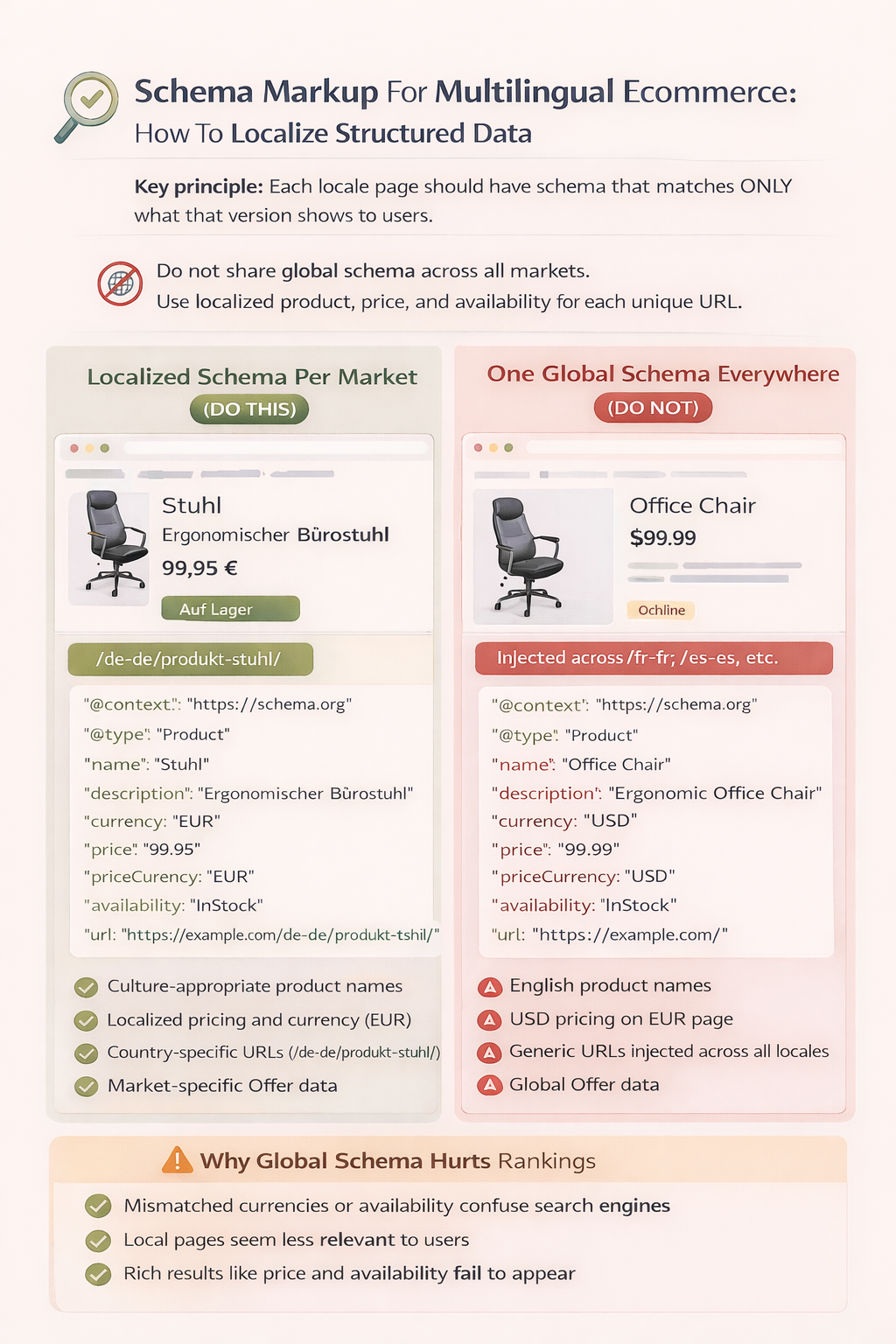
The Core Rule: Schema Must Match The Locale Page Exactly
This is the most important principle in international schema implementation:
Each locale page must have schema that reflects only what that page shows to users.
That means:
- No shared global schema injected across all versions
- No USD pricing in schema on EUR pages
- No English product names in schema on French pages
- No “InStock” schema when the product is unavailable in that country
Search engines compare structured data with visible content. Mismatches reduce trust and can suppress rich results.
Essential Schema Types For International Ecommerce
You do not need dozens of schema types. Focus on consistency and correctness.
1) Product + Offer (Required For Product Pages)
Every localized product page should include:
- Product
- One or more Offer objects
Key fields that must be localized:
- name (language-appropriate)
- description (aligned with on-page content)
- price
- priceCurrency
- availability
- url (the locale URL)
Currency must use ISO 4217 codes (e.g., USD, GBP, EUR), and pricing must match exactly what users see.
Schema vocabulary is defined by Schema.org, and consistency with on-page content is critical for eligibility.
2) BreadcrumbList (Strong For Category And Product Pages)
Breadcrumb schema helps search engines understand:
- site hierarchy,
- category relationships,
- and navigation context within each locale.
Best practices:
- Breadcrumb labels should be localized
- URLs should stay within the same locale
- Structure should match visible breadcrumbs
This improves clarity without introducing duplication.
3) Organization And Website (Once Per Locale)
For international stores, it’s often cleaner to:
- define Organization once (global brand),
- define WebSite per locale or language group.
Make sure:
- URLs reflect the locale version
- Contact or support details are not misleading
- Brand consistency remains intact across markets
Avoid injecting conflicting organization data across multiple locales.
4) FAQPage (Only Where Content Exists)
FAQ schema works well for:
- shipping questions,
- returns,
- delivery timelines,
- payment methods, when these differ by country.
Rules to follow:
- Only mark up FAQs that are visible on that page
- Localize both questions and answers
- Avoid reusing identical FAQs across all locales unless they truly apply
This is especially useful for international SERPs where trust questions are common.
Common International Schema Mistakes (And Why They Hurt)
Global schema reused everywhere
This causes currency, availability, and language conflicts.
One Product entity for multiple locale URLs
Each URL needs its own Product entity with localized values.
Ignoring availability differences
If a product is unavailable in one market, schema must reflect that.
Structured data contradicts visible content
Search engines trust users more than markup.
How Schema Fits With Hreflang And Canonicals
Schema does not replace hreflang or canonicals, but it must align with them.
Correct alignment:
- Locale URL → self-canonical
- Locale URL → correct hreflang cluster
- Locale URL → localized schema referencing that same URL
If schema references a different URL, language, or price than the page itself, it weakens the entire signal set.
Validation And Ongoing Maintenance
Schema should be validated:
- when launching a new locale,
- when changing pricing logic,
- when adding new currencies,
- and when inventory behavior differs by market.
Use testing tools to ensure:
- no errors,
- no warnings tied to missing required fields,
- and correct interpretation per locale.
International schema is not “set and forget.” It evolves as markets evolve.
Measuring International SEO Performance And Avoiding Costly Mistakes
International SEO only works when you can verify that the right pages are ranking in the right markets. Traffic alone is not a success metric. Measurement must confirm relevance, stability, and commercial impact across languages and countries.
This section shows how to measure international SEO properly—and how to spot problems early, before they turn into lost revenue.
What “Success” Actually Looks Like In International SEO
A healthy international setup shows three clear signals:
- Correct visibility: Each locale page appears in search results for its intended country and language.
- Stable rankings: Local versions do not swap positions or override each other unpredictably.
- Market-aligned performance: Traffic, engagement, and conversions behave logically for each region.
If any one of these is missing, something in the setup is leaking.
The Core Metrics To Track By Locale
Always segment performance by country and language, not just by page.
Key metrics to monitor regularly:
Visibility & indexation
- Indexed pages per locale
- Pages submitted vs indexed
- Impressions by country and language
- Top ranking URLs per market
Engagement & behavior
- Bounce rate by locale
- Time on page by market
- Category → product flow consistency
- Drop-offs tied to shipping or pricing confusion
Commercial signals
- Conversion rate per locale
- Revenue per market
- Product availability vs demand mismatch
- Refunds or support tickets by region (indirect signal)
Growth in the wrong market is not growth, it’s a signal mismatch.
Using Google Search Console For International SEO
Google Search Console is the primary diagnostic tool for international SEO.
What to use it for:
Performance reports
- Filter by country to confirm the correct URLs receive impressions
- Check whether the expected locale pages dominate their markets
Index coverage
- Identify locales with indexing gaps
- Spot duplicate or excluded pages by market
Hreflang validation
- Look for “no return tag” or invalid language-region issues
- Confirm hreflang clusters remain intact after updates
Important note: country targeting settings have been removed. Search engines now rely on URL structure, hreflang, localization, and user signals instead. This makes clean implementation even more critical.
Early Warning Signs Your International SEO Is Breaking
These patterns usually appear before rankings collapse:
- One locale consistently ranks across multiple countries
- Local pages are indexed but receive zero impressions
- Traffic increases but conversion rate drops sharply in new markets
- Category pages perform well, but product pages do not
- Search Console shows frequent hreflang or canonical inconsistencies
When these appear, the issue is almost always structural or technical, not content quality.
The Most Common International SEO Mistakes (At Scale)
As stores expand, these errors become more likely:
Treating localization as a one-time task: Markets evolve. Shipping rules, demand, and terminology change.
Letting templates override locale logic: Global themes or plugins often inject conflicting canonicals or schema.
Mixing analytics views: Blended reporting hides which markets are underperforming.
Launching new markets without validation: Every new locale should be tested for indexation, hreflang, schema, and conversion flow before scaling traffic.
A Practical Monitoring Routine
To keep international SEO stable:
Weekly
- Check top pages by country
- Spot ranking or URL swaps
- Review major indexing changes
Monthly
- Compare conversion rates by locale
- Review hreflang and canonical consistency
- Audit new URLs added per market
Quarterly
- Re-evaluate localization quality for top categories
- Identify new search behavior shifts
- Update schema where pricing or availability has changed
This keeps growth controlled instead of reactive.
Final International SEO Checklist + Next Steps
This final section pulls the entire guide into a single, practical reference. If international SEO feels complex, this checklist is how teams keep it controlled, repeatable, and scalable.
Use it before launching a new market, or auditing an existing one.
International & Multilingual SEO Readiness Checklist
1) Market And Locale Definition
- Languages and countries are clearly defined (no vague “global” targeting)
- Each language–country pair is treated as a unique locale (for example, en-US ≠ en-GB)
- Business rules (shipping, pricing, availability) are documented per market
2) Site Structure
- One clear structure is used consistently (ccTLDs, subfolders, or subdomains)
- Every locale has its own stable, crawlable URL
- No language or currency switching happens on the same URL
3) Hreflang Implementation
- All locale pages are connected in complete hreflang clusters
- Language and country codes are valid and consistent
- Self-referencing hreflang tags exist
- x-default is used only where appropriate
- Canonicals do not contradict hreflang
4) Localization Quality
- Category pages are localized for local search behavior
- Product pages reflect local sizing, terminology, and use cases
- Currency, taxes, shipping, and returns match the target market
- Internal links stay within the same locale by default
5) Technical SEO Hygiene
- Each locale page has a self-canonical
- Non-value URLs (filters, internal search, parameters) are controlled
- Crawl paths are clean and consistent
- Sitemaps include only canonical, indexable locale URLs
6) Schema Markup Alignment
- Product and Offer schema are localized per page
- Currency and availability match visible content
- Breadcrumbs reflect locale navigation
- FAQ schema is used only where localized FAQs exist
- No global schema conflicts across markets
7) Measurement And Monitoring
- Performance is reviewed by country and language
- Correct locale URLs receive impressions in the correct markets
- Conversion rates are tracked per locale
- Hreflang, canonical, and indexation issues are reviewed regularly
- New markets are validated before scaling traffic
The Key Principle To Remember
International SEO is not about adding more pages.
It is about clarity.
When structure, localization, technical signals, and schema all point to the same market intent, search engines stop guessing, and shoppers stop hesitating.
That’s when international growth becomes stable, measurable, and scalable.
Final Takeaway
For ecommerce brands expanding globally, international and multilingual SEO is a system, not a single tactic. Stores that plan structure first, localize for real buying behavior, and maintain clean technical signals avoid ranking conflicts, wasted traffic, and conversion drops.
This is the difference between being visible everywhere and selling effectively in each market.
Frequently Asked Questions
What is the difference between international SEO and multilingual SEO?
International SEO focuses on targeting different countries or regions, while multilingual SEO focuses on targeting different languages. Ecommerce stores often need both. For example, English for the US and UK is international SEO, while English and French in Canada is multilingual SEO.
Do ecommerce stores need hreflang tags?
Yes. Hreflang is required when the same or similar content exists in multiple languages or countries. It helps search engines show the correct version of a page to users and prevents different locale pages from competing with each other in search results.
Should I use subfolders, subdomains, or country domains for international SEO?
For most ecommerce stores, subfolders (example.com/uk/, example.com/fr/) are the best option. They are easier to manage, share SEO authority across markets, and scale faster than subdomains or country-specific domains.
Is translating product pages enough for international SEO?
No. Translation only makes content readable. Localization adapts pages to local buying behavior, including currency, shipping, sizing, terminology, and product expectations. Localized pages perform better in both rankings and conversions than direct translations.
How do I avoid duplicate content issues on multilingual ecommerce sites?
Duplicate content is avoided by giving each locale its own URL, using self-referencing canonicals, and implementing hreflang correctly. Each localized page should stand on its own while being connected to its alternates through hreflang.
Should each country version have different schema markup?
Yes. Each locale page should have schema markup that matches only what that page shows to users. This includes localized product names, prices, currency, availability, and URLs. Using one global schema across all markets can hurt visibility and rich results.
How can I measure if international SEO is working?
Success is measured by checking whether the correct locale pages receive impressions and traffic in their target countries, and whether conversion rates make sense by market. Monitoring indexation, hreflang consistency, and country-level performance is essential.
Can international SEO work without separate URLs for each country?
No. Search engines index URLs, not language or currency selectors. Each country or language version must have a unique, crawlable URL for international SEO to work reliably.