 Skip to content
Does your product page have good content, but still doesn’t rank? What’s missing?
For many ecommerce businesses, the answer isn’t pricing or design. It’s customer reviews.
Reviews are often treated as an afterthought on product detail pages and product listing pages. But in reality, they influence how search engines interpret relevance, freshness, and usefulness. This goes far beyond social proof. Reviews directly affect search rankings, visibility, and performance across e-commerce sites.
Why Reviews Matter Beyond Trust?
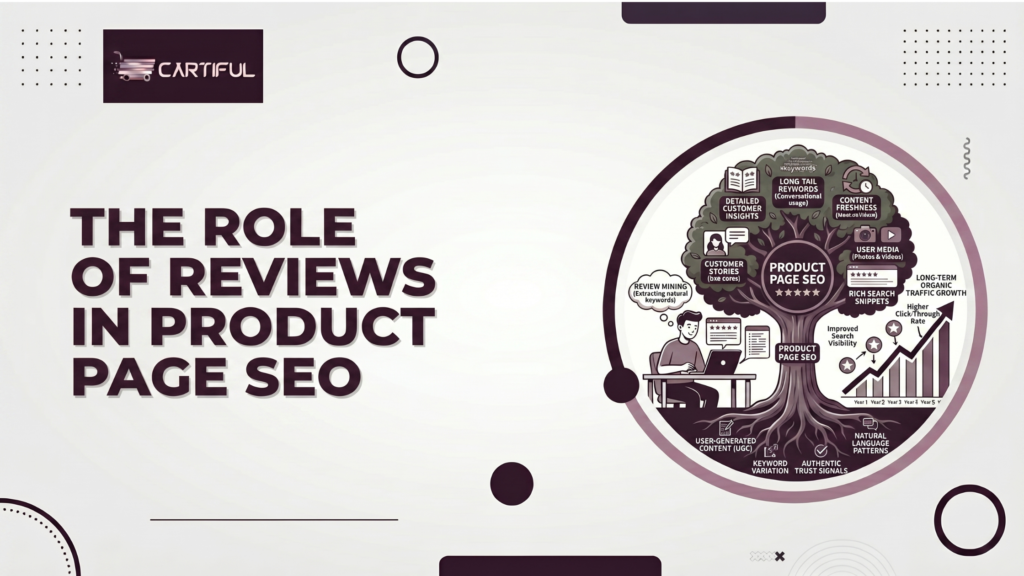
Reviews matter beyond trust because they add continuously updated, user-written content to product detail pages that search engines can crawl and evaluate. They introduce natural language, long-tail keywords, and real usage context that product descriptions usually miss. This ongoing feedback improves keyword optimization, strengthens keyword relevancy, and helps product pages appear more accurate and helpful in search results. Over time, this supports a stronger clickthrough rate, improved visibility, and more consistent organic performance.
How Reviews Help Search Engines Understand Products
Reviews give search engines context that product descriptions alone cannot provide. They explain how real people describe, use, and judge a product after buying it, which helps search engines better understand the customer journey.
Let’s break down exactly how that works.
User-Generated Language vs. Brand-Written Copy
Product descriptions are written to sell. Reviews are written to explain an experience.
That difference matters for search engines.
Brand copy focuses on features and benefits chosen by the business. Reviews focus on outcomes, expectations, frustrations, and daily use. Search engines trust this user-generated language because it reflects how people actually search. This strengthens Google EEAT signals by adding real-world experience to product content strategy.
Long-Tail Keywords, Real Use Cases, and Natural Phrasing
Reviews naturally introduce long-tail, intent-driven phrases that are difficult to predict during product development.
Examples pulled from typical review language:
- “fits true to size but tight around the shoulders”
- “good laptop bag for everyday office travel”
- “works well on my sensitive skin”
- “battery lasts a full workday”
These phrases map closely to how people search.
These phrases closely match real search behavior and contribute to keyword optimization without forcing keywords into product copy. Reviews help product pages rank for:
- use-case searches
- problem-based searches
- comparison-style queries
This expands organic reach without adding forced keywords to product copy.
How Reviews Keep Product Pages Fresh
Search engines prefer product detail pages that show ongoing activity. A page that never changes slowly loses relevance, even if the product is still selling.
Reviews solve this problem naturally.
Every new review refreshes the page without altering the main description or creating new URLs. Fresh review activity encourages search engines to crawl the page more often, improving crawl efficiency and keeping product listing pages from becoming stale.
From an SEO program perspective, reviews function as ongoing content updates that search engines can measure and reward.
Reviews and On-Page SEO Signals
Reviews do more than sit on the page. They quietly influence several on-page signals that search engines use to judge quality and relevance.
1. Content Depth and Page Relevance
Product descriptions explain what a product is supposed to do. Reviews explain what actually happens after someone buys it.
When reviews mention sizing issues, delivery speed, durability, or daily use, they add layers of meaning to the page. This extra context helps search engines understand not just the product, but how it fits different needs and buying situations.
As a result, the product page becomes relevant for a wider range of searches, without rewriting the core content.
2. Dwell Time, Engagement, and Repeat Visits
When shoppers scroll through product reviews, they stay longer. They read, compare opinions, and often return to the page before making a decision. Longer session time and repeat visits are strong engagement signals. They show that the page is doing its job, not just attracting clicks but holding attention.
Cartiful often sees product pages with visible, detailed reviews outperform similar pages in engagement metrics inside Google Analytics.
3. Reduced Bounce Rates Through Social Proof
Pages without reviews feel incomplete. Visitors land, scan, and leave because their questions remain unanswered.
Reviews reduce bounce rates by answering doubts immediately. A shopper worried about fit, quality, or shipping often finds the answer without scrolling further or opening another tab. Lower bounce rates signal that users are finding what they came for, which supports stronger SEO performance over time.
Star Ratings, Rich Results, and Click-Through Rates
Star ratings change how product pages appear before anyone even lands on the site. They influence who clicks and who scrolls past.
When reviews are marked up correctly using Product and Review schema, search engines can show star ratings directly in search results.
This structured data helps search engines understand review counts, average ratings, and product associations. Without markup, even good reviews may stay invisible in the results.
Why Visible Ratings Improve SERP CTR?
Imagine you search for a product and see two similar results. One has no rating at all. The other shows 4.6 stars from 120 people who already bought it.
You already know which one you’re clicking.
Those stars catch your eye before you even read the title. They give you instant confidence, even if both pages rank in the same position.
That is why star ratings consistently lift click-through rates. You’re not choosing based on rankings anymore; you’re choosing based on reassurance.
The Connection Between CTR and Organic Performance
Higher click-through rates tell the search engine rankings that users prefer a specific result. Over time, this behavior can help stabilize or improve organic visibility for competitive product terms.
Reviews do not directly push rankings overnight. But by improving how often people choose your result, they support stronger organic performance in the long run. At Cartiful, review markup and placement are treated as part of product page SEO, not a cosmetic add-on.
Reviews as Conversion Content (Not Just Feedback)
Reviews act as conversion content because they answer the exact questions buyers hesitate on before purchasing.
When someone worries about quality, sizing, delivery time, or durability, reviews provide straight answers from people who already bought the product, not brand promises.
Reviews and Q&A work together with product descriptions. Descriptions explain what the product is, while reviews explain how it performs in real situations, filling gaps that product copy cannot cover.
Photos and videos in reviews make this even stronger. Seeing real images, fit examples, or usage videos helps buyers picture the product in their own life, reduces doubt, and increases the chance they move from browsing to buying.
Best Practices for Using Reviews on Product Pages
Reviews work best when they are easy for users to find and easy for search engines to read. Below are practical, SEO-friendly ways to use reviews on product pages without hurting user experience.
Where to Place Reviews for SEO and UX
- Place the review section below the main product description and price, not hidden at the very bottom of the page
- Show star ratings near the product title so they are visible above the fold
- Add a “Read reviews” anchor link near the buy button to support engagement and session duration
- Keep reviews on the same product page URL to avoid splitting SEO value
- Make sure reviews load before related products, especially for SEO-friendly ecommerce layouts tied to Google Ads traffic
Structuring Review Sections for Crawlability
- Load review text in HTML, not inside blocked scripts or iframes
- Use pagination or lazy loading that still allows search engines to crawl review content
- Add Product and Review schema so ratings can appear in search results
- Avoid duplicating the same reviews across multiple product variations
- Ensure reviews are accessible to bots and users coming from organic search and Google Ads campaigns
Encouraging Authentic, Detailed Customer Feedback
- Ask open-ended questions instead of yes/no prompts
- Encourage buyers to mention fit, quality, delivery, and usage
- Invite photo or video uploads to increase customer trust and conversion rates
- Do not edit reviews to remove useful context, even when feedback is mixed
- Follow up after delivery, not immediately after purchase, to get more meaningful responses
Well-structured, keyword-rich reviews support SEO, improve conversion rates, and help product pages perform better across organic search and paid channels like Google Ads.
Common Mistakes That Limit SEO Value
Even when reviews are present, small setup mistakes can prevent them from helping SEO. These issues often go unnoticed but can quietly hold product pages back.
Thin or Duplicated Reviews
Short reviews like “good product” or “works fine” add little SEO value. They do not provide context, keywords, or real usage details that search engines can learn from.
Duplicating the same reviews across multiple product variations creates another problem. Search engines struggle to determine the original source, which can dilute relevance and weaken rankings.
Blocking Reviews From Indexing
Some review systems load content in a way search engines cannot crawl. If reviews are hidden behind scripts, iframes, or blocked resources, they may never be indexed. When this happens, reviews exist for users but do not contribute to SEO. Product pages lose out on freshness, content depth, and long-tail keyword coverage without anyone realizing it.
Over-Moderation That Removes Useful Context
Removing all detailed or negative reviews can hurt more than help. Buyers look for balance, not perfection.
Reviews that mention minor issues, delivery delays, or fit concerns often answer common questions. When that context is removed, users leave to find answers elsewhere, increasing bounce rates and reducing trust signals that support SEO.
Reviews help product pages stay relevant by adding fresh, real language that search engines can understand. They improve visibility by boosting click-through rates with star ratings and stronger search result appeal.
Once users land on the page, reviews answer doubts, reduce bounce rates, and support conversions. Handled correctly, reviews continue to work in the background as a long-term SEO asset.
Abbas Feedback
1. The Introduction Could Be Slightly Sharper
The opening question works, but the intro could tighten slightly.
Right now it feels slightly explanatory.
A stronger hook might highlight the ranking problem more directly.
Example idea:
Many ecommerce stores optimize product titles, descriptions, and images but still struggle to rank. One of the most overlooked ranking signals on product pages is customer reviews.
Small change, but it increases impact.
2. Add One Small Example Product Page
Most sections are conceptual.
Adding a quick example would help.
Example:
Running shoe product page with 300 reviews:
Reviews mention:
- “good for marathon training”
- “wide toe box”
- “great for flat feet”
These phrases help the page rank for problem-based searches.
This would make the concept even clearer.
3. The On-Page Signals Section Could Use Sub-Headings
This section is strong but dense.
Breaking it into clear subsections like you already started improves scannability:
Content depth
Engagement signals
Bounce rate reduction
Small formatting improvement.
4. The Best Practices Section Is Excellent but Slightly Long
The bullet points are good, but grouping them into categories could help:
Placement
Technical implementation
Review collection strategy
This improves readability.
5. The Conclusion Is Slightly Abrupt
The final paragraph is good but could summarize the three main SEO benefits of reviews.
For example:
Reviews improve SEO by adding natural language content, keeping product pages fresh, and increasing click-through rates through visible ratings.
This creates a stronger closing.
