Skip to content
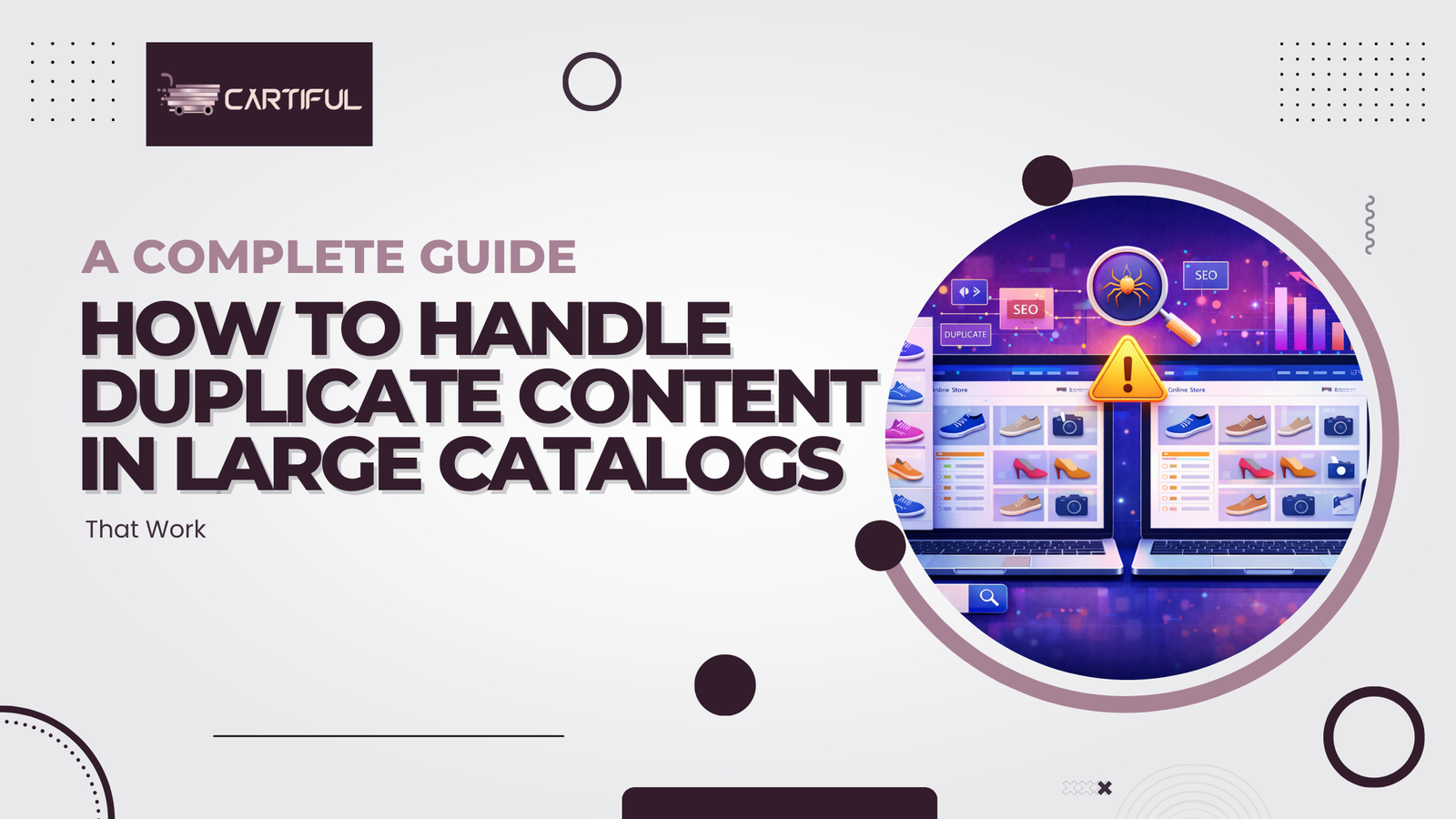
Duplicate content is one of the most misunderstood problems in ecommerce SEO. Many store owners fear “penalties,” while others ignore the issue entirely, assuming search engines will “figure it out.” In large catalogs with thousands or even millions of URLs, duplicate content is not an edge case — it is a structural reality.
Product variations, filters, pagination, sorting parameters, session IDs, international versions, and platform defaults all create duplication at scale. Left unmanaged, this duplication dilutes rankings, wastes crawl budget, weakens internal linking signals, and slows organic growth.
This guide explains how duplicate content actually works in large ecommerce catalogs, why it matters for SEO, and exactly how to control it without harming discoverability, conversions, or scalability.
What Duplicate Content Means in Large Ecommerce Catalogs
Duplicate content exists when multiple URLs contain the same or substantially similar content. In ecommerce, duplication is rarely malicious and almost always unintentional.
Common examples include:
- The same product accessible through multiple category paths
- Product variations with identical descriptions
- Filtered and sorted category URLs
- Pagination creating near-identical listings
- URL parameters for tracking, currency, or sessions
- International or regional versions of the same product
- Supplier-provided product descriptions reused across SKUs
In small sites, duplicate content is manageable. In large catalogs, it compounds rapidly and becomes an architectural problem rather than a copywriting issue.
How Search Engines Actually Treat Duplicate Content
Contrary to popular belief, search engines do not automatically penalize sites for duplicate content. According to Google, duplicate content is handled through canonicalization and clustering, not punishment.
When search engines encounter duplicates, they attempt to:
- Group similar URLs together
- Select one version to index and rank
- Ignore or de-prioritize the rest
The real risk is not a penalty. The risk is loss of control.
If search engines choose the wrong version as canonical, you may see:
- Rankings assigned to low-value URLs
- Important pages excluded from the index
- Crawl budget wasted on duplicates
- Link equity split across versions
Why Duplicate Content Is More Dangerous in Large Catalogs
Large ecommerce sites face unique risks that small sites do not.
Crawl Budget Waste
Search engines allocate a finite crawl budget to each domain. When thousands of duplicate URLs exist, crawlers spend time fetching low-value pages instead of:
- New products
- Updated stock pages
- Important categories
This slows indexation and limits growth.
Authority Dilution
When duplicate pages receive internal or external links, authority gets split instead of consolidated. This weakens ranking potential across the entire catalog.
Index Bloat
Duplicate URLs often end up indexed unintentionally, inflating index size with thin or redundant pages. This lowers overall site quality signals.
Scaling Complexity
Manual fixes do not scale. Large catalogs require system-level rules, not page-by-page patches.
The Main Sources of Duplicate Content in Large Catalogs
Before fixing duplication, you must understand where it comes from.
Product Variations
Examples:
- Size variations
- Color variations
- Material variations
Often, these pages differ only by SKU or image, while the description remains identical.
Category Path Duplication
The same product may exist under:
- /men/shoes/product-x
- /sale/shoes/product-x
- /brands/brand-a/product-x
Each path creates a unique URL with identical content.
Filters and Sorting Parameters
Examples:
- ?color=black
- ?price=low-to-high
- ?size=10&page=3
These can generate tens of thousands of near-duplicate URLs.
Pagination
Paginated category pages share most content, differing only in product order.
URL Parameters and Tracking
Examples:
- UTM parameters
- Session IDs
- Affiliate tracking codes
These often create crawlable duplicates if not handled correctly.
International and Regional Versions
Same product, different country:
- Currency changes
- Language overlaps
- Minimal localized content
Step-by-Step: How to Handle Duplicate Content in Large Catalogs
Step 1: Decide Which Version Should Win
Every duplicate cluster must have one preferred version.
Ask:
- Which URL best represents search intent?
- Which version should rank?
- Which version converts best?
- Which URL fits long-term structure?
This “winner” becomes the canonical reference.
Step 2: Use Canonical Tags Strategically (Not Blindly)
Canonical tags are the primary tool for duplicate control, but misuse is common.
Correct uses:
- Product variations canonicalized to a primary version
- Filtered URLs canonicalized to unfiltered categories
- Parameter URLs canonicalized to clean versions
Incorrect uses:
- Canonicalizing paginated pages to page one
- Canonicalizing unrelated content
- Using canonicals to hide structural issues
Each duplicate URL should either:
- Be canonicalized to a clear primary version, or
- Be intentionally indexable with unique value
Step 3: Control Filters With a Crawl-First, Index-Second Approach
Filters are unavoidable in large catalogs. The goal is controlled discoverability.
Best practice:
- Allow filters to be crawlable for product discovery
- Prevent most filtered URLs from being indexed
- Create dedicated indexable pages only for high-value attributes
This is typically achieved with:
- Canonical tags
- Meta robots noindex where appropriate
- Internal linking rules that avoid reinforcing filtered URLs
Step 4: Handle Pagination Without Creating Duplicates
Pagination creates near-duplicate content by nature.
Correct handling includes:
- Self-referencing canonicals on paginated pages
- Indexing page one of categories
- Allowing page two and beyond to be crawlable
- Avoiding duplicate category descriptions on every page
Pagination should support discovery, not compete for rankings.
Step 5: Normalize Category Paths
If products can be accessed via multiple category paths, choose one primary path.
Approaches include:
- Canonicalizing secondary paths to the primary URL
- Using consistent internal linking to the preferred path
- Avoiding linking to alternate paths from navigation or content
Consistency matters more than perfection.
Step 6: Rewrite or Differentiate Product Descriptions Where It Matters
Not every product description needs to be unique. Prioritize based on impact.
High priority:
- Best-selling products
- Products targeting competitive queries
- Products with multiple variations
Low priority:
- Low-traffic SKUs
- Commodity products with no search demand
Focus effort where it influences rankings and revenue.
Step 7: Use Noindex Selectively (Not Aggressively)
noindex is useful but dangerous if overused.
Good use cases:
- Internal search result pages
- Filter combinations with no search demand
- Temporary campaign URLs
- Duplicate tracking URLs
Bad use cases:
- Core categories
- Products meant to rank
- Pages needed for crawl paths
Always ensure noindexed pages can still pass link equity where needed.
Step 8: Standardize URL Parameters at the Platform Level
Large catalogs must control parameters globally.
Best practices:
- Use one URL format consistently
- Strip unnecessary parameters
- Configure parameter handling in search console tools
- Prevent session IDs from being indexed
Technical consistency reduces duplication at the source.
Step 9: Handle International Duplication With Clear Targeting
For global catalogs:
- Use clear language or regional targeting signals
- Avoid duplicating English content across regions
- Localize more than currency where possible
This prevents cross-region duplication and index confusion.
Step 10: Align Internal Linking With Canonical Strategy
Internal links should always point to the preferred version.
Audit:
- Navigation menus
- Breadcrumbs
- Product grids
- Content links
If internal links contradict canonicals, search engines receive mixed signals.
Duplicate Content Myths That Hurt Large Catalogs
“Duplicate Content Causes Penalties”
False. Poor handling causes ranking dilution, not penalties.
“Canonical Everything to the Homepage”
This destroys relevance and discovery.
“Google Will Always Pick the Right Version”
Sometimes it does not. Control is better than hope.
“Noindex Fixes Everything”
Noindex without structure creates crawl dead ends.
How to Audit Duplicate Content at Scale
Large catalogs require systematic auditing.
Focus on:
- Indexed URL count vs expected pages
- Parameter explosion
- Canonical mismatches
- Duplicate titles and meta descriptions
- Orphaned duplicate URLs
Audits should look for patterns, not individual pages.
How Duplicate Content Affects Revenue (Not Just SEO)
Duplicate content does not only affect rankings.
It can:
- Send traffic to poor-converting URLs
- Split reviews and trust signals
- Confuse users with inconsistent URLs
- Reduce internal search accuracy
SEO fixes often improve conversion clarity as well.
Building a Duplicate Content Policy for Large Catalogs
Successful ecommerce teams document rules.
A strong policy defines:
- Which pages can be indexed
- How filters are treated
- Canonical rules by page type
- Internal linking standards
- When noindex is allowed
This prevents future duplication as the catalog grows.
Final Thoughts
Duplicate content is not a mistake. It is a byproduct of scale.
Large ecommerce catalogs succeed in SEO not by eliminating duplication entirely, but by controlling it intentionally. When search engines clearly understand which URLs matter, authority consolidates, crawl efficiency improves, and rankings stabilize.
Treat duplicate content as a structural system, not a cleanup task, and your catalog can grow without collapsing under its own weight.