Skip to content
Running ads and posting consistently on social can still leave you struggling if your product pages don’t build trust with new shoppers. Paid traffic can boost sales, but organic listings are key for buyers to double-check before purchasing.
If your search result looks generic while competitors provide detailed info, you lose clicks and raise campaign costs. Schema markup helps search engines understand product details like price, stock, and variants.
This guide covers the essentials of schema, its implementation, and how to validate it for better results.
What Schema Markup Is?
Schema markup labels information on your website so search engines can accurately interpret it. Instead of relying on text and headings, schema provides a structured explanation of each page’s content, whether it’s a product, price, review, brand, or breadcrumb. It’s added to your website’s code without changing the page’s appearance.
Schema helps search engines understand details like product name, price, stock, and brand. It acts as a translator, helping machines read dense ecommerce pages with ease.
What “Structured Data” Actually Means
Structured data means information that follows a defined vocabulary and format so machines can process it consistently. In ecommerce, that vocabulary usually comes from schema.org and is implemented in a format called JSON-LD. You don’t need to memorize technical standards to use it effectively, but it helps to understand the concept: you’re assigning roles to information on the page.
For example, instead of a search engine seeing a random number like “$799,” schema clarifies whether that number is a price, which currency it uses, whether it applies to one variant or many, and whether it’s currently valid. Instead of guessing which image represents the main product, the schema explicitly points to it. This reduces ambiguity and makes your product data easier to trust.
Structured data is not about keyword stuffing or gaming rankings. It’s about precision. The clearer your data, the easier it is for search engines to match your product pages to relevant queries and present them accurately across different search features.
How Schema Helps Ecommerce Beyond “SEO”
Many store owners think schema is only about chasing rich results or special badges in search. In reality, its value goes deeper and shows up in ways that directly affect revenue.
First, a schema improves data consistency. When your structured data matches what’s visible on the page—price, availability, variants- it reduces mismatches that can confuse search systems or users. This is especially important during sales, seasonal campaigns, or high-traffic periods when prices and stock change frequently.
Second, the schema supports better click quality. When search listings communicate clearer product information, shoppers who click already understand what they’re getting. That often leads to fewer bounces and more intentional visits, which matters when organic traffic is meant to support paid ads and social campaigns, not compete with them.
Third, schema prepares your store for answer-driven and AI-assisted search experiences. Modern search results increasingly pull direct answers, prices, availability, brand details, and product attributes into summaries and overviews. Schema doesn’t guarantee placement in these areas, but it makes your content easier to extract and less likely to be misinterpreted.
Most importantly, schema turns your ecommerce site into a well-structured data source, not just a collection of pages. That’s why it works best when treated as store infrastructure, not a one-time SEO task. In the next section, we’ll connect this foundation to AEO and GEO principles and show how to structure your content so it remains readable for humans while still being easy for search and AI systems to understand.
AEO and GEO Without Breaking The Flow
When people hear AEO (Answer Engine Optimization) or GEO (Generative Engine Optimization), they often imagine rigid content blocks written only for machines. That approach usually backfires for ecommerce. Product pages and guides still need to persuade, reassure, and convert real shoppers. The goal isn’t to turn your site into a list of robotic answers—it’s to make your existing content easier to understand and extract without harming readability.
For ecommerce, AEO and GEO work best when they sit quietly inside well-written content. Instead of rewriting everything for answer boxes, you structure your information so that clear answers naturally exist within the flow. Schema markup supports this by giving search systems explicit signals about what those answers represent, while your copy continues to do its job for humans.
The Extraction Rule: One Page, Multiple Answer Candidates
Modern search systems don’t treat a page as one single answer. They scan it for multiple extractable moments, short explanations, definitions, and factual statements that can stand alone if needed. Your job is to make those moments easy to find without announcing them as “answers.”
In practice, this means the first one or two sentences under a heading should clearly explain the concept being discussed. For example, if a section is about product availability, the opening lines should state what availability means and how it’s handled in your store. The rest of the section can then expand with context, examples, and reassurance.
This approach helps in three ways. It supports featured snippets and “People also ask” style results. It allows AI-driven summaries to pull accurate information without rewriting your intent. And it keeps the page readable because you’re not interrupting the narrative with isolated Q&A blocks.
Where AEO And GEO Show Up In Schema Work
The schema is where AEO and GEO become operational, not theoretical. When your structured data clearly defines products, offers, brands, and relationships between them, you’re reducing the amount of interpretation search systems have to do. That clarity makes it easier for answers to be generated correctly.
From a GEO perspective, consistency is critical. Your brand name, product names, prices, and availability should appear the same in three places: visible page content, schema markup, and any supporting data sources such as feeds or catalogs. When those align, generative systems are more likely to surface accurate summaries instead of approximations.
From an AEO perspective, schema reinforces what your content already states. If your page explains shipping timelines clearly and your structured data supports the same expectations, search engines can confidently reference that information. This is why schema and content should never contradict each other; they work as a single system.
The key takeaway is simple: AEO and GEO don’t replace good ecommerce content; they reward clarity. In the next section, we’ll move from strategy to execution by mapping out which schema types belong on which ecommerce pages, so you know exactly where to focus your effort first.
The Ecommerce Schema Map: Which Pages Need Which Markup
One of the biggest mistakes ecommerce stores make with schema markup is trying to apply everything everywhere. Schema works best when it mirrors how your store is structured. Different page types serve different purposes, and search engines expect different kinds of structured data on each of them. When you align schema with page intent, you make your site easier to understand and far more reliable as a data source.
Think of this section as a decision map. You don’t need to implement every schema type at once. You need to start with the pages that drive revenue and trust, then expand outward in a logical order.
Product Pages (Highest Priority)
Product pages should always be your starting point. These are the pages where shoppers make decisions, and they are the clearest candidates for structured data because their intent is unambiguous: one product (or a set of closely related variants) being offered for sale.
On a product page, schema should answer very specific questions for search systems:
What is this product? Who is it for? How much does it cost right now? Is it available? Who is selling it?
This is where Product schema lives, supported by Offer or AggregateOffer data for pricing and availability. If your product page includes customer reviews that are visible to users, structured review data can also be added carefully. The key rule here is accuracy: whatever you mark up must match exactly what a shopper sees on the page.
From an AEO and GEO perspective, product pages benefit the most because they supply clean, factual answers that systems can reuse safely. When product schema is implemented correctly, you’re not just improving how a page ranks—you’re improving how confidently it can be referenced.
Merchant Listings vs. Product Pages (A Common Point of Confusion)
Many store owners hear about “merchant listings” and assume it replaces product schema. It doesn’t. Product schema explains individual products on your site. Merchant listing structured data focuses on how your products are presented and interpreted across broader shopping experiences.
A simple way to think about it is this:
Product schema describes the product page itself.
Merchant listing data helps search systems understand your product catalog in a commercial context.
For most ecommerce stores, product schema comes first. Merchant listing requirements make more sense once your product data is clean, consistent, and actively maintained, especially if you manage a large catalog or run frequent promotions. Trying to jump straight to advanced merchant listings without a solid product schema foundation often creates inconsistencies instead of improvements.
Category And Collection Pages
Category or collection pages are designed to group products, not to sell a single item. This distinction matters because category pages should not be marked up as Product pages. Doing so confuses search engines and can dilute trust in your structured data.
Instead, category pages benefit from lighter, contextual markup. Breadcrumb schema is especially useful here because it explains how products are organized within your store. This helps search engines understand site hierarchy and improves clarity when users navigate between categories and products.
From a content standpoint, category pages should also be supported by clear headings, short introductory descriptions, and internal links to key products. Schema doesn’t replace this—it reinforces it by confirming the page’s role in your site structure.
Homepage And Brand Pages
Your homepage and brand-focused pages play a different role. They define who you are, not what a specific product costs. This is where Organization schema becomes important.
Organization markup helps search systems understand your store as a real entity: your brand name, logo, official website, and sometimes links to trusted social profiles. This kind of clarity is especially valuable for GEO because generative systems rely heavily on entity recognition when summarizing brands or comparing stores.
While Organization schema won’t directly boost product rankings, it supports overall trust and consistency across your domain. Think of it as identity infrastructure rather than a conversion tool.
Blog Content And Guides
Editorial content such as blogs, buying guides, and educational articles should be treated differently from commercial pages. These pages are not selling a single product; they’re providing context, education, and reassurance.
For this type of content, Article schema is usually sufficient. It helps search engines classify the page correctly and understand its purpose without forcing it into a commercial mold. If you include FAQs within these guides, they should be written for users first, with realistic expectations about how they appear in search.
From an AEO perspective, blog content is where explanations live. From a GEO perspective, it’s where reasoning and nuance live. Schema here should stay clean and minimal, supporting clarity rather than over-structuring.
The Practical Takeaway
You don’t need a complex schema setup to get results. You need the right schema in the right places. Product pages first. Supporting structure next. Identity and content last.
In the next section, we’ll move from mapping to implementation by covering how schema is actually added, why JSON-LD is the preferred format for ecommerce, and where this code typically lives in Shopify and WooCommerce stores, without turning it into a developer-only discussion.
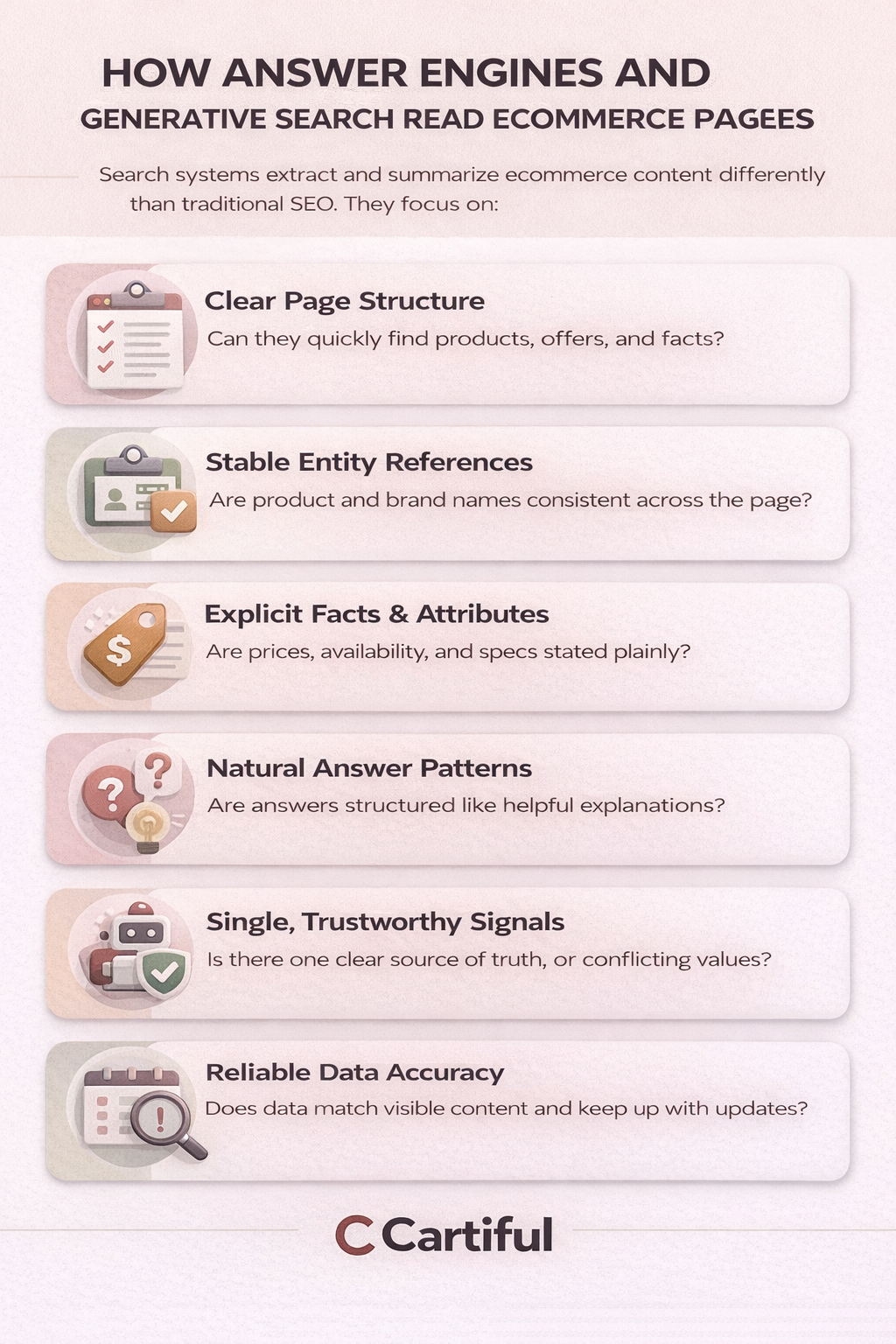
How Answer Engines And Generative Search Read Ecommerce Pages
To understand AEO and GEO for ecommerce, it helps to forget rankings for a moment and focus on how modern search systems actually read a page. Search engines and generative systems don’t experience your store the way a shopper does. They don’t “browse.” They parse, classify, and compare information across thousands of similar pages before deciding what can be safely reused as an answer.
At a high level, systems like Google and AI-driven search experiences follow a predictable pattern: they try to understand what the page is about, what role it plays, and which facts on the page are stable enough to summarize or reference. AEO and GEO are about making that process easier and more accurate.
Step One: Page Intent Comes First
Before any answer is extracted, search systems determine page intent. In ecommerce, this usually falls into a few clear categories: product page, category page, brand page, comparison page, or informational guide.
If the intent is unclear, everything else suffers. For example, when a page mixes heavy promotional language, vague descriptions, and inconsistent product details, systems struggle to decide whether it’s informational or transactional. That confusion reduces the likelihood that the page will be used as a source for direct answers or summaries.
This is why AEO for ecommerce starts with alignment. A product page should behave like a product page from top to bottom. A guide should behave like a guide. When intent is clear, answer extraction becomes safer.
Step Two: Entity Recognition And Consistency
Once intent is established, search systems look for entities. In ecommerce, entities usually include the brand, the product, product attributes (such as size, material, or model), and sometimes the seller.
The critical factor here is consistency. If your brand name appears in multiple variations, or a product is described differently across headings, descriptions, and specifications, systems treat that as uncertainty. Generative engines are especially cautious about summarizing content when entity relationships are unclear.
This is where GEO quietly operates. Generative systems don’t just look for keywords; they look for stable relationships. When the same product name, attributes, and claims repeat consistently across a page, the system gains confidence that it understands what’s being discussed and can reference it accurately.
Step Three: Attribute Extraction (The “Answer Layer”)
After entities are identified, systems scan for attributes—the factual elements that answer common questions. In ecommerce, these usually include price ranges, availability, variants, usage context, and sometimes shipping or return expectations.
This is where many stores unintentionally fail at AEO. The information exists, but it’s scattered. Price is shown visually but not described clearly. Availability changes dynamically but isn’t reinforced in text. Variants are selectable but never explained.
Answer engines prefer attributes that are:
- stated clearly in text
- introduced early in a section
- phrased in complete, factual sentences
When attributes are buried in UI elements or implied rather than stated, systems are less likely to extract them confidently.
Step Four: Trust And Reusability Signals
Before an answer is reused, systems ask a final question: Is this information safe to show elsewhere? This is where trust comes in.
Trust is influenced by several subtle factors:
- consistency between different parts of the page
- alignment between content and visible elements
- absence of exaggerated or contradictory claims
- overall clarity of structure
For generative systems, reuse is risky. If there’s a chance the summary could be wrong, outdated, or misleading, the system will often skip the page entirely and pull from a source that feels cleaner, even if that source is less detailed.
This is why AEO and GEO reward boring clarity over clever copy. Pages that state facts plainly, repeat key details naturally, and avoid ambiguity are easier to summarize and safer to reference.
Why This Matters Before Any Technical Work
None of the steps above require schema, code changes, or developer access. They’re about how content is written and organized. Schema comes later as a reinforcement layer, but it cannot fix unclear intent, inconsistent entities, or scattered attributes.
If your ecommerce pages are structured so that a human can quickly answer, “What is this product, who is it for, and what should I expect?” then answer engines can usually do the same. That’s the foundation AEO and GEO are built on.
In the next section, we’ll translate this understanding into practice by looking at how to structure ecommerce content so these answers exist naturally on the page, without turning product pages into long explanations or FAQ dumps.
Structuring Ecommerce Content So Answers Exist Naturally
Once you understand how answer engines and generative systems read a page, the next step is practical: how do you structure ecommerce content so clear answers already exist, without bloating the page or hurting conversions? This is where most AEO/GEO advice becomes unrealistic. Ecommerce pages can’t read like textbooks. They have to sell, reassure, and move quickly.
The goal isn’t to add more content. It’s to organize what already needs to be there so that both shoppers and search systems can understand it with minimal effort.
Start With A Clear Information Hierarchy
Every ecommerce page should follow a predictable hierarchy, even if the visual design is creative. Search systems rely on this consistency to locate answers.
At the top of the page, the product identity must be unmistakable. The product name, brand, and core description should appear immediately and match how the product is referenced elsewhere on the site. This anchors entity recognition and prevents confusion later in the page.
Directly after that, key attributes should be easy to spot. These include what the product does, who it’s for, and what makes it different. You don’t need long paragraphs here. Short, descriptive statements work better than marketing slogans because they can stand alone if extracted.
When hierarchy is clear, answer engines don’t have to search for meaning. They find it where they expect it.
Write Definitions Before Persuasion
A common ecommerce mistake is leading with persuasive language before explaining the product clearly. From an AEO/GEO standpoint, this delays understanding.
Each major section should begin with a plain-language definition or explanation before expanding into benefits. For example, if a section is about materials, start by stating what the material is and why it matters, then describe how it feels or performs. If a section covers sizing, explain how sizing works before encouraging shoppers to “find their perfect fit.”
This approach benefits humans and machines at the same time. Shoppers get clarity faster, and answer engines get clean, extractable statements early in the section.
Make Attributes Explicit, Not Implied
Many ecommerce pages rely on interface elements—dropdowns, tabs, icons—to communicate important information. While this works visually, it often hides details from answer engines.
AEO-friendly content states attributes explicitly in text, even if they are also selectable in the UI. If a product comes in multiple variants, explain that in a sentence. If availability changes, describe the conditions under which it changes. If shipping timelines vary by location, acknowledge that clearly.
This doesn’t mean repeating every detail multiple times. It means ensuring that essential facts are expressed at least once in complete, readable sentences.
Group Related Answers Together
Search systems prefer answers that live in context. Scattering information across unrelated sections increases the chance of misinterpretation.
For example, shipping costs, delivery timelines, and return policies should be grouped together rather than spread across the page. Product care instructions should live near material details. Warranty information should appear close to durability or quality claims.
When related attributes appear together, generative systems are more likely to summarize them accurately because they don’t have to stitch together meaning from distant parts of the page.
Use Headings That Reflect Real Questions
Headings play a major role in AEO. They signal what kind of answer follows. The best ecommerce headings mirror how shoppers think, not how internal teams label features.
Instead of vague headings like “Details” or “More Information,” use headings that imply a clear answer: what the product is made of, how it fits, how it’s used, or what to expect after purchase. These headings guide both users and machines toward the right interpretation.
This doesn’t mean turning every heading into a question. It means making sure the heading sets a clear expectation that the section fulfills.
Keep Answers Stable Over Time
Generative systems favor information that feels stable. If core product details change constantly or contradict themselves across the page, extraction becomes risky.
Where possible, separate stable facts (materials, intended use, core specifications) from variable elements (price, stock, promotions). This helps systems understand which parts of the page are safe to summarize and which parts should be treated as dynamic.
From a practical standpoint, this also makes your pages easier to maintain during sales or seasonal campaigns.
Why This Structure Supports AEO And GEO?
When ecommerce content is structured this way, answers don’t need to be “manufactured.” They already exist naturally in the copy. Answer engines can extract them without distortion, and generative systems can summarize them without guessing.
This is the point where technical reinforcement starts to matter. Once your content clearly communicates intent, entities, and attributes, you can support it with structured signals that confirm what the page is saying.
Schema Markup as a Reinforcement Layer (Not The Strategy)
At this point in the guide, schema should finally make sense, and not because it’s “important for SEO,” but because it confirms the answers your content already provides. If AEO and GEO are about clarity, then schema is about verification. It tells search and generative systems, “Yes, what you understood from the content is correct, and here’s the structured proof.”
This distinction matters. Schema does not create answers. It reinforces them.
Why Schema Comes After Content In AEO/GEO
Answer engines and generative systems first analyze visible content: headings, sentences, structure, and consistency. Only after they form an understanding do they look for structured signals to validate that understanding.
If your content is unclear, schema won’t rescue it. If your content is clear, schema reduces uncertainty.
This is why schema belongs after you’ve:
- clarified page intent
- stabilized entities (brand, product, attributes)
- made key facts explicit in text
When those pieces are in place, schema becomes powerful because it aligns perfectly with what the page already communicates.
What Schema Actually Does For Answer Engines
Schema translates human-readable content into machine-confirmed facts. It helps answer engines answer questions like:
- Is this definitely a product page?
- Which value is the current price?
- Which attribute represents availability?
- Which name should be treated as the official product identifier?
From a GEO perspective, this matters because generative systems are conservative. They prefer sources where content and structure agree. When schema and on-page content match, systems feel safer reusing that information in summaries, comparisons, and overviews.
Schema as an Accuracy Filter, Not a Ranking Trick
A common misconception is that schema is a shortcut to visibility. In reality, it acts more like an accuracy filter. It doesn’t force inclusion; it increases confidence.
When multiple ecommerce pages compete for the same query, the one with clearer content and matching structured data is easier to interpret and less risky to reference. Over time, this consistency helps your store become a dependable source rather than a one-off result.
This is especially relevant for ecommerce because product information changes. Schema helps systems distinguish between:
- stable product facts (what it is, who it’s for)
- variable commerce signals (price, stock, promotions)
That separation supports better extraction without misrepresenting your store.
The Role Of Schema In The Answer-Box Playbook
In an AEO/GEO framework, schema supports three specific outcomes:
- Answer validation
It confirms that extracted answers match authoritative page data.
- Entity reinforcement
It strengthens brand and product recognition across search and generative systems.
- Error reduction
It minimizes misinterpretation when pages are summarized out of context.
Notice what’s missing here: guarantees. Schema doesn’t guarantee featured snippets, AI summaries, or rich displays. What it does guarantee is that your intent is communicated clearly and consistently.
Setting Expectations Before Implementation
Before moving into schema types, mapping, and implementation, it’s important to set realistic expectations. Schema works best when treated as:
- ongoing infrastructure
- aligned with real content
- maintained alongside product updates
It is not a one-time paste-and-forget tactic.
How Schema Is Implemented In Practice (Without Turning This Into A Dev Manual)
Now that you know which schema types matter and why they support AEO/GEO, the next question is the one most ecommerce teams get stuck on: how is this actually implemented without breaking the site or creating technical debt?
This section is intentionally practical and beginner-friendly. You don’t need to become a developer to understand it. You just need to understand where schema lives, how it’s maintained, and what can go wrong if it’s treated casually.
Where Schema Lives On An Ecommerce Site
Schema markup lives in your page’s code, but that doesn’t mean it’s buried deep in complex templates. In most modern ecommerce setups, schema is injected in one of three places:
- Theme or template files
This is common for core schema such as Product, Breadcrumb, and Organization markup. When implemented at the theme level, schema automatically updates as product data changes. - Apps or plugins
Many Shopify and WooCommerce stores use apps to generate schema. These can be useful, but they also introduce risk if multiple tools inject overlapping markup. - Custom script blocks
Advanced teams sometimes inject schema using custom scripts or server-side rendering. This offers control but requires discipline to maintain.
From an AEO/GEO standpoint, the location matters less than the consistency. Wherever schema is added, it must stay aligned with visible content.
Why JSON-LD Is The Preferred Format
You’ll often hear about different schema formats, but for ecommerce, JSON-LD is the safest and most maintainable option.
JSON-LD keeps structured data separate from the visible page layout. That means:
- designers can update layouts without breaking schema
- schema can be edited without touching front-end UI
- validation and debugging are easier
For AEO/GEO, this separation is valuable because it reduces accidental inconsistencies. When content changes, the schema can be updated programmatically to match, rather than being scattered across HTML elements.
The Single Source Of Truth Rule
This rule is non-negotiable for ecommerce AEO/GEO:
If schema says something, the page must say the same thing.
Price, availability, product names, and ratings must match exactly. Even small mismatches, such as “in stock” in schema but “limited availability” on the page, introduce uncertainty.
Answer engines and generative systems treat mismatches as a trust issue. When trust drops, extraction drops.
The safest way to avoid this is to ensure schema pulls values directly from the same data source used to render the page. When schema is hardcoded or manually edited, it often falls out of sync during sales, stock updates, or catalog changes.
Platform-Specific Reality (Without Getting Too Technical)
Most ecommerce platforms already store structured product data internally. The job of schema is simply to expose that data cleanly.
- Shopify stores product names, variants, prices, and availability centrally. Schema should reference those fields directly, not recreate them manually.
- WooCommerce does the same through product objects and metadata. Plugins or theme-based schema usually work best when they tap into these native fields.
The AEO/GEO implication here is important: automation beats perfection. A slightly less detailed schema that stays accurate is far better than a “perfect” schema that goes stale.
Avoiding Duplicate And Conflicting Schema
One of the most common implementation problems is duplicate schema. This happens when:
- a theme adds Product schema
- a plugin adds Product schema
- a third-party app adds review schema
To search systems, this looks like conflicting sources of truth. Instead of reinforcing answers, it introduces ambiguity.
As a rule, each page should have:
- one Product entity
- one set of Offer or AggregateOffer data
- one clear brand reference
Before adding anything new, it’s critical to audit what already exists.
Implementation As An Ongoing Process
Schema should never be treated as “set and forget.” For ecommerce, it’s living infrastructure that needs to evolve with:
- new product variants
- seasonal pricing changes
- promotions and stock shifts
- catalog expansions
From an AEO/GEO perspective, maintenance matters more than depth. Systems reward consistency over time. A store that keeps schema aligned month after month becomes a safer source for answers than one that frequently contradicts itself.
Why This Step Unlocks The Next Layer?
Once schema is implemented cleanly and consistently, you’ve completed the reinforcement layer of the AEO/GEO stack. Your content is clear. Your entities are stable. Your facts are confirmed.
Validating And Monitoring Schema So Answer Engines Actually Trust It
Implementing schema is only half the work. For AEO and GEO, validation and monitoring are what turn schema from “present” into “trusted.” Search and generative systems don’t assume your structured data is correct just because it exists. They test it, compare it to page content, and watch how consistently it behaves over time.
This section explains how ecommerce teams should validate schema properly, what to monitor long term, and why this step directly affects whether your pages are reused as answers or ignored.
Validation Is About Eligibility, Not Perfection
The first thing to understand is that validation is not about chasing a “perfect” score. It’s about confirming that your structured data is eligible, readable, and aligned with what’s on the page.
When you validate schema, search systems are checking three things:
- whether the markup follows the correct structure
- whether required properties are present
- whether the data matches visible page content
If any of these fail, your page becomes risky to reuse. For answer engines, risk usually means exclusion.
What You Should Validate First (Priority Order)
For ecommerce AEO/GEO, validation should follow the same hierarchy as implementation.
Start with product pages. These are the pages most likely to be summarized, compared, or referenced. Make sure product identity, price, availability, and variants are all being read correctly.
Next, check breadcrumb and organization data. These don’t drive direct answers, but they support context and entity stability, which generative systems rely on heavily.
Finally, validate article or guide pages to ensure they’re classified correctly as informational, not transactional.
Trying to validate everything at once often leads to noise. Focus on revenue-driving and answer-prone pages first.
Why Mismatches Kill Answer Extraction
One of the most common validation issues isn’t technical, it’s content mismatch. The schema might say one thing while the page implies another.
Examples include:
- schema showing “in stock” while the UI shows limited availability
- a different product name in structured data than in the page title
- outdated prices left in schema after a promotion ends
From an AEO/GEO perspective, these mismatches are dangerous. Generative systems assume that if structured data and visible content disagree, neither can be trusted fully. When that happens, the page is less likely to be used as a source for answers, even if the error seems minor.
Monitoring Is Where AEO/GEO Compounds Over Time
Validation is a snapshot. Monitoring is what builds long-term trust.
Search systems observe how often your structured data changes, how frequently it breaks, and how reliably it stays aligned with page content. Ecommerce stores that maintain clean, consistent schema through sales, stock changes, and catalog updates gradually become safer sources for extraction.
Monitoring should focus on:
- new errors or warnings after theme or plugin updates
- changes during major campaigns or sales
- inconsistencies introduced by new apps or integrations
This is especially important for merchants running frequent promotions. If schema repeatedly falls out of sync during sales periods, answer engines learn to avoid relying on it.
Treat Validation As Part Of Store Operations
For ecommerce teams, schema validation should be treated like:
- checking feeds before launching ads
- reviewing tracking before a campaign
- QA before pushing a design update
It doesn’t need to be daily, but it should be routine, especially after changes that affect pricing, availability, or product structure.
This operational mindset aligns well with how Cartiful approaches growth for merchants and store owners: paid ads and social drive momentum first, and clean technical foundations support that growth quietly in the background over time.
Why This Step Matters For AEO And GEO Specifically
Answer engines and generative systems are conservative by design. They don’t reward experimentation; they reward reliability. Validation and monitoring are how you demonstrate that reliability.
When your structured data:
- passes validation consistently
- stays aligned with visible content
- survives updates and promotions without breaking
Your pages become easier to reuse, summarize, and trust.
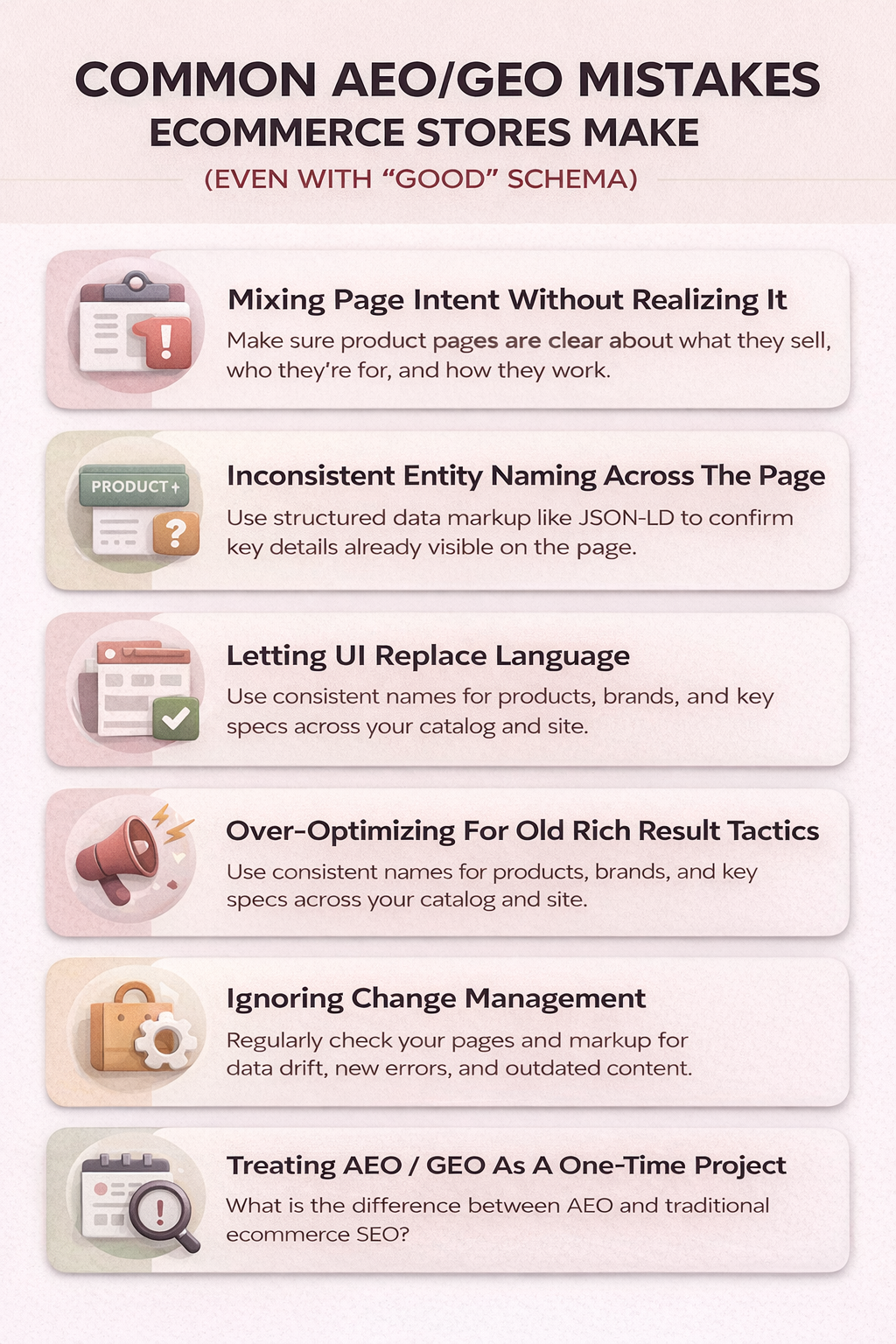
Common AEO/GEO Mistakes Ecommerce Stores Make (Even With “Good” Schema)
At this stage, most ecommerce teams assume they’re safe. The content is clearer. Schema is implemented. Validation passes. Yet their pages still don’t show up in answer boxes, summaries, or AI-generated comparisons as often as expected. In most cases, the problem isn’t missing schema or missing keywords; it’s subtle AEO/GEO mistakes that quietly reduce trust.
These issues don’t usually trigger errors. They simply make your pages less reusable.
Mistake One: Mixing Page Intent Without Realizing It
One of the fastest ways to break AEO/GEO is by blending multiple intents on the same page. Ecommerce pages often try to do too much at once: sell a product, rank for comparisons, educate, and answer support questions all in the same flow.
When intent becomes mixed, answer engines hesitate. A page that reads half like a product page and half like a buying guide is harder to classify and riskier to summarize. The system can’t tell whether it should extract a transactional answer, an informational explanation, or avoid the page altogether.
The fix is discipline. Product pages should focus on product answers. Guides should focus on explanations. Support or policy content should live where it belongs. Clear separation strengthens extraction.
Mistake Two: Inconsistent Entity Naming Across The Page
This is one of the most common GEO failures. A product is introduced with one name, referenced differently in specifications, shortened in FAQs, and altered again in reviews or internal links.
To a human, this feels normal. To a generative system, it looks like multiple similar but not identical entities. When that happens, summarization becomes risky, and the page is less likely to be used as a source.
Consistency doesn’t mean repetition. It means stability. The same product and brand names should anchor the page, even when the surrounding language varies.
Mistake Three: Letting UI Replace Language
Modern ecommerce design relies heavily on interface elements: tabs, toggles, icons, badges, and selectors. These are great for users, but answer engines don’t “interact” with interfaces the way humans do.
When critical information exists only inside UI components, such as variant logic, availability conditions, or delivery expectations, it may not be interpreted as an answer at all. From an AEO perspective, the answer technically doesn’t exist.
The solution is simple but often skipped: ensure that essential facts are stated in plain, readable sentences somewhere on the page, even if the UI also represents them visually.
Mistake Four: Over-Optimizing For Old Rich Result Tactics
Some ecommerce stores still build content and schema specifically to trigger outdated rich results. This includes forcing FAQ-style sections onto pages where they don’t naturally belong or over-marking content that isn’t truly answer-driven.
Generative systems are especially sensitive to this. When a page looks engineered rather than informative, reuse drops. AEO and GEO reward natural clarity, not artificial structure.
If a question genuinely helps shoppers, include it. If it’s there only to chase visibility, it usually hurts more than it helps.
Mistake Five: Ignoring Change Management
AEO/GEO success is cumulative, but many stores reset trust unintentionally. Theme changes, app installs, promotion launches, and catalog updates often introduce small inconsistencies that compound over time.
Examples include:
- schema falling out of sync during sales
- product descriptions updated without updating supporting sections
- new variants added without clarifying how they differ
Each inconsistency makes extraction slightly riskier. Over time, systems learn to avoid relying on the page.
The fix is not perfection, it’s awareness. Any change that affects product facts should trigger a quick content and schema check.
Mistake Six: Treating AEO/GEO As A One-Time Project
Perhaps the most damaging mistake is treating AEO/GEO like a checklist instead of a content discipline. Clear answers today don’t guarantee clear answers six months from now if the store evolves but the structure doesn’t.
Ecommerce stores that succeed with AEO/GEO tend to:
- revisit core pages regularly
- maintain stable language for key attributes
- update content with consistency in mind
This is why AEO/GEO works best when embedded into ongoing ecommerce operations, not isolated as a one-off SEO task.
That means: Most AEO/GEO failures don’t come from missing tactics. They come from small signals of uncertainty. When content, structure, and data drift even slightly, answer engines respond by choosing safer sources.
A Practical AEO/GEO Rollout Plan For Ecommerce Teams
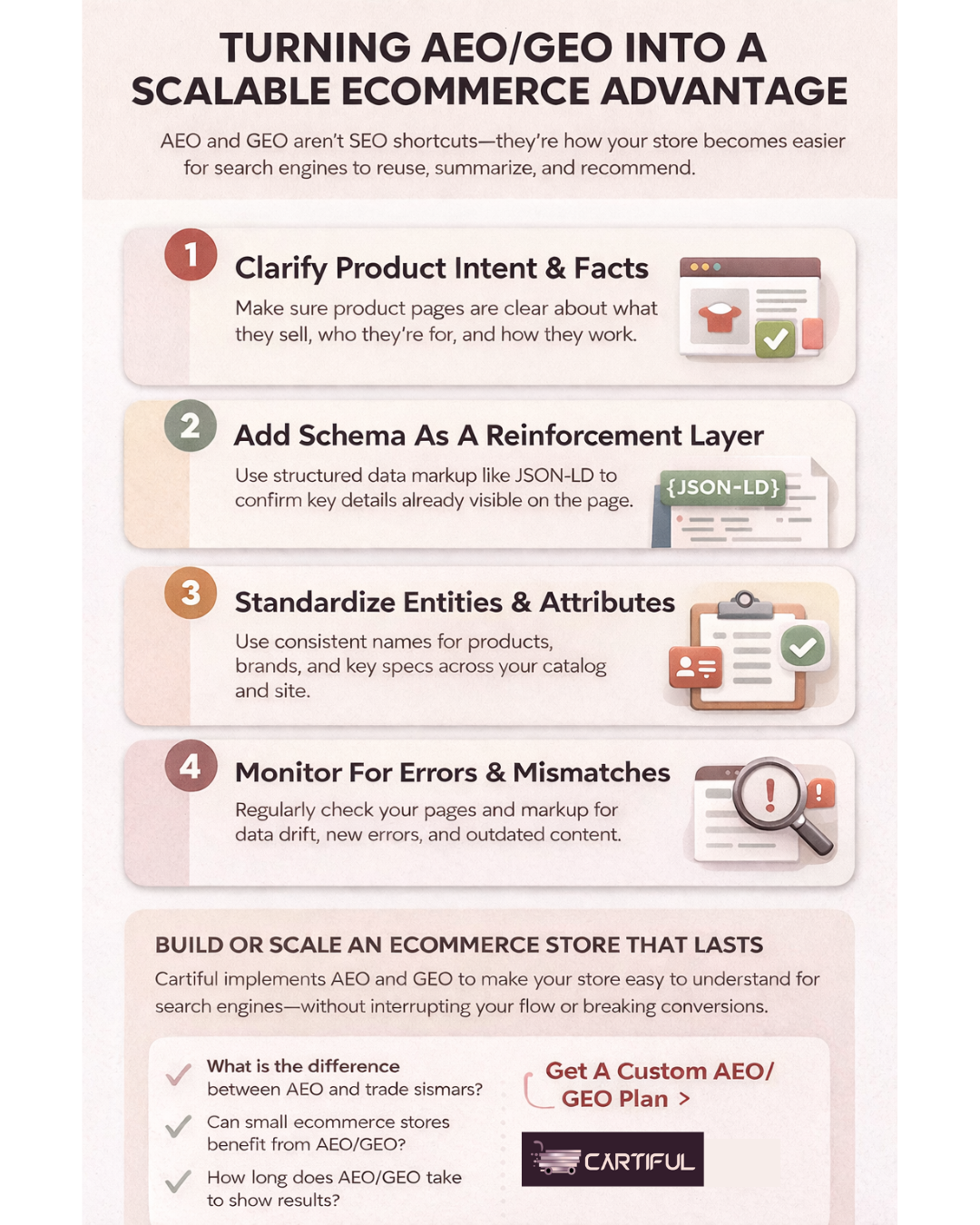
After understanding how AEO/GEO works, where schema fits, and what commonly breaks trust, the final challenge is execution. Most ecommerce teams don’t fail because they don’t understand the theory. They fail because they try to do everything at once, or they treat AEO/GEO like a one-off SEO project instead of a staged rollout.
This section lays out a realistic, low-friction implementation plan that ecommerce teams can follow without stalling growth, redesigning the site, or overwhelming developers.
Phase One: Fix The Pages That Already Matter
The fastest AEO/GEO wins come from pages that already receive traffic. You’re not trying to create new demand yet, you’re improving how existing demand is captured and understood.
Start with:
- top-selling product pages
- products that appear in comparisons or branded searches
- pages that already rank but have low click-through rates
For these pages, focus on three things only:
- clarify product identity and intent
- make key attributes explicit in text
- ensure schema confirms those same facts
This phase is about cleaning signal, not expanding content.
Phase Two: Stabilize Entities And Language Across The Store
Once priority pages are clean, the next step is consistency at scale. This is where GEO starts compounding.
Review how your brand name, product names, and core attributes are written across:
- product descriptions
- headings and specs
- FAQs and support content
- internal links and collections
You’re looking for drift. Minor differences that feel harmless to humans often introduce uncertainty for generative systems. Standardizing language doesn’t make content boring, it makes it reliable.
At this stage, many teams create simple internal rules such as:
- one official product name per SKU
- one standard way to describe materials, sizing, or usage
- one preferred format for availability and shipping language
These rules quietly improve extractability across the entire site.
Phase Three: Expand AEO-Friendly Structure Without Adding Bloat
Only after the foundation is stable should you expand content. This is where many teams go wrong by starting too early.
Expansion doesn’t mean longer pages. It means better-placed answers:
- short explanatory sections where confusion commonly exists
- grouped attributes instead of scattered details
- headings that reflect real shopper questions
This phase improves performance in “People also ask,” AI summaries, and comparison-style queries without changing the core selling experience.
Phase Four: Reinforce With Schema At Scale
Now schema becomes efficient instead of fragile.
At this point:
- page intent is clear
- entities are stable
- answers exist naturally in content
Schema can be applied consistently through themes, templates, or controlled plugins without constant manual fixes. This is where ecommerce teams see schema stop “breaking” during campaigns or updates.
The key mindset shift here is maintenance over perfection. A schema setup that survives seasonal sales is more valuable than an over-detailed setup that fails during promotions.
Phase Five: Monitor, Adjust, And Let Trust Build
AEO/GEO is not instant. It compounds as systems observe reliability over time.
Monitoring should focus on:
- changes after site updates
- pages that stop appearing in summaries or comparisons
- mismatches introduced by new content or features
The goal is not constant optimization. It’s preventing regression.
Ecommerce stores that succeed with AEO/GEO don’t constantly tweak. They protect clarity.
How This Fits Into Real Ecommerce Growth
This rollout works because it doesn’t compete with paid ads, social, or conversion optimization. It supports them.
When product pages are clearer:
- ad traffic converts better
- social traffic bounces less
- organic discovery feels more trustworthy
That’s why AEO/GEO works best as infrastructure, not a campaign.
The Bigger Picture
AEO and GEO aren’t shortcuts or trends you “add on” to ecommerce SEO. They’re the natural evolution of how search works when answers, summaries, and comparisons matter as much as rankings. For ecommerce brands, the real opportunity isn’t gaming answer engines, it’s becoming a store that’s easy to understand, safe to reference, and reliable to summarize.
When your pages have clear intent, consistent entities, and explicitly stated product facts, answer engines don’t need to guess. When schema is added as a reinforcement layer—not a crutch, it confirms that clarity instead of trying to manufacture it. Over time, this consistency builds trust, and trust is what allows your products and brand to show up more confidently across organic listings, AI-driven summaries, and comparison-style results.
At Cartiful, this approach fits naturally into how ecommerce growth actually works. Paid ads and social campaigns create momentum. Conversion optimization improves performance. AEO/GEO and clean technical foundations make that growth more durable by ensuring your store communicates clearly wherever buyers discover you, today, and as search continues to evolve.
FAQs
What Is The Difference Between AEO And Traditional Ecommerce SEO?
Traditional SEO focuses on rankings and traffic. AEO focuses on making content easy to extract as direct answers. For ecommerce, this means clearly stating product facts, attributes, and expectations so search and AI systems can summarize them accurately.
Does AEO/GEO Replace SEO For Ecommerce Stores?
No. AEO/GEO builds on SEO. Rankings still matter, but clarity and trust now determine whether your pages are reused in answer boxes, AI summaries, and comparison views.
Can Small Ecommerce Stores Benefit From AEO/GEO?
Yes. In fact, smaller stores often benefit faster because they can maintain consistency more easily. Clear product pages with stable language and clean structure are easier for answer engines to trust.
Do I Need Schema For AEO/GEO To Work?
Schema helps, but it’s not the starting point. AEO/GEO begins with content clarity and structure. Schema reinforces what’s already clear; it doesn’t fix unclear pages.
Will AEO/GEO Guarantee Featured Snippets Or AI Summaries?
No. Nothing guarantees placement. AEO/GEO increases eligibility and trust, which improves the chances that your content is reused—but final selection is always system-driven.
How Long Does It Take To See Results From AEO/GEO?
AEO/GEO compounds over time. Some improvements, like clearer product answers and better click quality, can show quickly. Broader visibility across summaries and comparisons usually builds gradually as consistency is observed.
Is AEO/GEO Only For Google?
No. The same principles apply to any system that summarizes or compares ecommerce content, including AI-powered search experiences and marketplace discovery surfaces.
How Often Should Ecommerce Pages Be Reviewed For AEO/GEO?
Key product pages should be reviewed whenever prices, variants, or positioning change. Beyond that, periodic checks, especially after campaigns or site updates, help prevent drift.