Skip to content
Ecommerce Stores Guide for Creating Evergreen Content
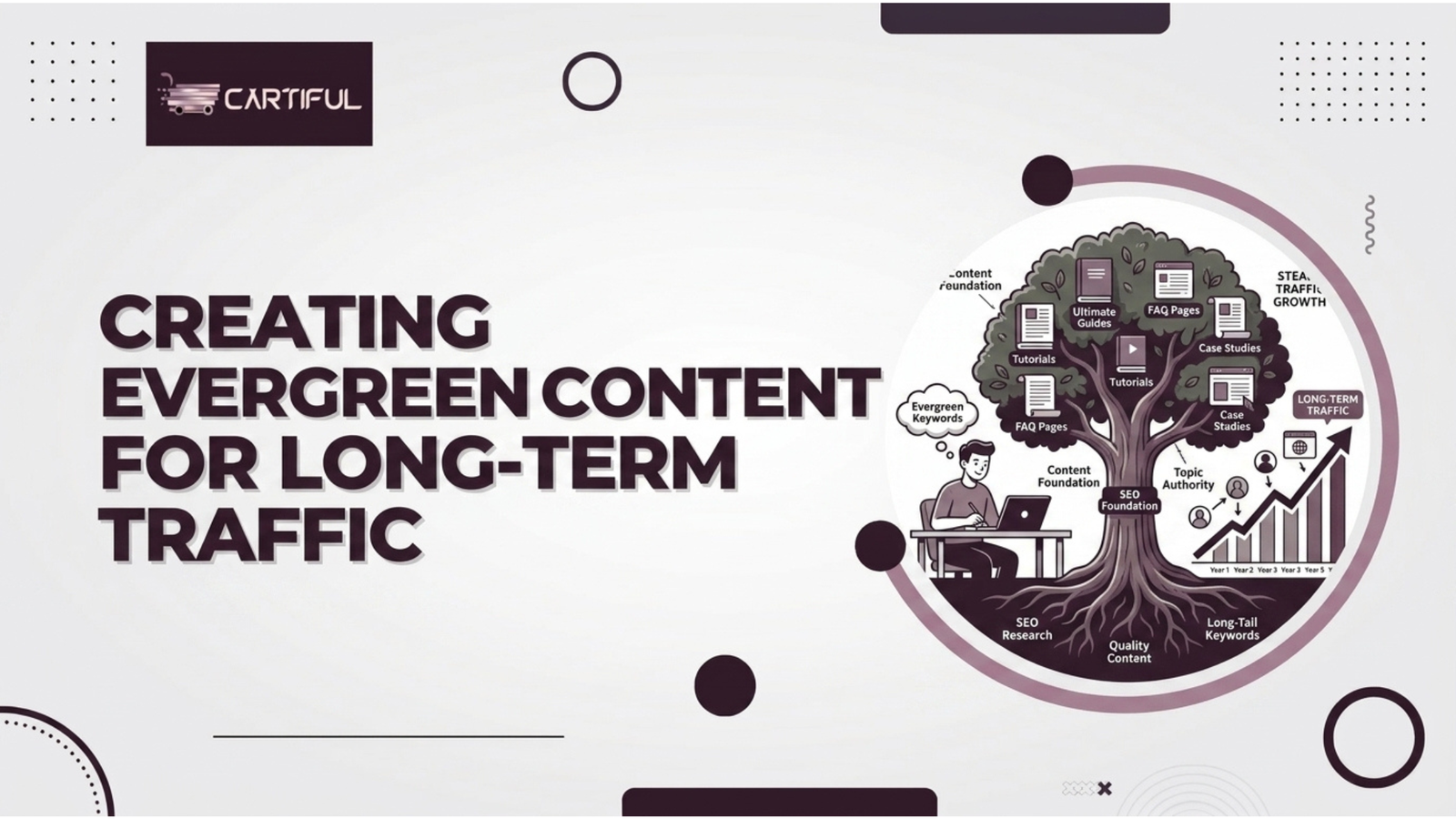
Evergreen content solves one clear problem: your store needs steady organic traffic, not spikes that disappear.
Creating evergreen content means publishing web content that stays useful months or years after it goes live. For ecommerce store owners, this type of content continues to drive buyers from search engines without relying solely on Google or Meta Ads.
At Cartiful, evergreen content is treated as a traffic asset. It supports paid ads, improves search rankings, and drives long-term organic growth rather than chasing short-term trends.
What Is Evergreen Content?
Evergreen content is content that remains useful over time and consistently drives organic search traffic by answering ongoing buyer questions, without relying on dates, trends, or temporary offers.
For ecommerce, evergreen content usually includes:
- buying guides
- product comparisons
- how-to articles
- category education pages
- common buyer questions
This type of content works because search intent does not change quickly.
Why Evergreen Content Matters for Ecommerce Stores?
Most blog posts bring short bursts of traffic.
Evergreen content builds momentum and continues to perform in search engine results.
Paid ads stop the moment spend pauses. Evergreen web content continues to attract buyers through organic search traffic, even when ad budgets slow down.
For ecommerce store owners, evergreen content:
- drives steady organic traffic from search engines
- supports product pages and category pages through internal linking
- improves search rankings as authority builds over time
- reduces long-term reliance on paid media and social media ads
According to Search Engine Land, organic search still accounts for more than 50% of trackable website traffic across industries.
At Cartiful, evergreen content sits at the center of the content strategy, helping stores stay visible in search results and maintain traffic consistency across changing ad cycles.
How Search Engines Treat Evergreen Content
Search engines favor evergreen content because it aligns with how search intent behaves over time.
Pages that answer stable buyer questions tend to generate consistent engagement signals such as clicks, time on page, and repeat visits. As these pages continue to attract visitors, they also accumulate backlinks and build topical authority around the subject.
Because evergreen topics remain relevant, these signals compound over time. Search engines interpret this as evidence that the page consistently satisfies search intent.
Google’s search algorithms prioritize usefulness and relevance rather than publish dates. That is why older evergreen pages can continue ranking above newer articles when they provide the most complete and helpful answer to a search query.
Google explains this approach in its helpful content documentation.
Evergreen Content vs Short-Lived Blog Posts
The difference between evergreen content and short-term blog posts shows up clearly in long-term organic traffic performance.
| Type | Evergreen Content | Short-Term Blog Posts |
| Lifespan | Months or years | Days or weeks |
| Search volume | Stable over time | Spikes then drops |
| Organic traffic | Compounding | Temporary |
| Content refresh | Periodic updates | Often ignored |
| Value to ecommerce | High | Limited |
Ecommerce blog posts are most effective when evergreen content is planned first.
Short-form content can then support distribution, social media marketing, and timely campaigns without weakening long-term search engine optimization.
Example of Evergreen Content vs Trend Content
The difference between evergreen content and trend-based posts becomes clear when looking at real examples.
Trend-based post
“Black Friday Deals on Running Shoes 2025”
Evergreen post
“How to Choose Running Shoes for Long Distance Training”
The trend post attracts attention for a few days while the sale is active. Once the event passes, search demand disappears, and the page quickly loses traffic.
The evergreen guide answers a question runners search for every year. Because the topic remains relevant, the page can continue to rank in search results and generate organic traffic long after publication.
For ecommerce stores, this distinction is important. Evergreen content compounds over time, while trend content usually creates short-term traffic spikes.
The Role of Search Intent in Evergreen Content
Evergreen content works when it aligns with stable search intent, allowing content to match how buyers use search engines and appear consistently in search results for informational and commercial queries over time.
Search intent usually falls into four types:
- informational
- commercial
- transactional
- navigational
Evergreen ecommerce content primarily targets informational and commercial search intent because these queries remain relevant over the long-term and drive organic traffic.
Examples store owners see year after year:
- “how to choose running shoes”
- “best skincare ingredients for acne”
- “shopify vs woocommerce for small stores”
These searches show consistent interest in Google Trends, proving why intent-based evergreen content continues to perform.
Long-Tail Keywords and Evergreen Reach
Long-tail keywords play a major role in evergreen content because they attract buyers with clear search intent.
These keywords are more specific, face less competition in search engines, and drive qualified organic traffic closer to purchase.
Examples such as “best protein powder for beginners” or “how to clean suede shoes safely” may show lower search volume, but they convert better because the intent is clear.
Evergreen content built around long-tail keywords tends to rank faster, hold search rankings longer, and stay relevant as search behavior remains stable.
Best Evergreen Content Formats for Ecommerce
Let’s look at the best evergreen content formats for long-term traffic:
1. Buying Guides
Buying guides work well for evergreen content because they explain how buyers should choose a product based on needs, use cases, or features.
These guides support blog posts and strengthen product and category pages through internal linking.
2. Product Comparisons
help shoppers understand differences between options and often perform well in search results for commercial search intent.
They attract buyers who are actively evaluating choices, which makes them valuable for organic traffic and conversions.
3. How-to Content
How-to guides or blogs focus on product usage, care, or setup and continue to attract traffic long after publishing.
This type of evergreen web content builds trust, reduces returns, and answers common buyer questions.
4. Category Education Pages
Category based content explains what a product category includes and who it is for.
These pages support search engine optimization by helping search engines understand relevance while guiding buyers earlier in the decision process.
Long Form Content vs Short Form Content
Long-form content works well for evergreen topics because it answers multiple buyer questions in one place.
It supports stronger search rankings, attracts backlinks over time, and performs better in search engines for informational and commercial search intent.
Short-form content still plays a supporting role in an evergreen content strategy.
It works best for social media posts, email snippets, internal linking, and directing users toward long-form evergreen pages that drive organic traffic.
How to Structure Evergreen Content for SEO
Structure matters more than word count when building evergreen content.
Search engines and users both respond better to web content that is easy to scan and easy to understand.
Evergreen content should follow a clear H1, H2, and H3 hierarchy, use short paragraphs, include bullet lists and tables where helpful, and end with FAQ sections.
This structure helps readers skim faster, allows search engines to extract answers, and improves visibility for AEO and LLM-based systems.
Google Search Console consistently shows stronger impressions and click-through rates for well-structured pages.
Content Refresh: Keeping Evergreen Pages Alive
Evergreen content is not set-and-forget. Even strong evergreen pages need periodic updates to remain accurate and competitive in search results.
A content refresh may involve updating examples, improving internal links, expanding sections, adding new FAQs, or revising statistics and screenshots. These updates help maintain the page’s usefulness and signal to search engines that the content remains relevant.
Understanding Content Decay
Over time, even evergreen content can lose rankings if it is ignored. This gradual decline is often called content decay.
Content decay occurs when competitors publish updated pages, new search results enter the rankings, or the page’s information becomes outdated. As a result, impressions and clicks may slowly decrease.
Monitoring performance in Google Search Console helps identify early signs of decay.
If impressions or clicks begin to decline for a page that previously performed well, it is often a signal that the content needs refreshing.
Updating examples, improving internal links, expanding sections, or adding new FAQs can help restore rankings and maintain long-term organic traffic.
Most evergreen pages benefit from a review every 6 to 12 months, especially when search intent or buyer behavior shifts.
Evergreen Content and Social Media
Evergreen content does not stop working once it ranks in search engines. It also plays a steady role in social media marketing by providing ecommerce store owners with content that remains relevant long after publication.
Using evergreen web content makes it easier to plan:
- timeless social posts that stay accurate
- email campaigns that remain useful over time
- social media calendars without constant rewrites
Unlike trend-based posts, evergreen links can be reused across platforms without losing relevance or engagement.
This helps maintain consistent organic traffic while reducing content creation pressure.
Evergreen blog posts can also be repurposed into:
- Instagram carousels that explain buyer topics
- Facebook educational posts that answer common questions
- ad landing pages that support paid campaigns
This approach keeps messaging aligned across social media, email, and web content while driving users back to evergreen pages that support search rankings and conversions.
Common Mistakes Ecommerce Stores Make With Evergreen Content
Many ecommerce stores struggle with evergreen content because of avoidable planning and structure issues.
These mistakes limit long-term organic traffic and weaken search rankings.
Common mistakes include:
- writing news-based or trend-driven blog posts instead of stable buyer questions
- ignoring search intent during keyword research
- publishing content without internal links to product pages or category pages
- treating blog posts as standalone content with no conversion path
- never performing a content refresh to keep information accurate
Evergreen content performs best when it is connected to the broader site structure and supports clear paths from search results to product discovery and conversions.
How Cartiful Helps Build Evergreen Traffic
Most ecommerce stores do not struggle with ideas. They struggle with consistency, structure, and follow-through.
Cartiful helps store owners plan an evergreen content strategy, map keywords to buyer intent, and create web content that search engines trust.
Existing blog posts are refreshed, expanded, and connected to paid ads, social media, and conversion-focused pages.
With the right structure and maintenance, evergreen content becomes a long-term traffic asset instead of another blog post that disappears from search results.
Final Takeaways
Evergreen content is one of the most reliable ways for ecommerce stores to build long-term organic traffic from search engines.
When content is aligned with search intent, supported by keyword research, and structured for search engine optimization, it continues to perform well in search results over time.
Strong evergreen content focuses on stable buyer questions, uses long-tail keywords, and connects blog posts to product pages and category pages.
With regular refresh cycles and clear internal linking, evergreen web content becomes a lasting traffic asset instead of a short-lived post.
Evergreen content turns a blog from a publishing schedule into a long-term acquisition engine. Instead of chasing temporary traffic spikes, it builds search visibility that compounds month after month.