Skip to content
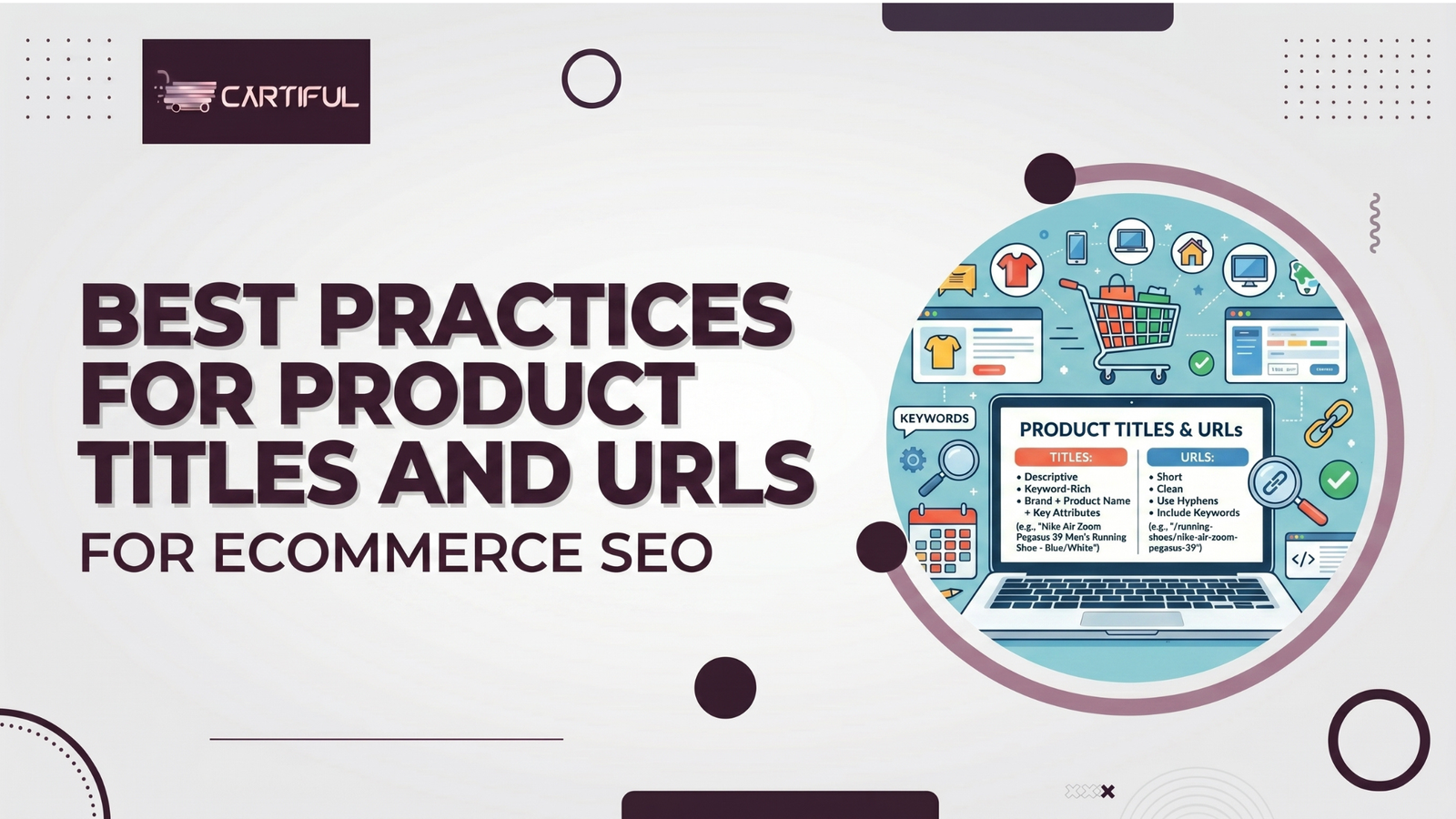
Product titles and URLs play a bigger role in ecommerce SEO than most stores realize. Clear product names help shoppers understand what they’re buying, improve click-through rates in search, and make large catalogs easier to manage.
The goal is not to stuff keywords into every title or keep changing URLs for SEO. The better approach is simpler: use product titles that sound natural, match how people search, and keep URLs clean, readable, and consistent.
Many ecommerce stores run into the same issues: supplier titles copied without edits, titles packed with unnecessary details, or messy URLs that keep changing over time. Fixing these basics can make product pages easier to scale and improve both search visibility and user experience.
Simple Rules for Product Titles and URLs
- Put the main product keyword near the beginning of the title
- Add details like brand, model, size, or color only when they help shoppers decide
- Keep the product title, H1, and meta title closely aligned in meaning
- Use short, readable URLs made of real words
- Stick to lowercase URLs with hyphens between words
- Avoid changing live product URLs unless there’s a clear reason
- If a URL does change, set up a permanent redirect to preserve traffic and rankings (Google for Developers)
Why Product Titles Matter
Product titles are often the first thing shoppers notice in search results. Google explains that title links help users quickly understand what a page is about and decide whether it’s relevant to their search. In many cases, the title tag becomes the most visible element of a product page in search, even when Google adjusts how it appears.
Research also supports keeping titles clear and tightly written. A large-scale study by Backlinko found that title tags around 40-60 characters tend to perform better in terms of click-through rate. Similarly, data from Search Engine Land shows that shorter, cleaner titles are less likely to be cut off or rewritten in search results.
That said, this is not about forcing every product title into a strict character limit. The real takeaway is simpler: clear, readable titles tend to perform better than long, overloaded ones.
At Cartiful, this becomes especially important for ecommerce stores running paid ads and SEO together. Product titles also influence how well landing pages convert once users arrive.
How Product Titles, H1, and Title Tags Work Together
On most ecommerce stores, a single product ends up with multiple “names,” including:
- The backend catalog name
- The visible product title on the page
- The H1 heading
- The HTML title tag
- The version shown in Google search results
Google may build title links from different elements on the page, including the <title> tag, headings like <h1>, visible text, structured data (like og:title), and even anchor text from other pages linking to the product. When signals conflict, it can become harder for search engines to understand the main title.
The goal is not to make every field identical, but to keep them closely aligned. If each version describes the product differently, it creates confusion for both search engines and shoppers.
In most ecommerce setups (especially Shopify), the best-performing structure is simple: keep all product naming fields consistent in meaning, with only minor adjustments for format where needed.
What Makes a Strong Product Title
A strong product title is clear, specific, and aligned with how people actually search for the product. It should help shoppers instantly understand what the item is without needing extra context.
Good product titles usually:
- Start with the main product type or core search term
- Include the brand when it influences buying decisions
- Add the model only when shoppers search for it directly
- Mention 1–2 key details (like size, material, or use case)
- Stay easy to read naturally
- Match the product page content closely
Google’s guidance on title links and product listings emphasizes putting the most important information first. This includes a product name, brand, and defining attributes, so users can quickly understand what the page offers.
Better Product Title Patterns
Instead of random formatting, ecommerce stores perform better when they follow consistent structures like:
- Brand + product type + key attribute
- Product type + brand + model
- Brand + model + product type + size/capacity
- Product type + material/style + use case
Examples:
- Nike Air Zoom Pegasus 41 Men’s Running Shoes
- Samsung QN85 55 Inch QLED 4K Smart TV
- Stainless Steel Water Bottle 32 oz
- Women’s Black Leather Ankle Boots
Ahrefs also highlights that ecommerce titles work best when they follow category-specific templates based on keyword intent and product type, rather than using a one-size-fits-all format across an entire store. Understanding SEO-friendly product structuring and catalog setup is important.
What to Avoid in Product Titles
Many ecommerce stores lose clarity in product titles by adding unnecessary or repetitive information. The goal is to keep titles clean, readable, and focused on what the product actually is.
Avoid:
- Repeating the same keyword in different forms
- Adding every possible variant detail into the title
- Using supplier-provided titles without editing them
- Starting with internal codes or SKUs shoppers don’t recognize
- Adding promotional phrases like “best price” or “cheap” in the main title
- Writing titles that feel made for search engines instead of real people
Google’s guidance is straightforward on this: product titles should be clear, descriptive, and focused on the most important product details. Instead of keyword stuffing, the emphasis is on accurate and useful information that helps users quickly understand the product.
How Long Should Product Titles Be?
There is no fixed character limit that works for every ecommerce product, but research gives a useful benchmark.
Studies show that shorter, well-structured titles tend to perform better in search results:
- Search Engine Land’s analysis of 10,000 titles found that most displayed titles fall roughly between 42 and 46 characters
- Longer titles are more likely to be truncated or rewritten in search results
A practical approach is:
- Keep the core product meaning clear within the first 40–60 characters
- Avoid cutting out important details just to meet a strict length rule
- Don’t overload the title—clarity matters more than precision
- Expect search engines to shorten or rewrite titles that are too long or unclear
In many cases, search engines may also pull title information from other visible page elements if they better match the query. This is why the most important product details should always appear early in the title, not buried at the end
Why Product URLS Still Matter
URLs are not direct ranking factors on their own, but they still play an important role in ecommerce SEO and user experience.
Google explains that simple, descriptive URLs help both users and search engines understand what a page is about. It also notes that clean URL structures make it easier for search systems to crawl and retrieve pages efficiently, while messy or duplicate URLs lead to wasted crawl effort and indexing issues
Another important point is that search engines don’t rely on folder structure alone to understand a site. They interpret relationships between pages through internal links and navigation. This is why a strong internal linking structure often matters more than the length of a URL path.
The real goal is not to create the shortest possible slug. It’s to build URLs that are readable, consistent, and easy to maintain as the catalog grows.
Best Practices For Product URLs
Good product URLs are simple, readable, and consistent. They should clearly describe the product without unnecessary clutter.
For most ecommerce stores, the safest approach is:
- Use clear, descriptive words that match how shoppers search
- Keep URLs in lowercase with hyphens between words
- Remove unnecessary parameters or tracking strings
- Avoid duplicate URLs showing the same product under different paths
- Keep a consistent structure across the entire store
Example of a clean URL: /products/womens-waterproof-hiking-jacket
Example of a messy URL: /product?id=94822&cat=12&ref=summer-sale&color=black
For a deeper breakdown of how site structure and SEO work together in ecommerce stores, you can also check Cartiful’s guide on ecommerce SEO strategy.
What To Avoid In Product URLS
Many stores unintentionally create URL issues that hurt scalability and SEO performance. Avoid:
- Session IDs or tracking parameters in URLs
- Promotional text that will become outdated
- Dates that are not part of the actual product
- Long internal database strings
- Multiple URLs for the same product under different categories
Should Product URLs Match Product Titles Exactly?
No, they should align, not mirror.
A good URL keeps the core product info but doesn’t repeat every word from the title.
Example:
Title: Samsung QN85 55 Inch QLED 4K Smart TV
URL: /products/samsung-qn85-55-inch-qled-tv
This works because it keeps the key identifiers (brand, model, size) and removes filler words that don’t help in a URL.
The rule is simple: titles are for shoppers, URLs are for structure.
Google recommends keeping URLs descriptive and readable, not forcing exact matches with page titles. Google Search Central
Product Variants and URLs
Variant handling can make product URLs messy fast.
Google’s ecommerce URL guide says each product variant should be identifiable by a separate URL. It also warns that fragments do not create separate indexed pages. For example, /product/t-shirt#black and /product/t-shirt#white are treated as the same page by Google.
That means if size, color, or material variants need their own search presence, they need real URLs, not fragment-based changes.
A practical setup looks like this:
- one stable parent PDP when variants do not need separate search targeting
- separate variant URLs when the variant meaningfully changes search intent
- one canonical plan so the site does not create duplicate product paths
When To Change a Product URL (and When Not To)
Most ecommerce stores break URLs for no real reason. The key is knowing when a change actually improves structure versus when it creates risk.
Change a product URL when:
- The slug is unclear, broken, or unreadable
- The product was placed in a temporary or messy structure
- Duplicate URLs exist for the same product
- Your current URL format doesn’t scale across the catalog
Don’t change it just because:
- It feels slightly too long
- A tool suggested a “better SEO version”
- The product title changed a little
- Another store uses a different structure
If a URL does change, it should be handled properly with a permanent redirect so you don’t lose traffic or rankings.
Scaling Product Titles and URLs
For larger ecommerce stores, the real issue isn’t individual URLs; it’s inconsistency at scale.
A practical system usually includes:
- Title templates based on product category
- A fixed order for brand, product type, model, and key detail
- Stable slug rules that don’t change over time
- Clear rules for when variants appear in titles vs URLs
- Regular cleanup of duplicates and weak formats
Ahrefs also highlights that ecommerce stores perform better when titles follow consistent, category-based templates instead of a one-size-fits-all format.
What Store Owners Actually Run Into in Practice
Across ecommerce teams and merchant discussions, a few patterns show up again and again:
- Shopify stores often mix up product titles and meta titles, which leads to overly long or cluttered on-page titles
- Many teams worry about whether URLs must exactly match product names, but in practice, close alignment with a clean, stable slug works just fine
- URL restructuring comes up often, but most experienced teams avoid migrations unless there’s a clear structural problem, since the risk usually outweighs the gain
These aren’t strict rules, but they reflect real issues that slow down ecommerce growth when catalog structure isn’t handled cleanly.
Frequently Asked Questions
1. Should product titles and title tags be identical?
No. They should not be identical, but they should stay very close in meaning so the product message remains consistent across the page.
2. How long should product title tags be?
For product title tags, 40–60 characters is a good practical range. The goal is clarity and readability, not hitting an exact number.
3. Should product URLs include keywords?
Yes. Product URLs should include simple descriptive keywords that clearly reflect the product being sold.
4. Do shorter URLs rank better?
No. Shorter URLs are not automatically better. What matters more is clarity, structure, and readability.
5. Should category folders be included in product URLs?
Category folders should only be included in product URLs if they improve site structure; they should be avoided to prevent duplicate or complex URL paths.
6. What happens if I change a product URL without a redirect?
Changing a product URL without a redirect causes loss of traffic from the old URL and breaks existing links, so a 301 redirect must always be used.
7. Should variant details be included in titles and URLs?
Variant details should only be included in titles and URLs if they affect search or buying intent, such as size or color, otherwise they should be kept out.
Final Takeaway
Good product titles and URLs are simple, clear, and match how shoppers search. They don’t force extra keywords or complex structures. Instead, they focus on readability and consistency as the catalog grows.
For most ecommerce stores, the best approach is not a full overhaul, but a focused cleanup of key pages like top products, high-traffic listings, and pages with low click-through rates.