Skip to content
If your ecommerce store isn’t ranking as expected, the problem is often not your products or pricing.
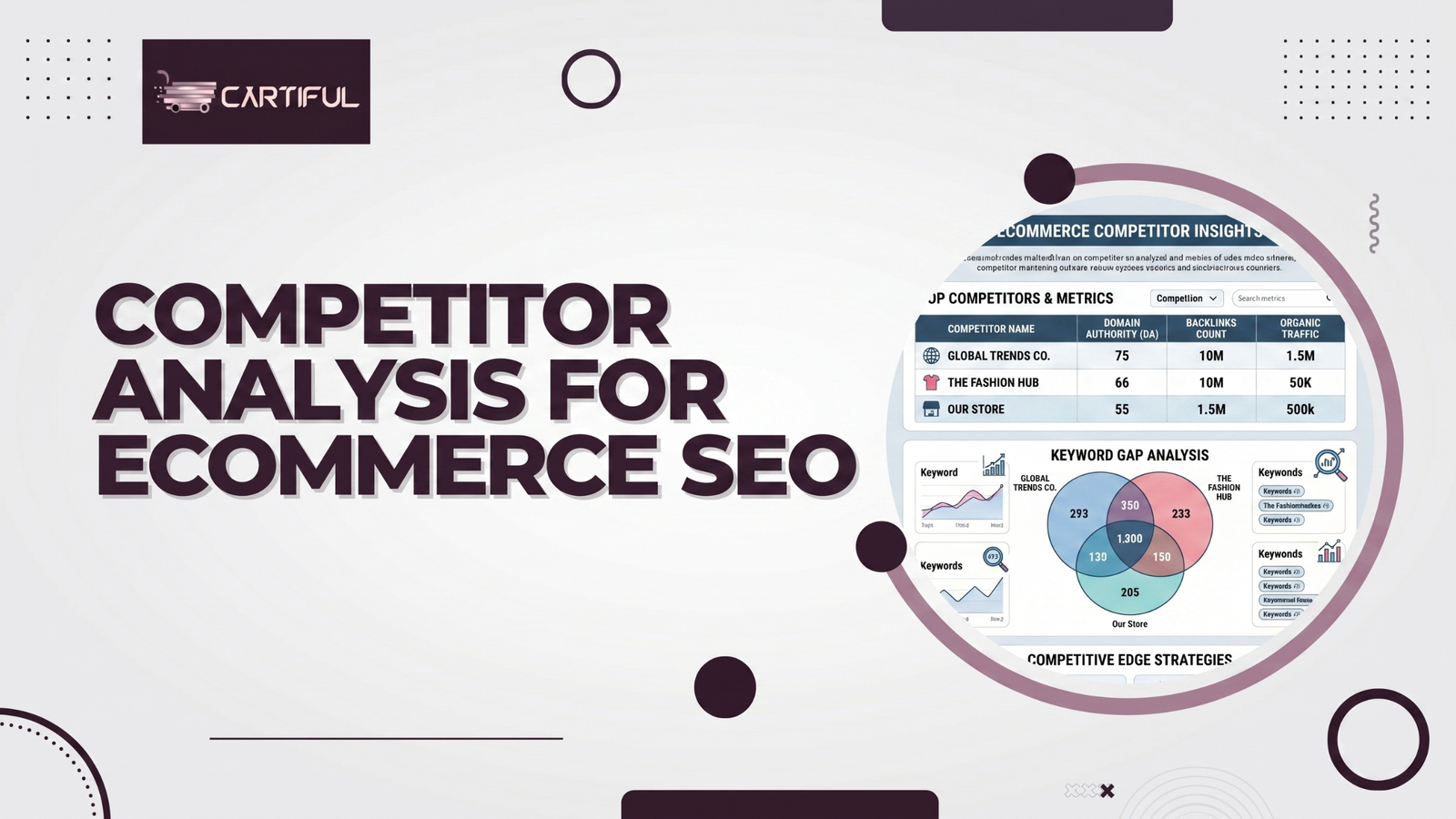
In many cases, competitors are simply doing a better job of aligning their content, structure, and technical setup with how search engines evaluate ecommerce websites. Competitor analysis for ecommerce SEO helps store owners understand why competitor websites rank higher, what strategies they use, and where realistic opportunities exist to improve search engine rankings.
When done properly, competitor analysis turns SEO from guesswork into a focused and measurable growth strategy.
What Is Competitor Analysis for Ecommerce SEO?
Competitor analysis in ecommerce SEO is the process of evaluating other online stores that compete for the same keywords, customers, and organic visibility.
It focuses on how competitor websites perform across:
- search engine results and SERP features
- product pages and category pages
- content types and content structure
- backlink profiles and referring domains
- technical SEO and site performance
- user experience, page speed, and Core Web Vitals
The purpose is not to copy competitors.
The goal is to identify content gaps, keyword gaps, and structural weaknesses that prevent your ecommerce site from capturing organic traffic.
Why Competitor Analysis Matters for Ecommerce Store Owners
Search engine optimization for ecommerce is inherently competitive.
Every product category, listing page, and buying guide competes for limited visibility in search engine results. Competitor analysis helps ecommerce store owners understand what is realistically achievable in their niche markets and where their efforts will have the greatest impact.
A well-structured competitive analysis helps you:
- Identify competitor keywords that already generate traffic
- Understand search volume and keyword difficulty before investing
- Reveal content quality gaps that competitors have not addressed
- Benchmark domain authority and backlink profiles accurately
- Align SEO strategy with customer needs and buying intent
Without competitor analysis, many ecommerce SEO strategies rely on assumptions rather than data.
Types of SEO Competitors
Not every website competing for your keywords sells the same products. In ecommerce SEO, competitor analysis usually reveals three main types of SEO competitors. Understanding these categories helps store owners evaluate rankings more accurately and avoid comparing the wrong sites.
Direct competitor
Direct competitors are other ecommerce stores selling similar products to the same audience.
For example,
If your store sells running shoes, direct competitors might include brands such as Nike, Adidas, or other niche athletic stores ranking for queries such as:
- best running shoes for marathon training
- lightweight running shoes
- men’s trail running shoes
These stores compete directly for product and category page rankings.
Marketplace competitor
Large marketplaces often rank for ecommerce queries because of their strong domain authority and large product catalogs.
Common marketplace competitors include:
- Amazon
- eBay
- Walmart Marketplace
- regional marketplaces such as Daraz
For example,
A search for “wireless earbuds” may show product pages from Amazon or Daraz above independent ecommerce stores.
While these competitors are difficult to outrank broadly, they still provide useful signals about:
- product page structure
- schema implementation
- review integration
Publisher competitor
Publisher competitors are informational websites that rank for research queries related to products.
Examples include:
- buying guide blogs
- review websites
- affiliate comparison pages
- media publishers such as TechRadar or Wirecutter
For example,
For the query “best budget gaming laptop”, Google may rank:
- review sites
- comparison articles
- buying guides
instead of ecommerce stores.
In these situations, ecommerce brands often need supporting content such as buying guides or comparison pages to compete effectively.
Identifying Your Real SEO Competitors
Your SEO competitors are not always your direct business competitors.
Some stores compete on branding or pricing, but never appear in organic search results. Others dominate search engine rankings despite having a smaller market presence.
To identify real SEO competitors, start by searching your core product and category keywords in Google. Pay attention to which domains appear consistently across multiple searches.
You can validate these findings using tools such as Semrush’s Organic Research, which shows keyword overlap, visibility index, and estimated organic traffic across competitor websites.
Your true ecommerce SEO competitors are the sites that repeatedly rank for the keywords you want to own.
Understanding Search Intent Before Analysis
Before comparing competitors, it’s important to understand search intent.
Search intent explains why a user performs a query, and it shapes how Google evaluates relevance. In ecommerce SEO, most queries fall into three main intent types:
- transactional searches focused on purchasing
- commercial searches comparing products or brands
- informational searches supporting buying decisions
Competitor analysis should always compare pages with similar intent. Comparing a blog post to a product listing often leads to misinterpretation of rankings and performance.
Competitor Research Tools
Competitor analysis becomes much easier with the right SEO tools. These tools help ecommerce store owners see which keywords competitors rank for, where their backlinks come from, and which pages drive the most traffic.
Below are commonly used tools for ecommerce SEO competitor research.
-
Semrush
Semrush offers several features that help identify competitors and analyze their rankings.
Key tools include:
- Organic Research to identify competitor domains
- Keyword Gap to find keywords competitors rank for but your store does not
- Backlink Analytics to review referring domains
- Traffic Analytics to estimate traffic sources
For example, using Semrush’s Keyword Gap tool, a store selling fitness equipment can compare its domain with competing stores and quickly identify missing keyword opportunities.
-
Ahrefs
Ahrefs is widely used for backlink and keyword research.
Useful features include:
- Site Explorer to view competitor keyword rankings
- Content Gap to identify missing keywords
- Link Intersect to find backlink opportunities
- Top Pages report to see which competitor pages drive the most traffic
Many ecommerce teams use Ahrefs to understand how competitors earn backlinks and which pages attract the most organic visibility.
-
Google SERPs
Many useful insights come directly from Google search results.
Searching your main product or category keywords shows:
- which domains rank consistently
- which content formats appear most often
- whether Google favors product pages, guides, or comparisons
For example, if search results mainly show comparison guides, a basic product page may struggle to rank.
-
Google Search Console
Google Search Console helps store owners review their own search performance.
By analyzing search queries and impressions, you can identify:
- keywords where competitors rank higher
- pages losing visibility
- opportunities to improve existing pages
Combining Search Console data with competitor tools helps store owners make better decisions about which pages and keywords to improve.
Step-by-Step Competitor Analysis Workflow
A simple workflow helps ecommerce store owners turn competitor research into practical SEO improvements. The steps below outline a clear process for analyzing competitors and identifying opportunities.
Step 1: Identify competitors
Start by listing websites that appear consistently when you search your main product and category keywords.
For example, if you sell home espresso machines, competitors might include:
- specialty coffee equipment stores
- large appliance retailers
- review or comparison sites
Focus on domains that appear across several related searches.
Step 2: Map keywords
Next, review which keywords competitors rank for and which pages target those keywords.
Common keyword groups include:
- category page keywords
- product-level searches
- informational queries
- product comparison queries
Tools such as Semrush or Ahrefs can help identify overlapping keywords between your store and competitor sites.
Step 3: Compare key pages
Review the pages competitors use to rank for important keywords.
Look at factors such as:
- page structure
- depth of product or category content
- internal links
- structured data (schema markup)
- customer reviews
For example,
A competitor category page ranking for “best office chairs” may include product comparisons, FAQs, and buying tips, while your page might only show product listings.
Step 4: Analyze backlinks
Backlinks help search engines understand which sites are trusted sources.
When reviewing competitor backlinks, focus on:
- referring domains linking to their site
- editorial mentions or reviews
- industry blogs and publications
- partnerships or supplier links
This helps reveal how competitors build authority within their niche.
Step 5: Prioritize opportunities
The final step is deciding which improvements will have the most impact.
Common priorities include:
- expanding thin product or category pages
- fixing technical SEO issues
- creating missing buying guides or comparisons
- improving internal links between pages
Focusing on these actions helps store owners move from analysis to meaningful improvements.
Keyword Gap Analysis: Finding Missed Opportunities
Keyword gap analysis highlights keywords that competitors rank for, but your ecommerce store does not. This process helps store owners avoid guessing which keywords to target and instead focus on terms with proven demand.
For ecommerce SEO, the most valuable keyword gaps often include:
- long-tail product and category keywords
- comparison-based queries
- modifiers related to size, use case, or pricing
- keywords triggering SERP features
These keywords usually align closely with the customer journey and conversion intent.
Content Gap Analysis for Ecommerce SEO
Content gap analysis goes beyond keywords to examine how effectively competitors address customer needs.
High-ranking ecommerce sites often publish content that clearly explains products, addresses objections, and supports purchase decisions. Google reinforces this approach in its guidance on creating helpful, people-first content.
When reviewing competitor content, look at:
- depth and clarity of product descriptions
- buying guides and comparison pages
- FAQ coverage on product and category pages
- use of visual elements and UGC photos
Content quality gaps usually present faster opportunities than chasing entirely new keywords.
Competitor Content Strategy Analysis
Competitor analysis should also look at how other stores create and publish content. Reviewing their content strategy can help explain why certain sites maintain strong organic visibility.
How often competitors publish content
Many ecommerce brands publish content regularly to support product discovery and buying research.
Competitors may publish:
- blog posts
- seasonal buying guides
- product comparison articles
For example,
A skincare store might publish a guide such as “best moisturizers for winter” before the colder months.
Publishing useful content around seasonal demand can help attract search traffic when customers are researching products.
Types of content formats used
Competitor content often appears in several formats, including:
- buying guides
- product comparison pages
- tutorials
- product reviews
- educational blog posts
Different formats help capture search traffic at different stages of the buying process.
For example, comparison pages targeting queries such as “Brand A vs Brand B” often attract shoppers who are close to making a purchase decision.
Coverage of buying guides and comparisons
Buying guides help customers understand product differences before purchasing.
Common formats include:
- “best product” lists
- category comparisons
- feature breakdowns
- recommendations based on use cases
As an example:
An outdoor gear store might publish a guide such as “Best Hiking Backpacks for Multi-Day Trips.”
These guides can attract search traffic while linking naturally to related product pages.
Evaluating Competitor Product Pages
Product pages are central to ecommerce SEO performance.
Competitor analysis should review how top-ranking stores structure their product pages and listings. This includes examining:
- title tags and meta descriptions
- header tags and content hierarchy
- internal linking to related products
- use of structured data and schema markup
Google explains how product structured data supports enhanced results, such as rich snippets, which can improve how product pages appear in search results. Competitors that implement structured data correctly often see higher click-through rates, even when their actual search rankings remain unchanged.
Example: Comparing a Competitor Product Page
To understand how competitor analysis works in practice, compare one of your product pages with a top-ranking competitor.
For example, imagine a store selling running shoes competing with a well-known brand page.
A competitor product page might include:
- detailed product description explaining cushioning, materials, and performance benefits
- structured headings that make the page easy to scan
- customer reviews and ratings visible in search results through schema markup
- internal links to related running shoes and collections
Your product page might currently have:
- a short description copied from the manufacturer
- limited product details or sizing guidance
- no customer reviews or schema markup
- weak internal links to other products
This comparison quickly reveals why the competitor page may rank higher. Expanding product descriptions, improving page structure, adding reviews, and strengthening internal linking can often close ranking gaps faster than targeting entirely new keywords.
Technical SEO Comparison
Technical SEO often explains differences in rankings among similar ecommerce stores.
Competitors that rank well typically meet baseline technical standards for crawlability, site architecture, and page speed. Google measures many of these factors through Core Web Vitals, which assess loading performance, interactivity, and visual stability.
Google also outlines technical SEO fundamentals in its SEO Starter Guide, making it clear that when competitor websites load faster and are easier to crawl, content improvements alone may not be enough to close ranking gaps.
Competitor Backlink Strategy Analysis
Backlink analysis should focus on how competitors earn links from other websites.
Understanding these patterns helps ecommerce store owners identify realistic link opportunities.
Where competitor links come from
Competitor backlinks often come from sources such as:
- product reviews from bloggers
- partnerships with industry websites
- guest articles
- media mentions
- supplier or manufacturer directories
Referring domain patterns
Reviewing referring domains helps identify which types of websites commonly link to stores in your niche.
Competitors may receive links from:
- niche blogs
- online publications
- ecommerce directories
- educational resources
Recognizing these patterns helps store owners focus on link sources that are relevant to their industry.
Replicable link opportunities
Some competitor links, such as large media coverage, may be difficult to replicate. However, many backlinks come from sources that other stores can realistically pursue.
Examples include:
- supplier or manufacturer listings
- partnership directories
- niche guest articles
- industry resource pages
Identifying these opportunities helps make link building more practical and focused.
Backlink Profile and Link Building Analysis
Competitor backlink profiles show how authority is built within your niche and which sites influence search engine rankings. Using Semrush’s Backlink Checker, store owners can review referring domains, backlink gaps, and historical link growth.
This analysis helps identify link-building techniques that work in your industry and avoid low-quality or irrelevant backlinks.
Internal Linking Strategy Comparison
Internal linking plays a key role in distributing authority across ecommerce websites.
Competitor analysis should examine:
- how category pages link to product pages
- use of descriptive anchor text
- connections between blogs and commercial pages
- crawl depth from the homepage
A strong internal linking strategy improves indexing and search visibility without requiring new backlinks.
SERP Features, Structured Data, and Entity SEO
Modern search results extend beyond traditional blue links.
As part of competitor analysis, it’s important to review SERP features such as rich snippets, FAQs, and product enhancements. Competitors who implement structured data correctly often benefit from increased visibility, improved click-through rates, and stronger entity recognition within Google’s Knowledge Graph, even without major content changes.
For ecommerce stores, this can translate into measurable ranking improvements without publishing new content.
Traffic Sources and Channel Overlap
Strong ecommerce SEO performance is rarely isolated.
Competitor analysis should account for how stores combine organic traffic with paid search ads, social media, and brand campaigns. Reviewing ad history and paid keyword overlap helps explain sudden ranking improvements during seasonal campaigns.
Google provides transparency around ad data and campaign behavior through its advertising documentation.
Turning Insights Into an SEO Strategy
Competitor analysis only delivers value when insights are translated into action.
Long-term SEO success depends on creating helpful content, maintaining strong technical foundations, and building trust over time. For ecommerce stores, this means focusing on changes that improve how search engines understand the site and how users experience it, rather than chasing quick wins.
For ecommerce store owners, the most effective approach is prioritizing:
- high-impact content gaps
- technical SEO fixes affecting performance
- internal linking improvements
- realistic link-building opportunities
Execution matters more than over-analysis.
Competitor Analysis Summary: Key SEO Gaps and Opportunities
| Area | Your Store | Top Competitor | SEO Opportunity |
| Product Page Depth | Thin descriptions | Detailed pages | Expand descriptions |
| Backlink Profiles | Few links | Strong authority | Target niche links |
| Page Speed | Average | Fast | Improve Core Web Vitals |
| Content Gaps | Missing guides | Full coverage | Create buying guides |
| Structured Data | Limited | Advanced | Add schema markup |
Conclusion: Turning Competitor Analysis Into Sustainable Ecommerce SEO Growth
Competitor analysis for ecommerce SEO helps store owners make more informed decisions about content strategy, technical improvements, internal linking, and link-building priorities.
When applied consistently, competitor analysis becomes more than a one-time SEO task. It helps e-commerce store owners make informed decisions on content strategy, technical SEO, internal linking, and link-building, while staying aligned with real customer needs and search intent.
At Cartiful, competitor analysis is treated as a core input across ecommerce SEO, paid growth, and content decisions. This ensures marketing efforts stay focused on actions that improve visibility, performance, and long-term growth rather than chasing isolated tactics.
FAQs: Competitor Analysis for Ecommerce SEO
1. How often should ecommerce stores run competitor analysis for SEO?
Most e-commerce stores should run competitor analysis every three to six months. This helps track changes in search engine rankings, competitor keywords, backlink profiles, and content strategy without reacting to short-term fluctuations.
2. What is the difference between competitor analysis and SEO competitor analysis?
Competitor analysis looks at overall business factors such as pricing and marketing efforts. SEO competitor analysis focuses on search engine rankings, keywords, backlinks, technical SEO, and organic traffic sources.
3. Which tools are best for ecommerce SEO competitor analysis?
Commonly used tools include Semrush’s Organic Research, Keyword Gap, and Backlink Analytics, along with Google Search Console and Google PageSpeed Insights for site performance and visibility analysis.
4. How do I find my real SEO competitors in ecommerce?
Your real SEO competitors are the websites that consistently rank for your product pages and category keywords in search engine results, even if they are not direct business competitors.
5. What is keyword gap analysis in ecommerce SEO?
Keyword gap analysis identifies competitor keywords your e-commerce store does not rank for, including long-tail and product-focused terms with commercial intent and measurable search volume.
6. Why is content gap analysis important for e-commerce SEO?
Content gap analysis reveals where competitors provide better product descriptions, buying guides, FAQs, or content structure, helping you improve relevance and content quality without chasing new keywords.
7. How do backlinks affect e-commerce SEO competitor analysis?
Backlink profiles influence domain authority and search engine rankings. Analyzing competitor backlinks helps identify relevant referring domains and effective link-building opportunities within your niche.
8. Should e-commerce stores copy competitor product pages or content?
No. Competitor analysis should guide improvements in content depth, structure, and user experience, not duplication. Search engines reward original, helpful content aligned with customer needs.
9. How does technical SEO factor into competitor analysis?
Technical SEO explains ranking differences through factors such as Core Web Vitals, page speed, site architecture, internal linking, XML sitemaps, and canonical tags that affect crawlability and performance.
10. Can competitor analysis help improve conversions as well as rankings?
Yes. Studying competitor product pages and user experience often reveals improvements that support both conversion rate optimization and stronger e-commerce SEO performance.
Abbas Feedback:
- I’m repurposing it into a guide
- Follow the headings hierarchy below and create content for the missing sections, higjlighted in bold and with some quick overview
- If you think there is some repetition, remove that part
- Also, try to add relevant examples, wherever applicable
Here are the updated sections
What Is Competitor Analysis for Ecommerce SEO
Why Competitor Analysis Matters for Ecommerce Store Owners
Types of SEO Competitors
- Direct competitor
- Marketplace competitor
- Publisher competitor
Identifying Your Real SEO Competitors
Understanding Search Intent Before Analysis
Competitor Research Tools
- Semrush
- Ahrefs
- Google SERPs
- Google Search Console
Step-by-Step Competitor Analysis Workflow
- Identify competitors
- Map keywords
- Compare key pages
- Analyze backlinks
- Prioritize opportunities
Keyword Gap Analysis: Finding Missed Opportunities
Content Gap Analysis for Ecommerce SEO
Competitor Content Strategy Analysis
- How often competitors publish content
- Types of content formats used
- Coverage of buying guides and comparisons
Evaluating Competitor Product Pages
Technical SEO Comparison
Competitor Backlink Strategy Analysis
- Where competitor links come from
- Referring domain patterns
- Replicable link opportunities
Backlink Profile and Link Building Analysis
Internal Linking Strategy Comparison
SERP Features, Structured Data, and Entity SEO
Traffic Sources and Channel Overlap
Turning Insights Into an SEO Strategy
Competitor Analysis Summary: Key SEO Gaps and Opportunities
Conclusion
FAQs