Most ecommerce stores don’t have a content problem. They have a structural problem.
Blog posts get published, guides are written, and category pages exist. But to search engines, everything looks disconnected.
Google Search, AI-driven search results, and large language models don’t just read pages. They look for patterns, relationships, and intent. Google explains this process in detail in its documentation on how Google Search understands and organizes content.
If your content doesn’t clearly show what your store is about and how related topics connect, search engines struggle to understand your site’s expertise. Rankings become unstable, and pages often compete with each other instead of strengthening the overall topic.
This is where content clustering helps by organizing related pages into a clear, structured topic ecosystem.
This guide explains how content clustering works for ecommerce SEO, why it matters for search visibility, and how store owners can use it to build stronger topical authority and consistent organic growth.
Why Ecommerce Content Often Fails to Rank
Traditional ecommerce content usually grows reactively.
A store owner publishes a blog because a keyword looks promising, a competitor ranks for it, or traffic dropped last month.
Over time, this results in dozens of pages that don’t communicate with one another.
Search engines see overlapping topics, mixed intent, weak internal links, and no clear authority signal. This directly conflicts with Google’s guidance on creating genuinely useful, intent-driven content, as outlined in its documentation on helpful content and search intent.
Users feel this too. They land on one article, get partial answers, and leave.
Content clusters address this by providing both users and search engines with a clear content map.
What Are Content Clusters?
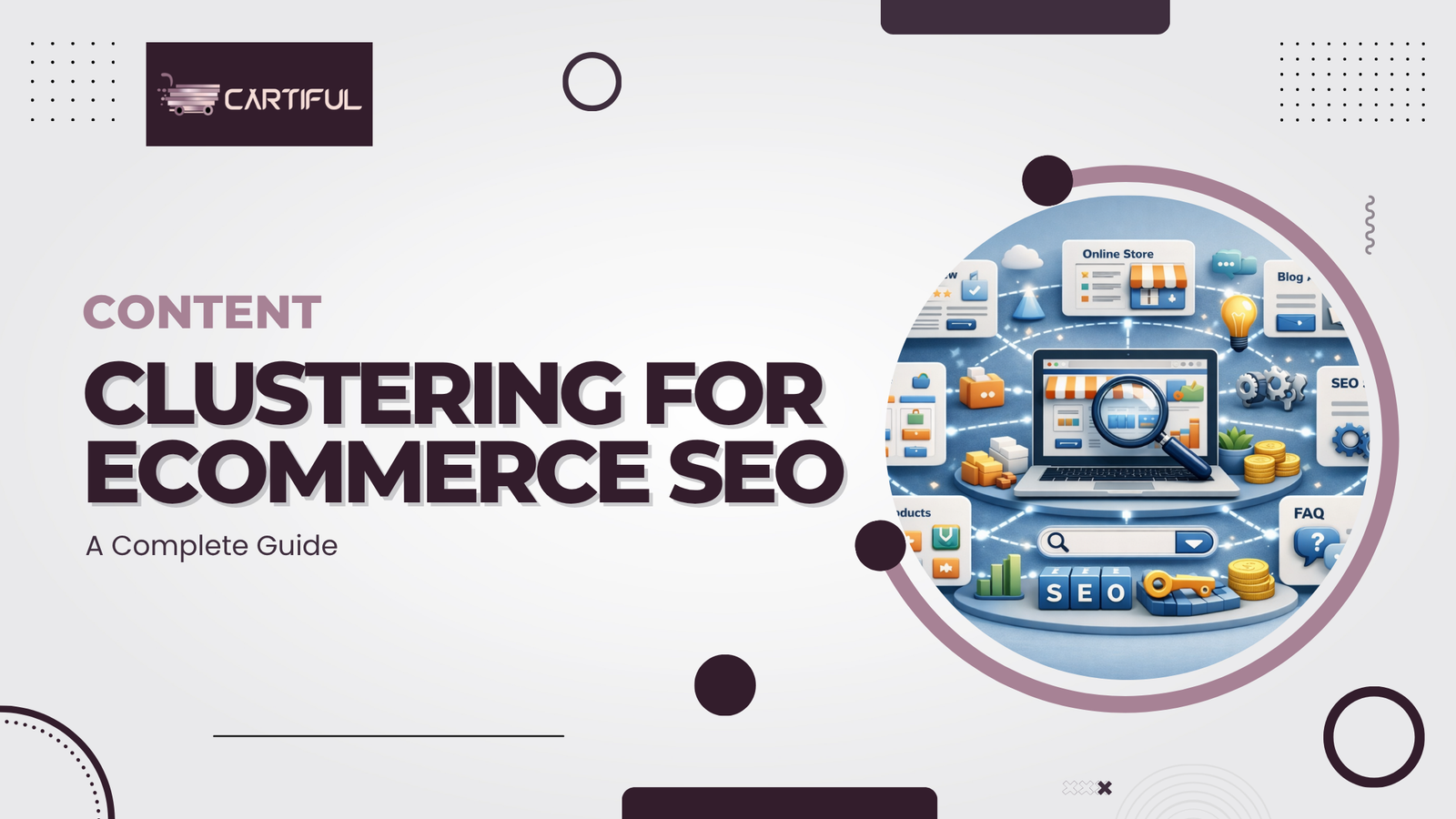
A content cluster is a group of pages built around one main topic.
At the center is a pillar page. This page explains the main topic clearly and broadly. Supporting it are cluster pages, each focused on one specific subtopic, question, or use case.
Every page links to related pages using natural internal linking. This concept is often referred to as the topic cluster model, which was originally popularized as a way to structure content around meaning rather than isolated keywords.
This creates clearer navigation, stronger topical signals, better user flow, and more consistent rankings.
Instead of ranking single pages, you start ranking topics.
What a Pillar Page Is and Why It Matters
A pillar page is not a long blog stuffed with keywords. It’s a reference page.
For ecommerce, pillar pages often cover topics such as ecommerce SEO basics, product page optimization, paid ads for ecommerce, and content marketing for online stores.
The goal is not to answer everything in detail. The goal is to introduce the topic and guide readers to deeper pages that address specific questions.
Cluster Pages: Where Rankings Actually Grow
Cluster pages do the heavy lifting. Each cluster page focuses on a clear search intent, a specific long-tail query, and one problem or decision stage.
Examples for ecommerce SEO include optimizing category pages, internal linking for product pages, handling duplicate content, or creating content for marketplaces like Amazon or Daraz.
These pages attract targeted traffic and feed authority back to the pillar page through internal links, which play a key role in how pages are discovered and understood.
Topic Modeling: The Missing Layer Most Stores Ignore
Content clusters show structure. Topic modeling explains meaning.
Topic modeling examines how search engines group queries by context rather than wording. Google doesn’t treat “ecommerce SEO tips,” “how to rank product pages,” and “online store search visibility” as separate ideas. They are semantically connected.
This approach aligns closely with how Google interprets language through natural language processing and semantic understanding, as the company has explained in detail in its description of how Google interprets search queries as humans do.
Topic modeling helps you plan content the way search engines already understand it.
Why Topic Modeling Matters More Now
Search engines rely heavily on semantic search, natural language processing, machine learning, and passage-level retrieval.
Google has confirmed that it can rank individual sections within a page, not just the page as a whole, through what it calls passage-level ranking.
AI-driven search systems summarize topics, not just pages. If your content only answers one narrow query, it gets ignored. If your content ecosystem covers the full topic, it gets trusted.
This is how smaller ecommerce stores compete with larger sites.
How Content Clusters Improve Ecommerce SEO Results
Clearer Signals for Search Engines
When pages are internally linked around a topic, search engine crawlers understand relevance faster. This improves indexing, crawl efficiency, and keyword coverage.
You can often see this effect directly inside Google Search Console, where impressions start appearing across related queries instead of a single keyword.
Better User Experience for Shoppers
Content clusters guide visitors naturally.
A shopper researching may start with informational, move to comparisons, and then land on product or category pages. This lowers bounce rates and improves engagement.
These engagement signals are measured using platforms like Google Analytics 4, which track how users interact with content across sessions via GA4 engagement metrics.
Stronger Topical Authority
Topical authority isn’t about publishing more. It’s about covering the right topics completely.
When your store consistently answers related questions, trust builds over time. This is especially important for ecommerce niches where buyers conduct extensive research before purchasing.
Content Clusters vs Random Blog Posting
| Random Content | Content Clusters |
| One-off blog posts | Structured content ecosystem |
| Keyword-driven | Intent-driven |
| Weak internal links | Strategic internal linking |
| Short-term traffic | Long-term authority |
This difference plays a major role in how stable and predictable your organic traffic becomes over time.
How Ecommerce Stores Should Build Content Clusters
Step 1: Audit Existing Content
Before writing anything new, review what already exists.
Use Google Search Console to find pages with impressions but low clicks, overlapping topics, and outdated articles. Most stores already have cluster content without realizing it.
Step 2: Define Your Core Content Pillars
Choose topics directly tied to how your store makes money.
Good pillars support product discovery, influence purchase decisions, and attract consistent search demand. Avoid broad marketing topics that don’t connect to ecommerce outcomes.
Step 3: Map Topics Using Search Intent
Keyword research is not just about search volume.
Look for long-tail terms, comparison queries, “how to” searches, and problem-based questions. Tools like Google Trends can help validate whether interest in a topic is growing or declining over time.
This creates a topic map that reflects how shoppers think.
Step 4: Create Cluster Pages With Purpose
Each cluster page should answer one main question, go deeper than the pillar page, link back to the pillar naturally, and link to related cluster pages where helpful.
Avoid repeating the same content across pages. Depth builds trust.
Step 5: Use Internal Linking Strategically
Internal links should feel helpful, not forced.
Use anchor text that explains what the linked page is about. Avoid generic phrases. Strong internal linking improves crawl paths, topic clarity, and user navigation.
Example: Content Cluster for a Sports Shoe Ecommerce Store
Imagine an online store called ActiveStride that sells running shoes, training sneakers, and lifestyle sports footwear. Instead of publishing random blog posts, the store builds a cluster around a high-value topic that connects directly to its products.
Pillar Page
Running Shoes Buying Guide
This page explains everything someone should know before buying running shoes: cushioning types, stability vs neutral shoes, how running shoes differ from training shoes, and how to choose the right pair. It introduces the topic broadly and links to deeper guides.
Cluster Pages
Best Running Shoes for Beginners
Helps new runners choose their first pair. Links to beginner-friendly products.
How to Choose the Right Running Shoe for Your Foot Type
Explains pronation, arch types, and stability shoes.
Running Shoes vs Training Shoes: What’s the Difference?
Comparison guide that helps users understand which shoe fits their activity.
Best Sneakers for Gym Workouts
Targets gym-related searches and links to training shoes.
How Long Do Running Shoes Last?
Educational content that also encourages replacement purchases.
Best Running Shoes for Flat Feet
Targets a high-intent long-tail query tied to product recommendations.
How to Clean Running Shoes and Sneakers
Maintenance content that builds topical depth.
Best Shoes for Treadmill Running
Specific use-case query tied to product collections.
Commercial Pages That Connect to the Cluster
These are actual store pages that benefit from the informational content.
- Running Shoes Collection
- Men’s Running Shoes
- Women’s Running Shoes
- Gym Training Shoes
- Lifestyle Sneakers
Cluster articles link naturally to these pages when recommending products.
Example:
- “Best Running Shoes for Beginners” links to the Running Shoes Collection.
- “Running Shoes vs Training Shoes” links to Gym Training Shoes and Running Shoes.
- “Best Running Shoes for Flat Feet” links to filtered products designed for stability.
How the Internal Linking Works
The pillar page links to every cluster article.
Each cluster article links back to the pillar page and to relevant product collections.
Some cluster articles link to each other when topics overlap.
Example flow:
Running Shoes Buying Guide
→ links to Best Running Shoes for Beginners
Best Running Shoes for Beginners
→ links to Running Shoes Collection
Running Shoes vs Training Shoes
→ links to Gym Training Shoes
Best Running Shoes for Flat Feet
→ links to Stability Running Shoes Collection
What This Achieves
Search engines see a clear topical structure around running footwear.
Instead of ranking one article for a single keyword, the store starts appearing for dozens of related searches such as:
- best running shoes for beginners
- running shoes for flat feet
- running vs training shoes
- how long do running shoes last
- best treadmill running shoes
Every one of those searches can eventually lead to a product page or category page.
That’s the real purpose of content clusters in ecommerce: not just ranking articles, but guiding shoppers from research to purchase.
Measuring Success From Content Clusters
Measuring content clusters is about tracking steady improvements in visibility and engagement, not instant ranking jumps.
Track progress using:
- Google Search Console for query coverage
- Google Analytics 4 for engagement
- internal linking analysis
- rankings across topic groups
Results take time, but they tend to last. Well-structured content clusters build momentum instead of short-term spikes.
Common Mistakes Ecommerce Stores Make
Most content clusters fail due to small structural mistakes, not because the strategy itself is flawed.
Some common mistakes include:
- Creating pillar pages without supporting content
- Writing cluster pages without internal links
- Ignoring search intent
- Chasing high search volume keywords only
- Publishing without a content brief
- Letting content grow without governance
Strong writing alone isn’t enough. Without clear structure, intent alignment, and ongoing content governance, even well-written pages struggle to deliver consistent SEO results.
How Content Clusters Support Sales, Not Just Traffic
Content clusters guide shoppers through decisions.
They reduce confusion, answer objections early, and build trust before a product page is even visited. For e-commerce stores, this results in higher-qualified traffic, higher conversion rates, and stronger brand recall.
Final Takeaway
Content clustering helps ecommerce stores move from scattered content to a clear, structured system that supports long-term growth.
They make your site easier to understand, easier to navigate, and easier to trust. For store owners who want consistent organic traffic instead of temporary spikes, this approach is no longer optional.
FAQs:
What is a content cluster in ecommerce SEO?
A content cluster is a structured group of related pages built around a single topic. It connects pillar content with supporting cluster content through internal links, helping search engines understand context while strengthening visibility and authority.
Are content clusters only for blogs?
No. Product guides, category pages, FAQs, and other related articles can all be part of a topic cluster. This approach works across your entire website content, not just blog posts.
How many cluster pages should one pillar have?
There’s no fixed number. A strong topic cluster strategy focuses on fully covering the subject and matching User Intent, rather than hitting an arbitrary page count.
Do content clusters help AI search results?
Yes. Clear structure and semantic relationships make it easier for AI-driven systems to understand and summarize your content accurately, improving visibility beyond traditional search results.
Can small ecommerce stores use content clusters?
Absolutely. Content clusters help smaller stores compete in search engine optimization by building topic authority through relevance and depth, instead of relying on high publishing volume.
How long does it take to see results?
Most ecommerce sites start seeing improvements in search rankings and user engagement within three to six months, as content relationships become clearer to search engines.
Should product pages be part of clusters?
Yes, when used thoughtfully. Linking product pages from informational content using clear anchor text helps guide users and supports conversion-focused content marketing.
Is topic modeling the same as keyword research?
No. Keyword research identifies terms, while topic modeling connects meaning. It supports a broader content strategy by organizing topics by intent rather than individual phrases.
Do content clusters replace backlinks?
No. Backlinks still matter in digital marketing, but content clusters improve how authority flows internally, making external links more effective when they’re earned.
Is this approach future-proof?
Yes. Content clusters align with how modern search engines evaluate usefulness, intent, and structure, making them a reliable long-term strategy for reaching the right target audience.