Skip to content
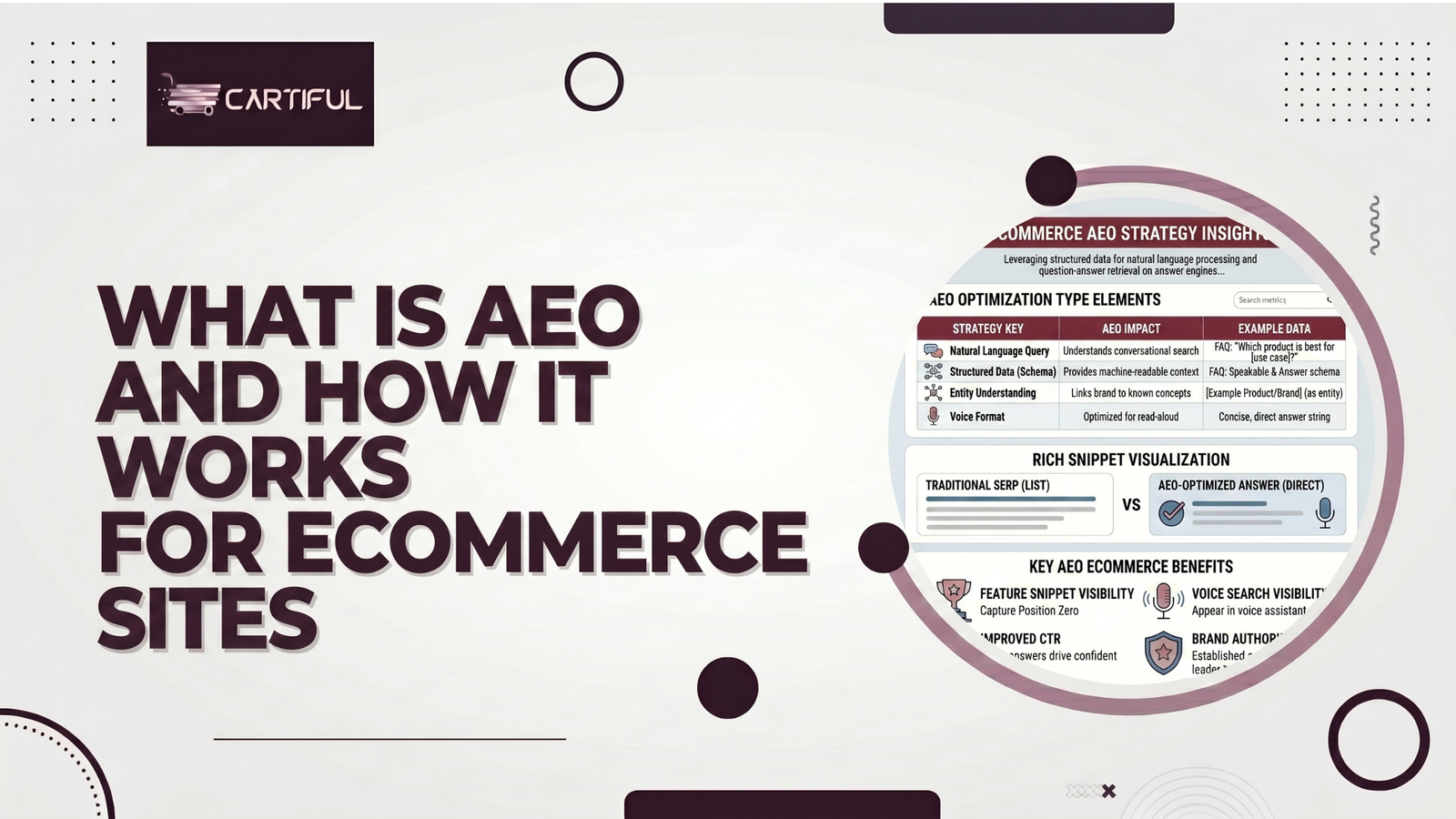
AEO usually stands for Answer Engine Optimization. In simple terms, it means shaping your site so AI-powered search experiences can understand your content, trust it, and use it when answering shopper questions. Industry sources like Ahrefs and CXL describe AEO as optimizing content so answer engines and AI systems can surface it directly in responses, not just rank it as a blue link.
For ecommerce sites, that makes AEO different from a standard SEO checklist. It is not only about ranking a product page for a keyword. It is also about helping AI-driven search features understand your products, categories, reviews, prices, availability, policies, and supporting content well enough to mention or cite your store when a shopper asks a detailed question. Google’s guidance on AI features says site owners should focus on helpful, satisfying content for people, while Google’s product structured data documentation shows that product information can appear in richer search experiences with price, availability, shipping, and review details.
For ecommerce brands, this matters now because Google has expanded AI search experiences such as AI Overviews and AI Mode, and its shopping experiences are increasingly tied to the Shopping Graph and merchant product data. Google says AI Mode shopping uses the Shopping Graph, which includes more than 50 billion product listings, with 2 billion updated every hour. Google also says AI Overviews began rolling out broadly in 2024 and later expanded further with AI Mode.
At Cartiful, the practical way to think about AEO is this: SEO helps your store rank. AEO helps your store become a usable source for AI-generated answers and shopping recommendations.
Quick answer
For ecommerce sites, AEO works best when your store makes product and category information easy for machines to read and easy for shoppers to trust.
That usually means:
- clear product and category pages built around real shopper questions
- clean product schema and merchant listing markup
- strong review and pricing signals
- helpful comparison, FAQ, and buying-guide content
- accurate product data through Merchant Center
- internal linking that connects informational content to commercial pages
- content written in a format that can be extracted, summarized, and cited more easily. Google’s AI-search guidance emphasizes unique, satisfying content, while Google’s product and merchant listing docs emphasize structured product data, accurate offers, and merchant-ready commerce details.
What AEO means in ecommerce
AEO is often described as the practice of improving your visibility in AI-generated answers rather than only in traditional search listings. Ahrefs defines it as making content visible and useful to AI systems that deliver direct answers, and Semrush describes it as increasing brand visibility in AI-generated answers.
For ecommerce, that usually shows up in three ways:
1. AI-assisted search answers
A shopper asks a question like “What are the best waterproof hiking shoes for flat feet?” and an AI search feature summarizes options, cites sources, and may mention or link products or category pages. Google says users in AI search experiences are asking longer, more specific, and follow-up questions, which is exactly the kind of behavior ecommerce sites need to prepare for.
2. Richer shopping experiences
Google’s product documentation says product structured data can support richer product appearances in Search, Images, and Lens, including price, availability, shipping, and review ratings. Its merchant listing guidance focuses on buyable product pages and commerce-ready product details.
3. AI shopping interfaces
Google says AI Mode shopping combines Gemini capabilities with the Shopping Graph to help users browse, compare, and narrow product choices. Shopify also notes that Perplexity Shopping works through conversational product discovery, which shows that answer-style shopping is expanding beyond traditional search results.
How AEO is different from traditional ecommerce SEO
Traditional SEO is mostly about helping a page rank in search results and earn clicks. Google’s SEO starter guide frames SEO as helping search engines understand your content and helping users decide whether they should visit your site through search.
AEO adds another layer. Instead of optimizing only for a click to your page, you are also optimizing to be:
- cited in an AI-generated answer
- summarized accurately
- included in a comparison or recommendation set
- visible in AI-assisted product discovery. Industry sources like Ahrefs and Semrush describe this shift clearly: SEO aims at rankings and clicks, while AEO aims at answer visibility and citations in AI systems.
That does not mean SEO stops mattering. Google’s AI features guidance says the same core advice still applies: focus on unique, useful content that satisfies visitors. In practice, strong AEO for ecommerce sits on top of strong SEO, not instead of it.
How AEO actually works for ecommerce sites
AEO works when AI systems can do four things reliably with your store:
Understand what you sell
Google uses structured data to understand content on a page, and its product documentation says product markup helps Google understand and display product details more richly. Merchant Center also says product data is used to match products to the right queries.
Trust the data
Google’s structured data policies say markup must match visible page content and follow technical and quality guidelines. Merchant Center says inaccurate product data can cause display issues or disapprovals.
Find the right page for the right query
Google’s ecommerce structure and crawlable-link documentation make clear that internal links, hierarchy, and crawlable navigation shape how Google finds and understands pages.
Extract a clear answer
Google’s AI search guidance says its systems reward content that is unique, non-commodity, and satisfying for users. For ecommerce, that often means product pages alone are not enough. AI systems also need FAQs, buying guides, comparison pages, shipping pages, return policy pages, and other supporting content that answers the questions shoppers actually ask.
The pages that matter most for ecommerce AEO
AEO on ecommerce sites is rarely about one page type. It is usually spread across a few key assets.
1. Product pages
Product pages are the most obvious AEO assets because they hold the core product facts AI systems need:
- product name
- images
- price
- availability
- variants
- reviews
- shipping details
- return information. Google’s product structured data documentation explicitly lists these kinds of fields as part of richer product experiences.
If a shopper asks a direct buying question, such as “Which waterproof hiking jacket has the best reviews under $150?”, product pages and merchant data become central.
2. Category and collection pages
Category pages help with broader commercial intent such as:
- best trail running shoes
- leather sectional sofas
- organic skincare sets
- gaming laptops under $1,000
These pages often work better for comparison-style or discovery-style queries than individual PDPs do. Google’s ecommerce structure guidance also makes category and subcategory pages central to product discovery and crawling.
3. Buying guides and comparison pages
These are often the strongest AEO assets for upper- and mid-funnel ecommerce questions because they are naturally suited to direct answers, tradeoffs, and category education. Google says people in AI search experiences ask longer and more specific questions, often with follow-ups. That maps closely to comparison content, “best for” content, use-case pages, and FAQ-driven guides.
Examples:
- best office chairs for back pain
- what size dehumidifier do I need for a basement
- trail running shoes vs hiking shoes
- how to choose the right serum for dry skin
4. Policy and trust pages
Shipping, returns, warranty, and business information matter more in AI-assisted shopping than many stores assume. Google’s merchant listing and policy docs support shipping and return markup, and Merchant Center uses product and merchant data to power shopping experiences.
If your store wants to be trusted in AI-generated recommendations, policy clarity helps.
The foundations of AEO for ecommerce
1. Structured product data
This is one of the strongest technical foundations. Google’s product structured data docs say that when you add product markup, your product information can appear in richer ways in Search, Images, and Lens. The merchant listing docs are even more commerce-specific, focusing on Product plus Offer data for buyable pages. Google also added support for product variants and updated merchant listing documentation over time.
For AEO, this matters because it makes your store’s product facts more machine-readable.
At a minimum, ecommerce brands should make sure their key PDPs have:
- product schema
- offer schema
- review data where valid
- variant relationships where relevant
- accurate shipping and return details were supported. Google’s documentation supports all of these as part of modern product and merchant listing markup.
2. Merchant Center and product data quality
Merchant Center is not only for paid shopping. Google says Merchant Center can help promote products and Google uses merchant product data to match items to the right queries. Its 2022 merchant listings update also expanded eligibility for enhanced product experiences in Google Search through product structured data, beyond Merchant Center users alone.
For ecommerce AEO, product data quality matters because AI shopping systems need:
- accurate titles
- correct pricing
- real availability
- up-to-date images
- reliable identifiers like GTIN or MPN where applicable. Merchant Center’s product data specification is explicit about accuracy and formatting requirements.
3. Question-focused content architecture
Google’s AI search guidance says users are asking longer and more specific questions. That means ecommerce sites should not rely only on product titles and category templates. They also need content that answers the kinds of questions shoppers ask before buying.
For ecommerce, that usually means building content around questions like:
- what is the best option for a certain use case
- what size, material, model, or version to choose
- how two product types compare
- what matters before buying
- how shipping, sizing, setup, warranty, or compatibility works
This is where FAQs, buying guides, comparison pages, and product-advice content become useful AEO assets.
4. Review and trust signals
Google’s product experiences can include review ratings. Product schema and visible review content help AI systems and search features understand real-world feedback on a product. Google’s review guidance and product docs support review visibility and product-level review markup.
For ecommerce AEO, reviews matter because AI-generated recommendations often need evidence. Strong review systems help answer questions like:
- which product is best rated
- which one lasts longest
- what real buyers liked or disliked
- which option is better for a specific buyer type
5. Internal linking and crawlable structure
AI systems still need to find your content. Google’s crawlable-link and ecommerce structure documentation makes it clear that internal links, navigation, and page relationships shape discovery and site understanding.
That means AEO for ecommerce depends on the same structural basics as SEO:
- category hierarchy
- breadcrumb paths
- pagination that exposes deep products
- internal links from guides to products and categories
- crawlable anchors, not only JavaScript interactions. Google explicitly says it generally crawls URLs found in <a href> links and not user-triggered button actions.
What AEO content looks like on an ecommerce site
AEO-friendly ecommerce content usually has a few traits in common.
It tends to be:
- clear and direct
- built around one core question or intent
- easy to extract in short answer blocks
- supported by structured facts
- backed by product data, comparisons, or reviews
- written in a way that a machine can summarize without losing the meaning. This is an applied conclusion based on Google’s AI content guidance, AI features docs, and structured data docs.
Examples of good AEO content for ecommerce:
Product Q&A blocks
Short, clear answers on PDPs or category pages:
- Is this waterproof?
- What size room is this for?
- Is this safe for sensitive skin?
- Does this work with iPhone 15?
Comparison sections
- Model A vs Model B
- best for beginners vs best for pros
- leather vs fabric sofa
- whey isolate vs concentrate
Use-case sections
- best running shoes for flat feet
- best office chair for short people
- best coffee grinder for espresso
- best winter jacket for wet weather
Policy and logistics answers
- delivery time
- returns window
- free shipping threshold
- warranty length
- installation or assembly details
AEO is not just informational for ecommerce
One mistake brands make is assuming AEO only matters for top-of-funnel informational content. That is too narrow.
Google’s AI shopping updates show that AI systems are being used deeper in the buying journey too. Google says AI Mode shopping helps users browse for inspiration, think through considerations, and narrow choices using the Shopping Graph. That means commercial and transactional product data plays a role, not just blog content.
For ecommerce, AEO touches:
- informational discovery
- category exploration
- product comparison
- shopping refinement
- merchant trust
- final product selection
So a strong strategy usually spans the whole journey, not just blog posts.
A practical AEO workflow for ecommerce stores
A good way to implement AEO on an ecommerce site is to work in layers.
Step 1: Identify the questions shoppers actually ask
Look at:
- search queries already reaching the site
- on-site search terms
- customer service tickets
- product Q&A themes
- review content
- buying objections from sales or support. Google’s AI search guidance emphasizes satisfying real user needs, which makes this question-first step critical.
Step 2: Map each question to the right page type
Examples:
- direct product facts → PDP
- broad shopping queries → category page
- comparisons → guide or comparison page
- policy questions → shipping, returns, or FAQ page
- compatibility questions → PDP plus support page
Step 3: Make the page answer the question clearly
Lead with the answer, then add details.
This is where concise answer blocks, specs, tables, FAQ sections, and comparison layouts help. Google’s AI features guidance says to create unique, satisfying content for users asking more detailed questions.
Step 4: Add or improve structured data
Use:
- product markup
- merchant listing markup
- review data where valid
- variant markup
- FAQ markup only where appropriate and supported. Google supports these structured data types with specific guidelines.
Step 5: Strengthen internal linking
Link informational content to categories and products, and make sure key commercial pages are reachable through crawlable site structure.
Step 6: Keep product data fresh
If price, availability, reviews, or product details are stale, AI search experiences and merchant systems become less useful. Google’s merchant documentation emphasizes accuracy and freshness in product data.
Common mistakes ecommerce brands make with AEO
The most common ones are:
- treating AEO like a buzzword instead of a site-structure and content problem
- focusing only on blog content and ignoring PDPs, categories, and merchant data
- publishing vague AI-written content with no original product insight
- leaving product schema incomplete or inaccurate
- ignoring Merchant Center data quality
- hiding answers inside weak templates instead of putting them upfront
- relying on JavaScript-heavy product experiences without crawlable fallbacks
- failing to connect informational pages to commercial pages. These points are grounded in Google’s AI content, structured data, crawlability, and merchant documentation.
How to measure AEO for ecommerce
AEO is harder to measure than traditional rankings, but it is still measurable.
Useful signals include:
- growth in impressions and clicks from AI-feature-heavy queries
- Merchant listings and Product snippets health in Search Console
- richer product-result visibility
- branded mentions and citations in AI answers
- traffic and conversions from long-tail question pages
- changes in query mix toward longer, more specific searches
- assisted conversions from informational pages into product or category pages. Some of these are analytics interpretations, while the Search Console and merchant-health pieces are directly supported by Google’s reporting systems and docs.
A practical checklist
Use this before rollout and during audits.
Content
- Does the site answer real shopper questions clearly?
- Are key answers easy to find near the top of the page?
- Do buying guides, comparisons, and FAQs exist for major categories? Google’s AI search guidance emphasizes unique, satisfying content for detailed queries.
Product data
- Are price, availability, images, and identifiers accurate?
- Is Merchant Center data clean and current?
- Do PDPs use valid product and offer markup?
Trust
- Are reviews visible and real?
- Are shipping and return policies clear?
- Do important trust details appear on the page and in markup where relevant?
Structure
- Are key pages reachable through crawlable links?
- Do categories, breadcrumbs, and pagination support product discovery?
- Do informational pages link to commercial pages?
Technical
- Is structured data valid?
- Is important markup present in the initial HTML where possible?
- Are AI- and JS-heavy experiences still crawlable?
1. What does AEO mean in ecommerce?
AEO usually means Answer Engine Optimization. For ecommerce, it is the practice of making your store’s content and product data easier for AI-powered search and answer systems to understand, summarize, and cite. Industry sources like Ahrefs, CXL, and Semrush use this definition broadly.
2. Is AEO different from SEO?
Yes, but it builds on SEO. SEO is mainly about ranking and earning clicks from search results. AEO focuses more on being surfaced, summarized, or cited directly in AI-generated answers and shopping experiences.
3. Does AEO matter for ecommerce product pages?
Yes. Google’s product and merchant listing documentation shows that structured product information can power richer search and shopping experiences using product facts like price, availability, reviews, and shipping information.
4. What pages matter most for ecommerce AEO?
Usually product pages, category pages, comparison pages, buying guides, FAQs, and policy pages. Google’s AI-search and ecommerce docs support a mix of helpful content, strong structure, and machine-readable product data.
5. Is schema important for AEO?
Yes. Google uses structured data to understand page content, and product schema is directly tied to richer product and merchant listing experiences.
6. Does Merchant Center matter for AEO?
Yes. Google says Merchant Center product data is used to match products to the right queries, and Google’s shopping experiences draw from merchant and Shopping Graph data.
7. Can buying guides help ecommerce AEO?
Yes. Google says users in AI search ask longer, more specific, and follow-up questions. Buying guides and comparison pages are often better suited to those queries than bare product listings are.
8. Is AEO only about Google?
No. Industry sources use AEO to describe visibility across AI answer systems more broadly, including tools such as ChatGPT and Perplexity, even though implementation details vary by platform.
Final takeaway
AEO for ecommerce is really about making your store easier for AI systems to understand and easier for shoppers to trust. It sits on top of strong SEO, not outside it. The stores most likely to benefit are usually the ones with clean product data, strong schema, helpful comparison and FAQ content, clear merchant policies, and a structure that connects informational intent to commercial pages. Google’s AI-search, product, and merchant documentation all point in that direction.
The smartest way to approach it is not to chase a new acronym. It is to build a store that answers shopper questions clearly, exposes product facts accurately, and gives AI-powered search systems enough confidence to use your content when it matters.
If you want your store to rank better and become a stronger source for AI-driven shopping results, explore Cartiful to fix schema, site structure, and internal linking issues across your store.