Skip to content
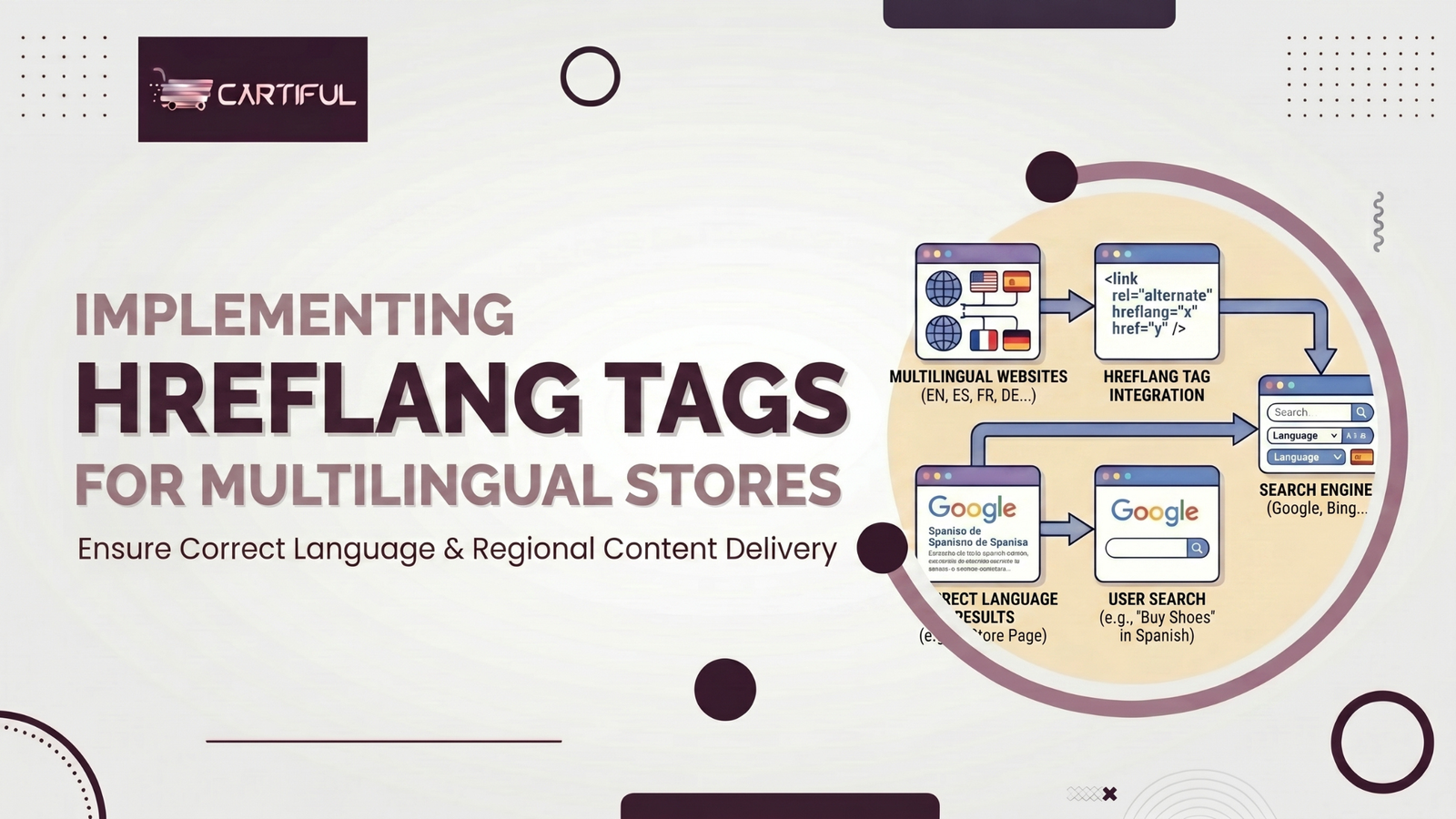
When an ecommerce store serves multiple languages or country-specific versions, search engines need a clear way to determine which version of a page to show each user. That is where hreflang comes in.
Hreflang helps map equivalent pages across different languages and regions. It does not determine language on its own, but it tells search engines how different versions of the same page relate to each other and which audience each version is intended for.
For ecommerce stores, this matters more than it does for most other types of websites. A store may run English versions for the US, UK, and Australia, or separate French versions for Canada and France. Even when the content looks similar, differences in currency, shipping, pricing, or product availability make each version a distinct experience.
Without a clean hreflang setup, search engines may show the wrong version in search results, split signals across multiple URLs, or send users to a store that does not match their location. Over time, that creates both ranking inefficiencies and poor user experience.
At a practical level, the goal is simple: each market-facing version should have its own indexable URL, its own correct canonical, and a clean hreflang cluster connecting all equivalent versions. This becomes much easier to manage when it is part of a structured ecommerce SEO approach for multi-region stores.
What hreflang Actually Does
Hreflang is often misunderstood. It is not a translation tool, and it does not directly improve rankings. Instead, it serves as a localization signal that helps search engines understand how different versions of a page relate to one another.
In simple terms, hreflang tells search engines that multiple URLs represent the same core content but are intended for different audiences. For example:
- en-us → English for users in the United States
- en-gb → English for users in the United Kingdom
- en → a general English version without regional targeting
This distinction becomes important because multilingual and multi-regional setups are not the same. Some stores only translate content, while others adjust pricing, shipping, and product availability by country. Many ecommerce businesses operate across both models simultaneously.
When hreflang is implemented correctly, it helps search engines group these variations together and serve the most appropriate version based on the user’s language and location.
Why hreflang Matters for Ecommerce
Ecommerce sites rarely differ by language alone. In most cases, different country versions also introduce changes in currency, pricing, shipping timelines, product availability, promotions, and even legal policies.
Because of this, two pages that look nearly identical can still represent very different store experiences.
A UK user landing on a US product page, for example, may see incorrect pricing, unavailable shipping options, or misleading product availability.
Without hreflang, search engines try to decide which version to show on their own. That can lead to:
- the wrong country version appearing in search
- ranking signals being split across similar pages
- users landing on mismatched store experiences
A correct hreflang setup reduces this ambiguity. It helps search engines match the right version to the right audience while keeping signals consolidated across equivalent pages.
When You Need hreflang
You usually need hreflang when the same core page exists in more than one language or country version.
Common ecommerce examples include:
- one English version for the US and another for the UK
- one French version for France and another for Canada
- one Arabic version and one English version of the same product catalog
- one global product page and several country-specific versions with local currency or shipping details
You usually do not need hreflang for pages that are not real equivalents. If the page content, product range, or intent is substantially different, those may not belong in the same alternate cluster.
How hreflang Should Be Structured
A valid hreflang setup is built around complete and consistent relationships between pages.
Each page should list all of its alternate versions, including itself. If one page references another, the other page must return the reference. Without that reciprocity, search engines may ignore the relationship entirely.
In practice, a simple cluster might look like this:
- the US page references US, UK, and default versions
- the UK page references US, UK, and default versions
- the default page references all versions as well
This structure ensures that every page is part of the same clearly defined group. One of the most common problems on ecommerce sites is incomplete clusters, where one or more versions are missing from the set—often after migrations, template updates, or regional expansions.
For a deeper reference on how these clusters should work, Google’s localized version guidelines provide a clear technical baseline.
Language Codes vs Country Codes
One of the easiest ways to break hreflang is by mixing up language and country targeting.
Google supports a language code and, optionally, a country code. So:
- en means English
- en-us means English for the United States
- en-gb means English for the United Kingdom
- fr-ca means French for Canada
Use language-only values when the page is meant for all speakers of that language, regardless of country. Use language-plus-country only when the page truly targets a specific regional audience with meaningful local differences.
For ecommerce, that often means:
- en for a single global English store
- en-us, en-gb, and en-au for country-specific versions with different store rules or pricing
hreflang and Canonical Tags Must Work Together
One of the most common mistakes in multilingual ecommerce is treating hreflang and canonical tags as interchangeable. They are not.
Hreflang connects equivalent pages across different regions or languages, while canonical tags define which version of a page should be treated as the primary version. When these two signals conflict, search engines are forced to choose between them.
In a clean setup, each localized page should usually:
- reference itself as the canonical
- remain indexable on its own
- connect to other versions through hreflang
Problems arise when one version points to another as canonical while still being included in the hreflang cluster.
For example, if a UK page canonicalizes to a US page but is still listed as an alternate, the signals conflict.
That conflict can weaken or break the cluster because one signal says “these are alternate equivalents,” while the other says “ignore this page and use another instead.” Community discussions from Reddit keep returning to this issue, especially when Google selects a different canonical than the one the team expected.
What x-default Is and When to Use It
x-default serves as a fallback signal when none of the defined language or regional versions is a strong match for the user. Instead of guessing, search engines can rely on this neutral version to handle audiences that don’t match.
For ecommerce stores, x-default usually makes sense in a few specific situations:
- a country or language selector page
- a global storefront page
- a fallback version for unsupported regions
What often goes wrong is using x-default as a blanket fallback for every page. Pointing all hreflang clusters to the homepage ignores the idea of page-level equivalence and weakens the entire structure.
A better approach is to treat x-default as part of the same page set. If the cluster is built around a product or category page, the fallback should reflect that same context—not redirect users to an unrelated entry point.
Where You Can Implement hreflang
Hreflang can be implemented in three main ways:
- HTML link elements in the page head
- HTTP headers (for non-HTML content)
- XML sitemaps with hreflang annotations
For most ecommerce stores, the practical decision comes down to choosing between HTML and XML sitemaps.
HTML head tags: These work well when templates are stable and can reliably output the full alternate set. They are easy to inspect directly on individual pages and helpful for debugging smaller sites.
XML sitemap annotations: These are often easier to manage at scale, especially for large multilingual catalogs. Instead of relying on template output, the entire hreflang structure can be maintained in a centralized file.
For the technical side, Google’s documentation on building and maintaining XML sitemaps for indexing and crawling confirms that sitemap-based implementations are fully supported when structured correctly.
Which Method Is Better for Ecommerce?
There is no single best answer. The better method is the one your team can maintain correctly.
On large stores, sitemap-based hreflang can be easier to scale and audit. On simpler sites, HTML tags can be easier to debug page by page.
For ecommerce, this often becomes a strategic decision, especially when managing multiple markets, languages, and catalog variations. It connects closely with SEO and AEO planning for multi-region ecommerce visibility, where structure and scalability matter more than the method itself.
Pick a Stable URL Structure First
Before hreflang, the store needs a stable structure.
In practice, most multilingual ecommerce sites use one of these:
- subdirectories such as /us/ and /uk/
- subdomains such as us.example.com
- country-code domains such as example.co.uk
The important point is not which format you pick. It is whether the format is consistent, indexable, and easy to map across equivalent pages.
This is especially important when scaling across markets, where inconsistent structure can break both crawlability and targeting. A well-planned structure is usually part of a broader ecommerce website strategy and architecture setup.
Avoid Locale-Adaptive Pages for Search
Pages that change content dynamically based on user location or browser settings can create indexing issues.
While this approach may seem user-friendly, it makes it harder for search engines to access and index the correct version of each page.
For ecommerce SEO, it is usually safer to rely on separate URLs for each region or language rather than a single adaptive page.
For example:
- /us/product-x/
- /uk/product-x/
- /fr/product-x/
This becomes even more important when traffic is coming from paid and organic channels across regions. Consistency in URLs helps maintain clarity across both Google Ads campaigns and organic search targeting.
Common Ecommerce hreflang Setups
Same language, different countries
This is common for English-language stores:
- en-us
- en-gb
- en-au
Use this when pricing, currency, shipping, or product ranges differ enough to justify separate regional pages.
Different languages, same market
This is common in places like Canada or the Middle East:
- en-ca
- fr-ca
- en-ae
- ar-ae
Use this when users in the same country need different language experiences.
Global language page plus local pages
Sometimes a store has:
- en as a generic English page
- en-us
- en-gb
- x-default
This can work, but only if each version has a real purpose and the cluster is complete.
Common Mistakes That Break hreflang
Missing reciprocal tags
This is one of the most common issues. If one version references another but does not receive a return tag, the relationship is often ignored, and the cluster loses its validity.
Wrong canonicals
If regional pages canonicalize to a different locale, the signals start to conflict. Instead of reinforcing each version, the setup instructs search engines to consolidate them, weakening the hreflang cluster.
Using the homepage as x-default for everything
A blanket homepage fallback often does not match the real content equivalence of the page set. X-default should point to the neutral version of that specific page set, not to the site root by default.
Auto-redirecting users and bots by IP
Automatically redirecting users based on location can interfere with crawling and indexing, especially when bots are treated the same as users.
Incomplete locale coverage
If one page lists multiple regional versions but those versions do not return the same full set, the cluster becomes inconsistent. Every page in the group should reference the complete set of alternates, including itself.
Tagging pages that are not true equivalents
Hreflang should only connect pages that serve the same purpose across markets. A policy page, blog post, or unrelated content should not be grouped with a product page just because the language matches. Keeping page intent aligned is essential for maintaining a clean international structure.
A Practical hreflang Workflow for Ecommerce Teams
Step 1: Map equivalent URLs
For each page type, line up all real equivalents:
US product page, UK product page, AU product page, default page.
Step 2: Decide canonical rules
Each locale page should usually self-canonicalize.
Step 3: Choose implementation format
Use head tags or XML sitemaps, depending on what your platform can maintain cleanly.
Step 4: Add full reciprocal annotations
Each page or sitemap entry should include the complete alternate set, including itself.
Step 5: Add x-default where needed
Use it for neutral or selector pages only when it truly serves as the fallback for that content set.
Step 6: Validate after deployment
Check source code or sitemaps, then sample pages across page types.
Step 7: Re-audit after migrations
Platform changes, URL rewrites, and regional expansions often break clusters quietly. These issues often appear when updates are made without aligning technical SEO with broader marketing and campaign workflows.
This is why hreflang should not be treated as a one-time setup. It needs to stay aligned with ongoing updates across channels such as PPC, social media, and campaign landing pages, where new URLs and regional targeting are introduced regularly.
What a Good Ecommerce hreflang Program Looks Like
A strong setup usually has:
- unique URLs for each locale version
- self-canonical localized pages
- complete reciprocal hreflang clusters
- clean country and language codes
- a sensible x-default
- no forced geo-redirects blocking crawl access
- consistent mapping across product, category, and key content pages
Real-World SEO Community Takeaways
In practice, multilingual SEO teams tend to run into the same few problems repeatedly: missing return tags, canonicals that conflict with hreflang, moving annotations into sitemaps without validating completeness, and using generic x-default targets that do not match the actual page set.
One practical pattern is that sitemap-based setups are often preferred on larger multilingual sites because they are easier to maintain at scale. That is not a ranking advantage by itself, but it is often the safer operational choice when the site has many locales and the team can keep the sitemap export clean.
Best Practices Checklist
Use this checklist before launch:
- create a separate crawlable URL for each language or country version
- use correct language and country codes
- make each localized page self-canonical
- add full reciprocal hreflang annotations
- include each page in its own alternate set
- use x-default only when a neutral fallback truly exists
- avoid forced geo-redirects for crawlers
- choose one implementation method you can maintain
- validate clusters after migrations and template changes
- audit product pages, category pages, and key informational pages separately
How Cartiful Would Approach This
Cartiful would usually start by reviewing the market structure: which locales really need their own URLs, which pages are true equivalents, and where changes to currency, shipping, inventory, or language justify separate versions.
Then the focus would shift to aligning canonicals, hreflang clusters, and URL structure so that the signals support each other rather than conflict.
After that, the implementation method should be chosen based on what the team can maintain accurately over time. In multilingual ecommerce, a simpler setup that stays correct is usually more valuable than a more complex setup that breaks every quarter.
If your store is dealing with country-version conflicts, wrong canonicals, or inconsistent hreflang across markets, contact Cartiful to review the setup and identify where the international structure is breaking down first:
Final Take
hreflang is one of the most important technical signals for multilingual ecommerce, but only when it is implemented cleanly.
The goal is not just tagging pages by language. It is making sure each shopper and each search engine reaches the version that actually fits the market.
When URL structure, canonicals, and hreflang are aligned, international ecommerce becomes easier to interpret, manage, and scale.