Skip to content
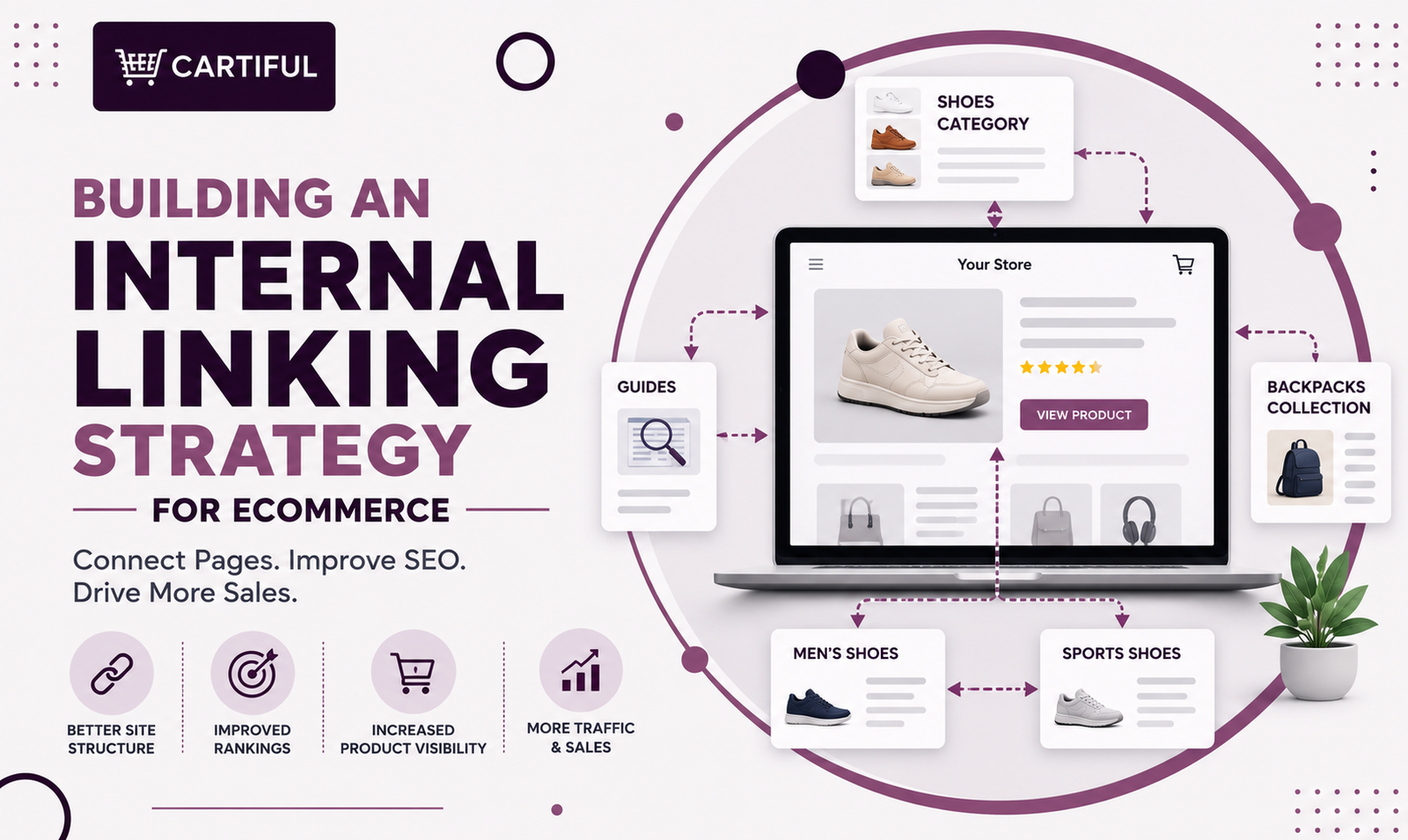
Internal linking helps ecommerce stores guide shoppers and search engines through categories, products, collections, and content. It makes important pages easier to find, shows how products and categories connect, and supports stronger organic visibility.
For larger stores, this becomes even more important. If products sit too deeply, rely only on filters, or have weak links from categories and content, search engines may not crawl or value them properly. At Cartiful, this is often one of the first areas worth reviewing because many stores have menus and breadcrumbs, but no real internal linking strategy behind them.
Quick Answer
A strong internal linking strategy for ecommerce connects categories, subcategories, products, and supporting content in a clear structure. It keeps important commercial pages easy to reach, uses descriptive anchor text, gives priority products more than one crawl path, and avoids sending too much link value into filters, sort pages, or low-value URLs.
Why Internal Linking Matters for Ecommerce Stores
Internal links do more than help shoppers move around a store. They help search engines understand the catalog, find deeper product pages, and recognize which categories matter most.
This is especially useful because ecommerce pages target different search intent.
Category pages often rank for broader terms such as “women’s running shoes” or “wooden dining tables”. While product pages target more specific searches, such as model names, brands, colors, sizes, or product variations.
- A strong internal linking system should make three things clear:
- Which categories are the main commercial hubs?
- Which products need more visibility?
- Which blogs, guides, or campaign pages should link back to key selling pages?
For Cartiful clients, this also supports paid ads, social media, product guides, and landing pages. When shoppers enter from any channel, they should have a clear path to relevant categories and products.
Start With a Clear Ecommerce Hierarchy
The strongest internal linking strategy starts with the site hierarchy. Google’s ecommerce structure guidance recommends clear navigation from the home page to categories, from categories to subcategories, and from those pages to products.
A simple structure often looks like this:
Home → Category → Subcategory → Product
For example:
Home → Men → Running Shoes → Nike Pegasus 41
Or:
Home → Furniture → Sofas → Leather Sofas → Chesterfield Sofa
This does not mean every store needs the same structure. It means every important page should have a clear place. If the hierarchy is messy, internal links become harder to manage. If the hierarchy is clear, menus, breadcrumbs, category links, product grids, and content links can all reinforce the same structure.
For a deeper related guide, Cartiful’s ecommerce SEO guide can support this section internally.
Use Category Pages as Internal Linking Hubs
Category pages should not only list products. They should act as hubs that guide users and search engines deeper into the store.
A strong category page can link to:
- Relevant subcategories
- Best-selling products
- Featured collections
- Brand pages
- Buying guides
- Seasonal or campaign pages
For example, a “Sofas” category page may link to:
- Leather sofas
- Sectional sofas
- Sleeper sofas
- Small-space sofas
- A sofa buying guide
- Popular sofa products
This helps users narrow their choices and helps search engines understand how the product set is organized. Ahrefs also notes that category pages can pass internal value to important subcategories and products, while helping users and search engines understand the site’s structure.
Cartiful already has a related blog on linking category and product pages for ecommerce, which would be a strong internal link from this section.
Give Important Products More Than One Internal Path
One common ecommerce mistake is making a product depend on a single discovery route. If a product can only be reached on page 8 of a category or only after a filter is applied, it may not receive enough internal support.
Priority products should have more than one useful path. These can include:
- Category pages
- Subcategory pages
- Breadcrumbs
- Related product sections
- Complementary product sections
- Brand pages
- Buying guides
- Comparison pages
- Seasonal collections
This matters most for best sellers, high-margin products, products used in ad campaigns, and items that already convert well.
For example, a trail-running shoe page could be linked from:
- The running shoes category
- The trail running shoes subcategory
- A “best shoes for trail running” guide
- Related trail-running shoes
- Complementary socks or hydration products
- A seasonal outdoor collection
Ahrefs’ product page SEO guidance also recommends strategic internal links between products and categories to help search engines understand site structure and distribute internal value.
Use Related and Complementary Products With Intent
Related products are one of the easiest internal linking opportunities on ecommerce sites, but they are often used too loosely. A block that links to random items may help a little with page views, but it is not much of a strategy.
The strongest related-product systems usually separate different intents:
- similar products for substitution
- complementary products for bundles or add-ons
- higher-tier alternatives for upsell
- entry-level alternatives for price-sensitive shoppers
For example, a trail-running shoe page might link to:
- similar trail-running shoes
- waterproof socks
- hydration belts
- a premium version of the same shoe family
That is better than a generic “you may also like” block filled with unrelated items.
Connect Informational Content to Commercial Pages
Many ecommerce stores publish blogs, guides, gift lists, and how-to content but fail to link them properly to category or product pages. That weakens both SEO and sales potential.
A buying guide should not sit alone. It should send users toward the most relevant commercial page.
For example:
A guide on “how to choose running shoes for flat feet” can link to the running shoes category, stability running shoes subcategory, and a few suitable products.
A guide on “best sofa styles for small apartments” can link to the sofas category, small-space sofas subcategory, and a curated product list.
A Ramadan sales blog can link to seasonal collections, best sellers, gift bundles, and campaign pages.
This is where internal linking becomes more than navigation. It turns content into a path toward purchase.
Anchor Text Should Be Descriptive, But Natural
Google’s link documentation says descriptive anchor text makes it easier for people and search engines to make sense of linked pages.
Its Search Essentials guidance also says to use words people would use to look for your content and place them in descriptive locations such as link text.
For ecommerce, that means anchor text should usually describe the destination clearly without sounding forced.
Better examples:
- women’s waterproof hiking jackets
- leather sectional sofas
- men’s trail running shoes
Weaker examples:
- click here
- view more
- product page
- best cheap buy now shoes
Ahrefs also points out that internal anchor text can help clarify category and product relationships, especially when templates are built carefully.
The practical rule is simple: write anchors for clarity first, keyword support second.
Keep Links Crawlable
Crawlable links are a basic requirement for ecommerce SEO, but many modern stores still get this wrong. Important category, product, and collection links should use standard HTML links with clear destination URLs.
A safe internal link looks like this:
<a href=”/mens/running-shoes”>Men’s Running Shoes</a>
Weaker setups include:
- Links hidden behind buttons with no crawlable URL
- Links triggered only by JavaScript events
- Product cards that require scripts before the URL appears
- Lazy-loaded modules that do not render consistently
- Personalized product blocks that hide important links from crawlers
This matters most on headless storefronts, filtered navigation, product recommendation modules, and custom ecommerce builds. If search engines cannot consistently find the link, the page may receive less internal support than expected.
Do Not Let Filters and Sort Orders Consume Your Link Equity
Large ecommerce stores can create thousands of low-value URLs through filters, sort options, and faceted navigation. These URLs are useful for shoppers, but they can become an SEO problem when search engines crawl too many versions of the same category page.
Common examples include:
- ?sort=price-asc
- ?color=black&size=10
- ?brand=nike&page=4
If these URLs receive too many internal links, crawl attention can shift away from core categories, subcategories, and product pages.
Screaming Frog notes that ecommerce filters can create duplicate URLs and crawl waste when they are not controlled properly. Ahrefs also recommends managing faceted navigation carefully so important pages remain the main crawl and ranking targets.
Filters should still help shoppers narrow products, but they should not become the store’s main internal linking path.
Prioritize clean category URLs, useful subcategory pages, and approved landing pages instead of every possible filter combination.
For example:
Better: /sofas/leather-sofas/
Weaker: /sofas?material=leather&sort=popular
Large Stores Need Priority-Based Internal Linking
As a catalog grows, not every product can get the same level of internal support. A store with hundreds or thousands of SKUs needs to decide which pages deserve stronger links from menus, category pages, blogs, campaign pages, and product modules.
A practical priority model looks like this:
Tier 1: Core categories and subcategories
Pages with strong search demand, high revenue value, or major store importance.
Tier 2: Priority products
Best sellers, high-margin items, seasonal products, flagship SKUs, or products used in paid campaigns.
Tier 3: Supporting products
Products that still need clear discovery paths but do not need extra visibility from major pages.
Tier 4: Long-tail products
Lower-priority SKUs that can rely mostly on normal category grids, pagination, breadcrumbs, and search paths.
This helps store owners avoid spreading internal links too thin. The goal is to make important categories and products easier to reach, while still keeping the wider catalog accessible.
Make Menus, Breadcrumbs, and Pagination Work Together
Menus, breadcrumbs, and pagination are not the full strategy, but they are the base.
- Menus show the main category structure.
- Breadcrumbs reinforce page hierarchy.
- Pagination helps expose deeper product lists.
- Category links guide users into more specific product groups.
- Contextual links connect guides and blogs to commercial pages.
- Related product links create useful product-to-product paths.
A store that only depends on menus and breadcrumbs usually has a thin linking strategy. A stronger setup adds contextual links from content, curated links from category pages, and relevant product modules.
Build Links Around Paid and Social Campaigns Too
Internal linking is not only an SEO task. It also supports paid ads, social media, email campaigns, influencer traffic, and seasonal promotions.
If Cartiful is running Meta Ads, Google Ads, or social campaigns for a store, the landing pages should connect naturally to the rest of the catalog.
For example:
A Meta Ads landing page for Eid outfits should link to relevant collections, best sellers, size guides, and related accessories.
A Google Shopping product page should link back to the correct category, related alternatives, and complementary products.
An influencer campaign page should guide users toward featured products, bundles, and the broader collection.
This helps paid traffic explore more products instead of bouncing after one page. It also gives campaign pages a better place inside the store structure.
A Practical Internal Linking Framework for Ecommerce
Use this simple framework when planning links.
1. Structure Links
These include home, menu, category, subcategory, product grid, pagination, and breadcrumb links.
2. Commercial Support Links
These include featured categories, best sellers, brand pages, collection pages, comparison pages, and campaign pages.
3. Contextual Content Links
These include buying guides, FAQs, gift guides, care guides, size guides, and blog posts that link to relevant categories or products.
4. Conversion Links
These include related products, complementary products, bundles, upsells, and product alternatives.
The goal is to make every link useful. If a link does not help the shopper, clarify the structure, or support a priority page, it may not need to be there.
What to Audit First
If you want to improve internal linking on an ecommerce store, start with these questions:
- Are the most important categories linked prominently from the site’s main structure?
- Can important products be reached through more than one internal path?
- Are deep products too dependent on long pagination chains?
- Do supporting content pages link to relevant commercial pages?
- Are anchor texts descriptive and relevant?
- Are filters and sort URLs absorbing too much internal attention?
- Are there orphan or near-orphan products?
- Are JavaScript components hiding links from crawlers? Google’s link and structure documentation make each of these checks relevant for crawlability and site understanding.
Ecommerce Internal Linking Checklist
1. Structure
- Link from the home page to main categories.
- Link from categories to relevant subcategories.
- Link from categories and subcategories to product pages.
- Keep important commercial pages within a few clicks where possible.
- Use breadcrumbs on category, subcategory, and product pages.
2. Product Discovery
- Give priority products more than one internal path.
- Use related products only when they are relevant.
- Use complementary products to support bundles and add-ons.
- Do not rely only on pagination or filtered states.
- Keep best sellers and campaign products easier to reach.
3. Content Support
- Link buying guides to relevant categories.
- Link blog posts to commercial pages where useful.
- Use FAQs to send users toward helpful pages.
- Use descriptive anchor text.
- Avoid linking to unrelated products just to add more links.
4. Technical Checks
- Use crawlable <a href> links.
- Avoid JavaScript-only navigation for important links.
- Check product grids, menus, breadcrumbs, and related product modules.
- Avoid internal links to redirected URLs.
- Keep internal links consistent with canonical URLs.
5. Index Control
- Prioritize core categories, subcategories, and products.
- Do not let filters and sort pages dominate internal links.
- Create indexable landing pages only for filter combinations with real value.
- Keep low-value URL variations out of the main link path.
Common Internal Linking Mistakes
The most common ecommerce internal linking mistakes are:
Relying Only on Menus and Breadcrumbs
Menus and breadcrumbs help, but they rarely cover the full catalog strategy. Content links, category links, product modules, and campaign links also matter.
Giving Products Only One Crawl Path
If a product is only reachable through one deep category path, it may not get enough internal support.
Linking Too Much to Filtered URLs
Filters are useful for browsing, but they should not replace real category and subcategory pages.
Using Generic Anchor Text
Anchor text such as “click here” or “view more” does not give enough context. Use clear product, category, or guide names where possible.
Burying Priority Products
Best sellers, high-margin products, and campaign products should be easier to find.
Publishing Blogs Without Commercial Links
A blog that never links to products or categories does little for ecommerce growth.
Using JavaScript in a Way That Hides Links
Important links should be crawlable, not dependent only on scripts or click events.
Treating Every Product the Same
Some products deserve more internal support because they bring more revenue, rank better, or support active campaigns.
How Cartiful Approaches Ecommerce Internal Linking
Cartiful starts by mapping the store structure: main categories, subcategories, priority products, campaign pages, and supporting content.
Then, the team reviews how users and search engines move through the site. This includes navigation, breadcrumbs, category grids, product modules, blog links, and technical crawl paths.
Frequently Asked Questions
1. What is an internal linking strategy for ecommerce?
An ecommerce internal linking strategy is a plan for how categories, subcategories, products, brand pages, campaign pages, and content pages link to each other. It helps users move through the store and helps search engines understand which pages are important.
2. Which ecommerce pages should get the most internal links?
The strongest internal support should usually go to main category pages, key subcategories, high-priority products, best sellers, seasonal collections, and campaign landing pages. These pages often carry the most commercial value.
3. Should blog posts link to product and category pages?
Yes, when the links are useful. Buying guides, comparison posts, gift guides, and educational blogs should link to relevant categories or products so readers can move from research to purchase.
4. Are related products good for SEO?
Yes, if they are relevant. Related products can help users compare options, find alternatives, and keep moving through the store. They also create useful product-to-product link paths.
5. Does anchor text matter for internal links?
Yes. Clear anchor text helps users and search engines understand the destination page. For ecommerce, descriptive anchors such as “men’s trail running shoes” or “leather sectional sofas” are better than vague labels like “click here.”
Final Takeaway
A strong ecommerce internal linking strategy is not about adding more links. It is about making key categories, products, and content easier to find.
Start with a clear hierarchy, use descriptive anchor text, give priority products more than one path, and keep filters or sort URLs from taking over the structure.
For store owners, this supports search visibility, smoother shopping paths, and better conversion opportunities across paid ads, social media, content, CRO, and SEO.