Skip to content
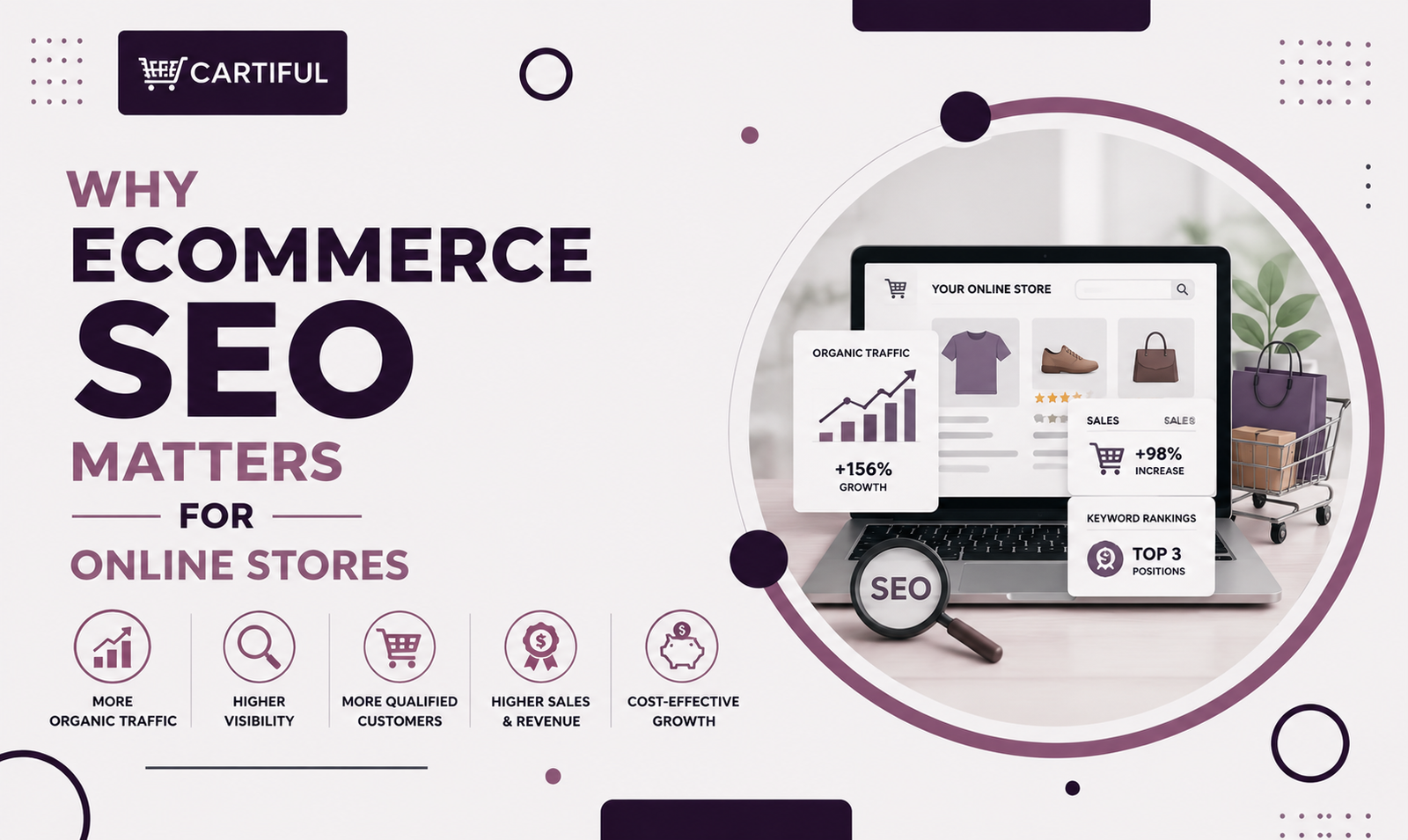
Ecommerce SEO matters because online stores need to be found before they can sell. Google’s own ecommerce documentation says a core challenge for any ecommerce site is being found in Search, and that when you share your ecommerce data and site structure clearly, Google can more easily find and parse your content. That helps your products and pages appear across Google surfaces and helps shoppers find your site at different stages of the buying process. (Google for Developers)
For an online store, SEO is not only about ranking a few product pages. It is about making your catalog, categories, reviews, images, brand pages, and buying guides easier to surface when shoppers are researching, comparing, or ready to buy. Google specifically notes that ecommerce content can appear across Search, Images, Lens, the Shopping tab, Business Profile, and Maps, depending on the content and data you provide. (Google for Developers)
At Cartiful, the practical view is simple: ecommerce SEO matters because it helps a store build steady visibility that is not tied only to ad spend. Google Merchant Center states that free listings can show products across Google at no cost and can generate traffic to your online store without paying for ads. That does not make SEO “free,” because it still takes work, but it does make organic visibility one of the few channels that can keep sending qualified traffic after the page is built and indexed. (Google Help)
SEO Helps Stores Show Up Across More Than One Google Surface
A lot of store owners still think SEO means “rank in the ten blue links.” That view is too narrow now.
Google’s ecommerce docs say product and store content can appear in:
- Google Search
- Google Images
- Google Lens
- the Google Shopping tab
- Business Profile
- Google Maps (Google for Developers)
Merchant Center documentation also says eligible free listings may appear on Search, Images, Lens, YouTube, Gemini, the Shopping tab, and the products module on Business Profile. (Google Help)
That matters because ecommerce buying behavior is not one-dimensional. Some shoppers start with a product query in Search. Some compare visually in Images. Some use Lens. Some search by store, brand, or local availability. Good ecommerce SEO gives your store more chances to appear wherever that research starts. (Google for Developers)
SEO Brings in People With Clearer Purchase Intent
Paid social can create demand. SEO often captures demand that already exists.
When someone searches for a product type, a category, a comparison, a review, or a brand-plus-product phrase, they are often much closer to a buying decision than someone casually scrolling a feed. Google’s ecommerce guidance reflects this by splitting ecommerce content across different stages of the shopping process and recommending content types that help shoppers at each stage, including product data, company story, special offers, merchant reviews, customer reviews, live streams, and educational content. (Google for Developers)
That is one reason ecommerce SEO matters so much. It helps a store meet shoppers when they are already looking.
This also comes through in practitioner discussions. In a recent Reddit thread from ecommerce operators, one commenter put it plainly: the goal is not rankings for their own sake, but revenue or leads from organic traffic. That is a useful framing for online stores. SEO should be judged as a sales channel, not as a vanity project. (Reddit)
SEO Makes Category Pages Work Harder
For many ecommerce sites, category pages matter even more than individual product pages. A product page may rank for a very specific query. A category page can rank for broader commercial intent and pull in shoppers much earlier in the buying process.
Google’s ecommerce site-structure guidance says navigation and cross-page links affect how Google understands the site, and it recommends linking from menus to category pages, then to subcategories, then to product pages. It also says Google looks at page link relationships to infer relative importance. (Google for Developers)
That means SEO helps stores do things that paid campaigns alone do not solve well:
- build stronger category hubs
- signal which products matter most
- connect supporting content to money pages
- make deep catalog pages easier to reach and index (Google for Developers)
A store with strong category SEO is usually easier to crawl, easier to browse, and better positioned to rank for mid-funnel and bottom-funnel terms.
SEO Helps Google Understand the Store Better
Ecommerce sites are full of moving parts: products, variants, reviews, prices, shipping details, returns, local availability, categories, and collections. If Google cannot interpret those signals clearly, visibility becomes less consistent.
Google says structured data can improve the accuracy of its understanding of your ecommerce content. It also recommends using structured data to reinforce page purpose and help Google interpret different page types more accurately. (Google for Developers)
This is one reason SEO matters beyond “keywords.” Good ecommerce SEO usually includes:
- clean site structure
- logical internal linking
- product and merchant structured data
- readable URLs
- crawlable navigation
- indexation control for low-value URLs (Google for Developers)
In other words, SEO is partly how you make the store easier for Google to read.
SEO Supports Organic Product Visibility Without Paying for Every Click
Google Merchant Center’s free listings documentation is very direct here. It says products can show for free across Google and that free listings are a way to generate traffic to your online store without paying for ads. It also notes that Google uses the product data you provide to match products with relevant searches. (Google Help)
That matters for online stores because paid acquisition is rarely stable forever. Costs move. platforms change. margins tighten. Organic visibility gives a store another route into the market.
That does not mean stores should stop running ads. It means SEO matters because it gives the business a traffic source that is not billed on every visit. That is especially important for:
- stores with thin margins
- stores in repeat-purchase categories
- brands trying to grow branded search over time
- catalogs with many long-tail product queries
SEO Helps Smaller Stores Compete in Narrower Niches
Most smaller stores are not going to outrank giant marketplaces for the biggest head terms overnight. But ecommerce SEO is not only about the largest queries.
Google’s ecommerce docs recommend building clear structure, useful content, and strong product information so the right pages can be surfaced for the right searches. That gives smaller stores room to compete on:
- long-tail product terms
- niche categories
- specific use cases
- local intent
- informational searches tied to products (Google for Developers)
A Reddit ecommerce thread made a similar point from the operator side: broad national queries are much harder than more specific geographic or niche searches, and rankings alone are not the real goal anyway. Revenue is. (Reddit)
That is why good ecommerce SEO often starts by narrowing focus, not by chasing the biggest keyword in the category.
SEO Matters Before, During, and After the Click
Many people talk about SEO as if it stops at getting traffic. For stores, that is not enough.
Google’s ecommerce guidance covers product data, reviews, site structure, structured data, page discovery, and content for different shopping stages because SEO affects more than click volume. It affects what the shopper sees before the click and what they find after landing on the site. (Google for Developers)
A good ecommerce SEO setup can improve:
- how your listing appears in search
- whether product details are understood correctly
- whether your category pages make sense
- whether your products are easy to find from internal navigation
- whether deeper catalog pages are actually indexed
So SEO matters because it improves the path into the store, not just traffic totals.
SEO Still Matters in AI Search
This question comes up more now: if AI Overviews and AI Mode exist, does classic SEO still matter?
Google’s answer is effectively yes. Its documentation says the same SEO best practices remain relevant for AI features such as AI Overviews and AI Mode, and that there are no extra requirements or special optimizations needed beyond sound SEO fundamentals. Google also says pages shown as supporting links in AI features must be indexed and eligible to appear in Search with a snippet. (Google for Developers)
That makes ecommerce SEO even more important, not less. If your store pages are not indexed, useful, and technically sound, they are less likely to surface well in either classic search or AI-supported search experiences. (Google for Developers)
SEO Gives Stores a Better Long-Term Asset
A paid campaign can drive traffic fast, but it stops the moment spend stops. A well-built category page, a strong buying guide, or a properly optimized product page can keep bringing in visits long after publication.
That is one of the strongest reasons ecommerce SEO matters. It turns parts of the site into reusable growth assets:
- category pages can rank for broad commercial terms
- product pages can rank for exact product intent
- reviews and comparison content can pull in research traffic
- image optimization can support visibility in Google Images and Lens
- structured data can make listings more informative across Google surfaces (Google for Developers)
This is also why weak SEO compounds in the wrong direction. If category pages are thin, internal links are weak, and product data is messy, the store does not build much long-term search value.
Where Stores Usually Miss the Point
A lot of online stores either ignore SEO or reduce it to basic product-page edits.
The bigger opportunity is broader than that. Google’s ecommerce documentation shows that stores need to think about:
- site structure
- product data
- structured data
- content for different shopping stages
- crawlable navigation
- support for Google surfaces beyond basic web results (Google for Developers)
So if a store only asks, “Did we put keywords in the title?” it is missing most of what ecommerce SEO actually does.
How Cartiful Would Frame It
Cartiful would usually frame ecommerce SEO as part visibility system, part catalog system, and part growth system.
It matters because it helps a store:
- get products and categories in front of shoppers at the right time
- build stronger non-paid traffic over time
- make the catalog easier for Google to understand
- support visibility across multiple Google surfaces
- reduce overdependence on paid media for every sale
That is a better business framing than “SEO is about rankings.”
Final Take
Ecommerce SEO matters because online stores need dependable ways to be found by shoppers who are already searching, comparing, and buying. Google’s own documentation makes that clear: ecommerce content can appear across several Google surfaces, structured data and site structure help Google interpret store content more accurately, and the same SEO basics still matter in AI search features. For most stores, SEO is not an optional extra. It is part of how the catalog becomes visible, usable, and commercially valuable over time. (Google for Developers)
1. FAQ: Why is SEO important for ecommerce stores?
SEO matters because it helps shoppers find your products, categories, and content through Google Search and other Google surfaces. Google says ecommerce data and structure help its systems find and parse store content more easily. (Google for Developers)
2. FAQ: Does ecommerce SEO only help with Google Search rankings?
No. Google says ecommerce content can appear in Search, Images, Lens, the Shopping tab, Business Profile, and Maps, depending on the setup and content provided. (Google for Developers)
3. FAQ: Is SEO still worth it if a store already runs paid ads?
Yes. Merchant Center says free listings can generate traffic without paying for ads, which makes SEO and organic product visibility useful alongside paid channels. (Google Help)
4. FAQ: Does SEO still matter with AI Overviews and AI Mode?
Yes. Google says the same SEO best practices remain relevant for AI features and that pages need to be indexed and eligible for Search to appear as supporting links. (Google for Developers)
5. FAQ: What should online stores measure from SEO?
Revenue, qualified traffic, and page-level business impact matter more than rankings alone. That view also shows up in practitioner discussions, where store operators point out that organic revenue is the metric that actually matters. (Reddit)