Skip to content
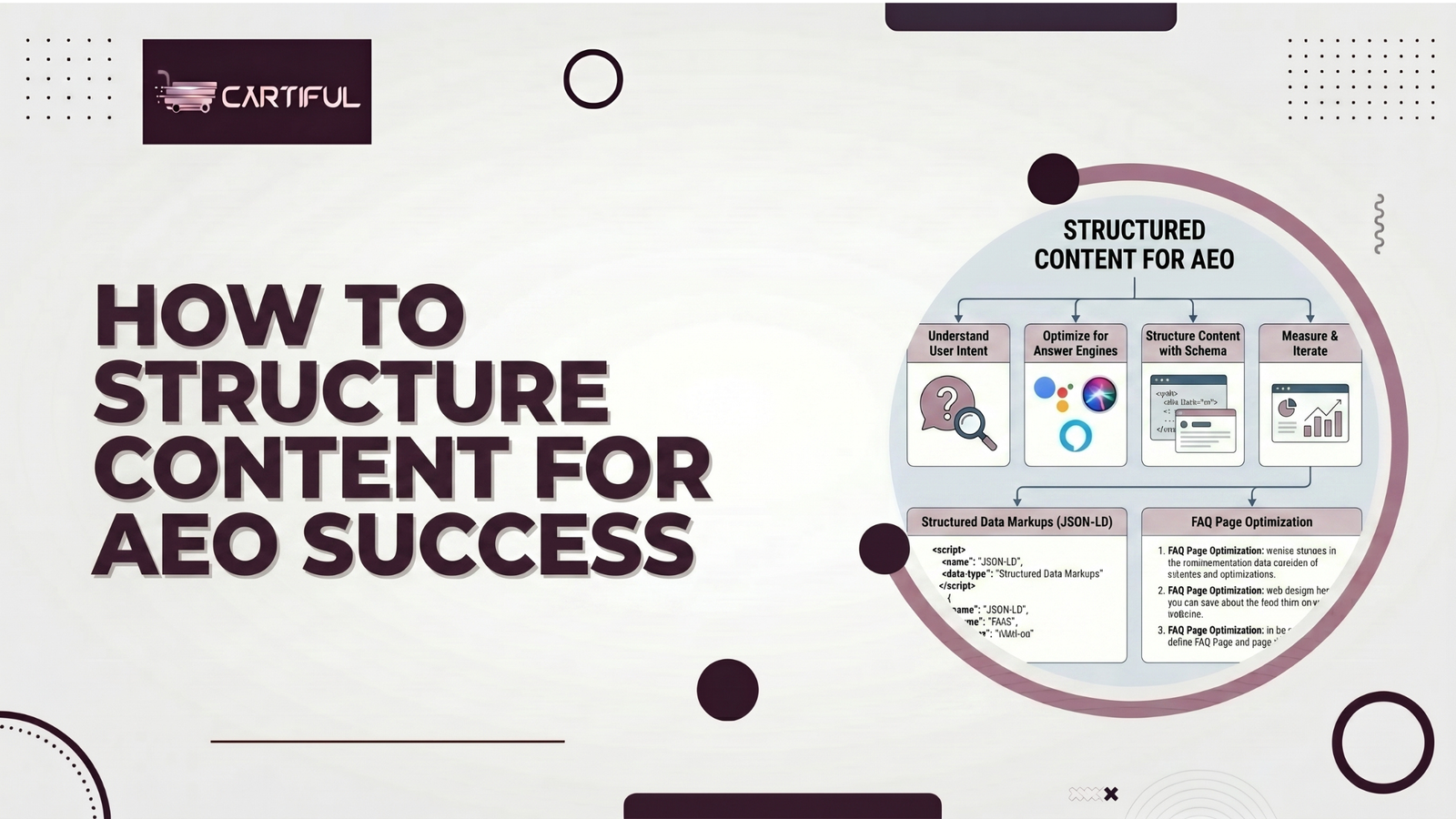
AEO usually means Answer Engine Optimization. For ecommerce sites, it is the practice of structuring content so AI-powered search experiences can understand your store, extract the right details, and surface useful answers tied to your products, categories, and buying content. Industry sources such as Ahrefs describe AEO as optimizing content for direct answers and AI-driven discovery rather than only traditional rankings.
For ecommerce, content structure matters because AI search is not only reading blog posts. It is also reading product facts, merchant data, reviews, shipping details, return policies, comparisons, and FAQs. Google’s product documentation says structured product information can appear in richer ways in Search, Images, and Lens, including price, availability, review ratings, shipping information, and more.
Google’s guidance for AI search experiences is also clear on the bigger principle: do not build for a special AI loophole. Build helpful, unique, satisfying content for visitors. Google says the same fundamentals that support Search also support AI Overviews and AI Mode.
At Cartiful, the practical view is simple: AEO works best when your ecommerce content is easy to scan, easy to verify, and easy to connect to a real commercial page.
Quick answer
For ecommerce sites, content tends to perform better for AEO when it is structured like this:
- one clear topic or question per section
- a direct answer near the top
- short supporting blocks under clear headings
- product facts presented consistently
- comparison and use-case sections where relevant
- FAQ-style answers for common objections
- strong internal links from informational content to category and product pages
- structured data that matches what the page actually shows. Google’s AI-features guidance, helpful-content guidance, and product structured-data documentation all point in this direction.
Why content structure matters for AEO on ecommerce sites
AI search systems do not read pages the same way a human designer or merchandiser does. They need the page to make its meaning obvious. Google says AI search experiences are handling longer, more specific, and follow-up questions, which means content that buries the main answer, mixes many intents together, or hides key facts inside weak page templates becomes harder to use well.
For ecommerce sites, this affects more than blogs. It affects:
- product pages
- category pages
- comparison pages
- buying guides
- support content
- shipping and returns content
- FAQ blocks
- merchant data and structured product details. Google’s merchant listing and product docs support the importance of these page and data types in product discovery and richer search experiences.
A useful way to think about it is this: AEO-friendly structure helps a machine answer, “What is this page about?” and “What exact question does it solve?” without guessing too much.
Start with the query types ecommerce shoppers actually ask
The strongest ecommerce AEO content is usually built around the kinds of questions shoppers already ask before buying. Google says AI search is shifting toward more complex, conversational, and multimodal questions. That means ecommerce brands should not structure content only around short head keywords. They also need content that matches buying-stage questions.
Common ecommerce query types include:
- product fact questions
Is this waterproof? Does this fit true to size? Is this safe for sensitive skin? - comparison questions
Product A vs Product B, leather vs fabric, whey isolate vs concentrate - use-case questions
Best office chair for back pain, best stroller for travel, best serum for dry skin - merchant and policy questions
How long is shipping, what is the return window, does this come with a warranty - selection questions
Which model is best for beginners, what size should I buy, which option is best under a specific budget
These questions map naturally to ecommerce content formats such as PDP FAQ blocks, category intros, comparison pages, buying guides, and support content. That structure aligns well with Google’s advice to create unique, satisfying content that meets user needs directly.
The best page structure for AEO on ecommerce content
The most reliable pattern for ecommerce AEO is usually:
1. Lead with the answer
Put the clearest answer near the top of the page or section.
2. Add short support under clear headings
Use H2s and H3s that mirror how people ask questions.
3. Keep facts grouped
Price, size, material, compatibility, delivery, and return info should not be scattered randomly.
4. Add proof
Use reviews, specs, examples, and comparisons where relevant.
5. Connect to the right commercial page
If the page is informational, it should still point users clearly toward a category or product that solves the need.
This structure is not a formal Google template, but it follows Google’s helpful-content and AI-search guidance closely.
How to structure product pages for AEO
Product pages are often the most important AEO assets on an ecommerce site because they hold the core facts AI systems need. Google’s product documentation says product information can appear in richer ways in Search when structured well, including price, availability, review ratings, shipping information, and more.
A product page built for AEO should usually include these blocks:
Clear product title
Use a product title that states exactly what the product is.
Short summary near the top
Add a short block that explains the product in plain language.
Key specs grouped together
Dimensions, materials, compatibility, care instructions, or technical specs should sit in a clear section.
Use-case section
Explain who the product is for, what problem it solves, or when it should be used.
Review section
Visible reviews and ratings help both trust and machine understanding when implemented correctly. Google’s review and product documentation support visible, page-matching review data.
FAQ section
Answer common purchase questions such as shipping, sizing, compatibility, setup, or care.
Supporting merchant details
Availability, shipping, returns, and offer data should be visible and consistent with structured data and Merchant Center where relevant. (Google Help)
A weak PDP for AEO usually has a title, a gallery, a short sales sentence, and little else. A stronger PDP answers the main buyer questions before the user has to dig for them.
How to structure category pages for AEO
Category pages often work better than PDPs for broad commercial queries and “best for” discovery. They also help AI systems understand product groupings and shopper intent across a whole category. Google’s ecommerce and product documentation supports the role of category-level product discovery and merchant-ready product information.
A category page built for AEO should usually include:
- a short category intro that states what the page covers
- a block on who the category is best for
- key subtypes or buying criteria
- links to major subcategories
- a shortlist of featured or best-selling products
- answers to common category-level questions
- internal links to deeper buying guides or comparisons
Example: a category page for “office chairs” can be structured around:
- best office chairs for back support
- best office chairs for small spaces
- ergonomic vs executive chairs
- what to look for before buying
- links to featured models and comparison content
This kind of structure helps the page work for both shopping discovery and AI-style answer extraction.
Use comparison pages and buying guides as AEO bridges
On many ecommerce stores, the pages most likely to earn AI-driven visibility are not the PDPs alone. Comparison pages and buying guides are often better suited to direct-answer queries because they naturally organize product differences, tradeoffs, and use cases.
Good examples include:
- best humidifier for a nursery
- standing desk vs sitting desk
- protein isolate vs concentrate
- best trail running shoes for beginners
- which espresso machine is easiest to clean
These pages work well for AEO because they can be structured as:
- short answer
- comparison table
- pros and cons
- who each option is best for
- recommended products or categories at the end
That makes them useful both as answer content and as internal-linking bridges into commercial pages. This structure fits Google’s AI-search guidance around detailed, need-based questions.
FAQ blocks matter, but only when they answer real questions
FAQ-style content can be useful for AEO when it answers real objections, uncertainties, or buying questions. Google’s FAQ structured data documentation says FAQ markup may help users discover information in a rich result, but it also says rich-result display is not guaranteed and general structured-data rules still apply.
For ecommerce, FAQ blocks are usually strongest when they answer things like:
- Is this true to size?
- Is this dishwasher safe?
- Can this be used outdoors?
- How long does shipping take?
- What is the return policy?
- Does this work with my device?
- Is this safe for sensitive skin?
A weak FAQ section repeats obvious statements or adds filler. A stronger one addresses real purchase friction.
Use structured data to support the content structure
AEO content should be easy for AI systems to read from the page itself, but structured data strengthens that clarity. Google’s product, merchant listing, and FAQ documentation all show how structured data supports richer machine understanding of page content.
For ecommerce pages, the most useful structured data types often include:
- Product
- Offer
- AggregateRating
- Review
- FAQPage where appropriate
- merchant listing markup for buyable product pages
Google also recommends that structured data match the visible page content. That means your product facts, review ratings, FAQ answers, and merchant details should not say one thing in code and another thing in the interface.
Keep the structure scannable
One of the easiest AEO wins for ecommerce is making pages easier to scan.
A strong format usually includes:
- short paragraphs
- clear H2 and H3 headings
- bullet lists for specs or use cases
- comparison tables where relevant
- direct answer blocks
- grouped sections for shipping, returns, compatibility, sizing, and materials
This is not because Google says “use bullets.” It is because AI systems and users both benefit from clearer organization. Google’s AI-search guidance centers clarity, usefulness, and satisfaction.
Internal linking is part of AEO structure
AEO is not just about what is on the page. It is also about how pages connect.
A strong ecommerce AEO structure usually links:
- buying guides → categories
- comparisons → products
- FAQs → PDPs or support pages
- category pages → subcategories
- PDPs → related products
- editorial content → commercial pages
Google’s crawlable-links and product documentation make the same larger point: discovery and understanding depend on content relationships, not just isolated pages. Merchant data may support product understanding, but internal linking still helps Google and users move through the site logically.
Keep product and merchant facts fresh
For ecommerce AEO, stale data is one of the fastest ways to weaken the content. Merchant Center says accurate and correctly formatted product data is essential for successful free listings and for avoiding display issues. Google’s merchant listing docs also warn that JavaScript-generated product markup can be less reliable for rapidly changing fields like price and availability. (Google Help)
That means pages built for AEO should keep these details fresh:
- price
- stock status
- shipping promises
- return details
- review counts and ratings
- selected-variant information
A page structured well but carrying stale facts is still a weak AEO page.
A good ecommerce AEO content template
Here is a practical structure that works well for many ecommerce informational and commercial pages:
Intro
State the topic or buyer question clearly.
Short answer
Give the direct answer in 2 to 4 sentences.
Key factors
List the main things a shopper should consider.
Recommended options or subtypes
Break the category into clear choices.
Product or category links
Point the user to the most relevant next step.
FAQ block
Answer the most common objections or follow-up questions.
Trust and policy details
Where relevant, add shipping, returns, sizing, or warranty details.
This is not the only format, but it works well because it mirrors how AI search and human users both consume information.
Common mistakes ecommerce brands make
The most common content-structure mistakes for AEO are:
- burying the answer under long intros
- mixing too many intents on one page
- writing vague copy with little product detail
- skipping comparison and use-case sections
- leaving PDPs too thin
- failing to connect informational content to commercial pages
- publishing content that sounds generic and could fit any store
- using schema that does not match the visible page
- relying on Merchant Center or product schema alone without better on-page structure. These mistakes run against Google’s helpful-content, AI-features, and merchant-listing guidance.
A practical checklist
Use this before publishing or auditing AEO content on an ecommerce site.
Page purpose
- Does the page answer one main shopper need clearly?
- Is the core intent obvious from the heading and intro?
- Is the direct answer visible early on?
Structure
- Are sections broken under clear H2s and H3s?
- Are lists, tables, or short blocks used where helpful?
- Are buying factors grouped logically?
Ecommerce detail
- Does the page include product facts or buyer guidance where relevant?
- Are pricing, availability, shipping, and returns easy to find on commercial pages?
- Are reviews visible and current?
Structured data
- Is the right schema type in place?
- Does it match the visible content?
- Has the page been tested in Rich Results Test?
Linking
- Does the page link to the right category or product pages?
- Do supporting guides feed users into commercial pages naturally?
- Are internal links crawlable?
1. What does AEO content look like on an ecommerce site?
It usually looks like content that answers a real shopping question clearly, supports that answer with useful product or category details, and connects the user to the right next step. That can include PDP FAQ blocks, comparison pages, buying guides, and stronger category intros.
2. Should ecommerce product pages be structured differently for AEO?
Yes. Product pages should usually answer the core buyer questions more clearly, group key facts together, include visible trust signals, and use clean product schema and offer data.
3. Do FAQ sections help ecommerce AEO?
They can, when they answer real buyer questions. Google supports FAQ structured data, but the bigger win is often the clarity the FAQ adds to the page itself.
4. Does schema matter for content structure?
Yes. Schema does not replace good structure, but it supports machine understanding of products, offers, reviews, and FAQs when it matches the page correctly.
5. Are category pages important for AEO?
Yes. Category pages often match broader shopping and comparison intent better than single product pages do, especially for discovery-style or “best for” queries. This is an inference supported by Google’s AI-search behavior guidance and product-discovery documentation.
6. Is AEO only about blog content?
No. For ecommerce, it touches PDPs, category pages, comparisons, guides, FAQs, merchant data, and policy pages. Google’s shopping and product docs support that wider view.
Final takeaway
For ecommerce sites, structuring content for AEO is really about making your store easier for AI systems to understand and easier for shoppers to trust. The strongest pages usually answer one need clearly, keep product and merchant facts organized, use structured data properly, and connect informational intent to commercial action. Google’s AI-search, helpful-content, and product documentation all point toward the same conclusion: clarity beats clutter.
The brands most likely to benefit are usually not the ones publishing the most pages. They are the ones building pages that answer the right question cleanly, prove the answer with real product detail, and move the shopper naturally toward the next buying step.