Skip to content
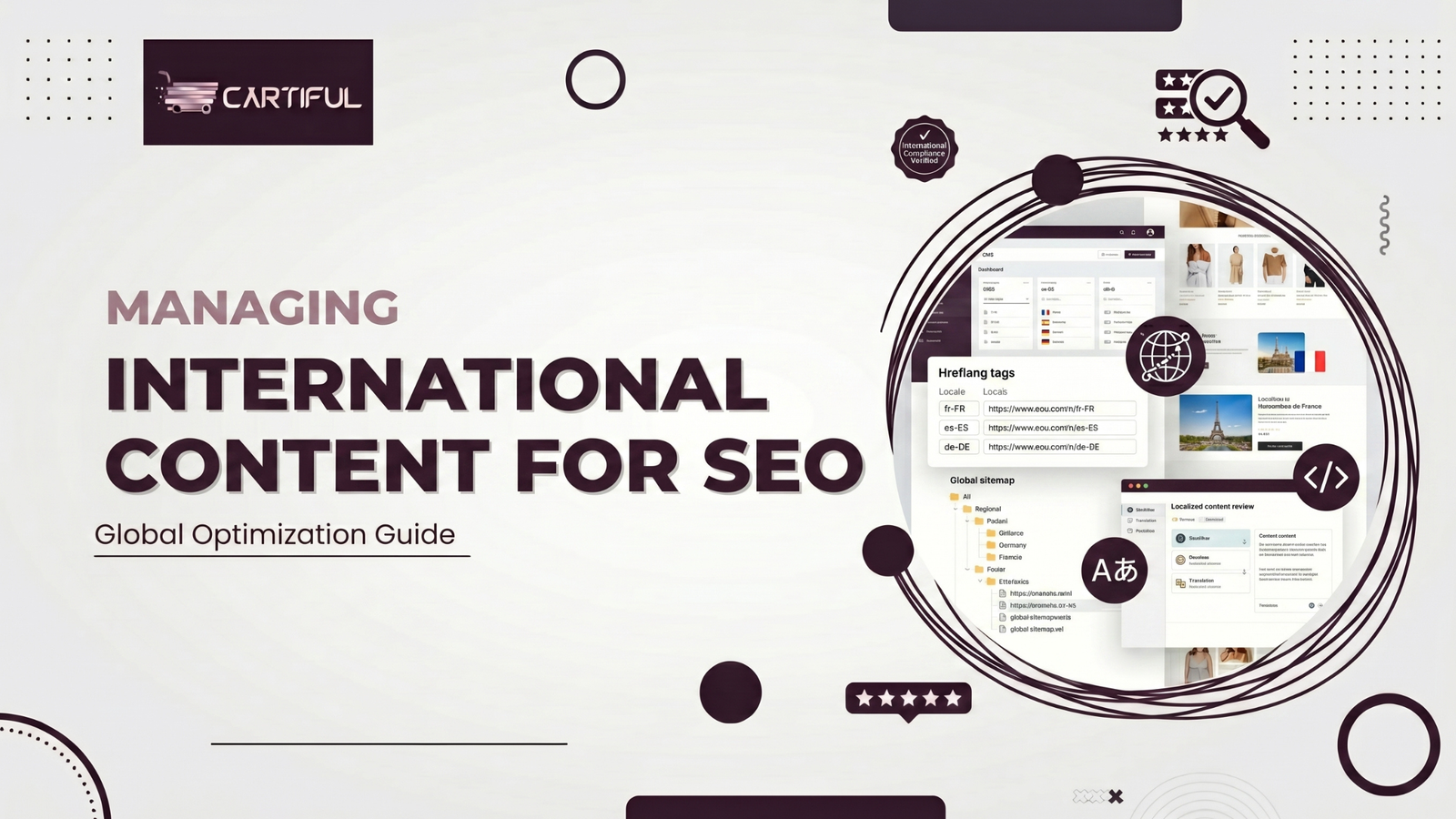
Expanding into international markets sounds exciting. But managing international content for SEO is where most ecommerce store owners struggle.
Ranking in different countries is not just about translating product pages. It requires a structured international SEO strategy that aligns with search intent, user behaviors, website structure, and technical implementation, including hreflang tags and canonical URL management.
Managing international content for SEO means structuring multilingual pages so search engines show the correct version of a page to users in each country. This involves localization, international keyword research, hreflang implementation, and a clear domain strategy that aligns with how search engines interpret global websites.
If international content is not handled correctly, search engines may show the wrong version of a page in the wrong country.
That leads to poor user experience, reduced visibility in search engine results pages, and missed revenue opportunities.
This guide explains how ecommerce merchants can manage multilingual content properly while building a scalable international SEO framework.
What Managing International Content Really Means
Managing international content means organizing, optimizing, and structuring a multilingual website so search engines understand:
- which language version targets each country
- which URL structure represents each market
- which page should appear in regional search results
It combines search engine optimization, content localization, market research, website localization, and technical implementation strategies.
According to Google’s official documentation on localized versions, hreflang tags help search engines understand language and regional targeting so the most relevant version appears in search results.
Without proper signals, search engines may treat similar language versions as duplicate content, which weakens overall SEO performance.
For ecommerce stores, this often means managing multiple versions of product pages, category pages, and promotional content across different markets so shoppers land on a localized experience that matches their region.
Why International SEO Requires a Different SEO Strategy
International SEO is not an extension of local SEO.
It involves targeting multiple international markets with different search engines, cultural norms, and user behaviors.
For example, Google uses geolocalized versions such as google.fr, google.de, and google.ae to serve region-specific search results.
Each country has:
- Different search intent patterns
- Different cultural moments
- Different purchasing behavior
- Different local SERP competitors
An effective international keyword strategy must adapt to these differences instead of using a single global content planning approach.
For example,
An e-commerce store selling athletic footwear may see very different search behavior across markets.
In the United States, shoppers may search for “running shoes,” while UK users may search for “running trainers.”
Without localized keyword targeting, the store may miss relevant search demand.
Start With Market Research Before Content Production
International expansion should begin with structured market research and market segmentation.
A useful starting point is identifying where international interest already exists. Many stores discover organic traffic coming from regions they have not actively targeted yet.
Before building multilingual content, ecommerce store owners should analyze:
- Search demand in target markets
- Competitive landscape
- Local backlink profile strength
- Pricing sensitivity
- Local search intent
Tools such as Google Trends enable real-time comparison of product demand across countries. Google Market Finder helps evaluate export readiness and potential target markets.
Performance data inside Google Analytics and Google Search Console can reveal organic traffic from diaspora populations and cultural sub-groups that may justify international expansion.
For example, a skincare brand may notice that searches for “mineral sunscreen” are significantly higher in Australia than in other markets. Insights like this help determine where localized pages and international SEO efforts should begin.
Together, these insights show why website localization and content localization are essential for ecommerce brands expanding into international markets.
Step-by-Step International SEO Setup for Ecommerce Stores
Expanding internationally requires more than translation. A structured rollout helps search engines understand which pages target each region.
A practical international SEO setup often follows a sequence like this:
- Validate international demand
Review organic traffic data and search trends to identify markets already showing interest in your products. - Choose the right domain structure
Decide whether to use country-code domains, subdirectories, or subdomains based on scalability and authority consolidation. - Localize priority pages first
Begin with high-value pages such as product pages, category pages, and top landing pages. - Implement hreflang tags
Ensure each language and country version references the correct alternatives. - Localize payments, shipping, and currency
Payment options, delivery timelines, and currency displays should reflect regional expectations. - Build country-specific backlinks
Local publications, influencers, and regional websites help strengthen authority signals within each market.
Following a structured rollout reduces implementation errors and helps search engines interpret international targeting more accurately.
Choosing the Right Domain Strategy and URL Structure
Your domain strategy affects how search engines interpret international targeting.
There are three primary URL Structure models:
1. Country-Code Top-Level Domains (ccTLDs)
Examples:
- example.fr
- example.de
Country-code top-level domains provide strong geographic signals but require separate backlink profiles and higher maintenance.
2. Subdirectories
Examples:
- example.com/fr/
- example.com/de/
Subdirectories consolidate authority under one domain and are often the most scalable implementation strategy for ecommerce brands.
3. Subdomains
Examples:
- fr.example.com
Subdomains offer flexibility but must be carefully aligned with canonical URL signals.
Google explains best practices for multi-regional domain structure in its documentation on managing multi-regional sites.
Choosing the right website structure depends on long-term international expansion plans and operational capacity.
When to Use ccTLDs vs Subdirectories
Different domain structures send different geographic signals to search engines.
Choosing the right structure depends on expansion goals, technical resources, and long-term SEO strategy.
| Domain Strategy | When It Works Best | Key Consideration |
| ccTLDs (example.fr) | Strong country-specific branding | Requires a separate domain authority building |
| Subdirectories (example.com/fr/) | Centralized SEO authority | Easier to manage within one domain |
| Subdomains (fr.example.com) | Operational flexibility | Must align canonical and hreflang signals carefully |
Many international ecommerce brands favor subdirectories because they balance scalability with centralized domain authority.
Implementing Hreflang Tags and Canonical URL Signals
Hreflang tags help search engines understand which version of a page is intended for a specific country and language.
Example:
- <link rel=”alternate” hreflang=”en-us” href=”https://example.com/us/” />
- <link rel=”alternate” hreflang=”fr-fr” href=”https://example.com/fr/” />
These tags are commonly implemented across product pages, category pages, and informational content so visitors from each region land on the correct localized version of the site.
Incorrect implementation can result in:
- Wrong country pages ranking
- Search engine confusion
- Reduced click-through rates
Hreflang implementation should be validated in Google Search Console and verified within the page source or HTTP headers to ensure consistency across all language variations.
Canonical URL tags should also be aligned to prevent duplicate content issues across similar regional versions.
International Site Architecture Example
When expanding internationally, the website structure must clearly signal regional targeting.
A typical international ecommerce architecture may look like this:
- example.com/us/
- example.com/uk/
- example.com/fr/
- example.com/de/
Each regional section can contain:
- localized product pages
- translated category pages
- regional promotions
- localized shipping information
- country-specific customer support pages
This structure helps search engines understand geographic targeting while keeping domain authority centralized.
International Keyword Research and Search Intent Alignment
International keyword strategy goes beyond translation.
Different regions use different terminology within the same semantic field.
For example:
- “Trainers” in the UK
- “Sneakers” in the US
- “laufschuhe” in Germany
Understanding these variations ensures product pages and category pages align with the way users actually search in each market.
Demand patterns can also shift by climate, lifestyle, and seasonal trends.
Search volume for winter apparel, for example, is naturally higher in colder regions, which affects how category pages and collections should be localized.
Effective international keyword research requires:
- Local keyword research databases
- Search volume comparison
- Cultural nuance analysis
- Local SERP competitor evaluation
- Real-time demand tracking
Content optimization must reflect local search intent, not internal brand terminology.
Content Localization vs Direct Translation
Translation changes language. Content localization adapts messaging to cultural norms, currency format, payment preferences, and regional expectations.
For ecommerce merchants, this includes:
- Local shipping policies
- Local tax rules
- Region-specific promotions
- Cultural moments such as Ramadan or Black Friday
Localization technology and translation memory systems improve consistency across large content campaigns.
However, human review ensures alignment with user-experience expectations for each target market.
Managing Multilingual Content at Scale
As international markets expand, the content production flow becomes more complex.
A structured approach requires:
- Translation management system integration
- Clear content planning workflows
- Structured content management systems
- AI tools and generative AI assistance
- Defined implementation strategies
AI tools can accelerate draft creation, but final publication should consider cultural context, compliance with local regulations in sensitive industries, and applicable local regulatory requirements.
Predictive models can assist in prioritizing high-potential markets, but decision-making must be grounded in actual performance data.
Technical SEO and Global Performance Optimization
International SEO also depends on technical infrastructure.
A content delivery network (CDN) ensures faster load times across regions, improving user experience and reducing bounce rate.
Performance becomes especially important when visitors access the store from distant regions. Slower load times can reduce engagement and negatively impact conversions.
Google’s SEO Starter Guide confirms that crawlability, mobile optimization, and performance impact search rankings.
Technical consistency across multilingual versions strengthens overall search engine optimization performance.
Building a Country-Specific Backlink Profile
Link building should align with local search environments. Digital PR campaigns targeting regional publishers strengthen country-specific backlink profiles.
For instance, a fashion brand entering the French market may build visibility by earning mentions from French fashion blogs, regional magazines, and lifestyle publishers. These local signals strengthen relevance within that country’s search ecosystem.
Search engines evaluate authority signals based on relevance, domain strategy, and country association.
International content campaigns must be tailored to local audiences to sustain strong search engine results page performance.
Using Data to Optimize International Content
International SEO requires continuous monitoring.
Key metrics include:
- Country-level traffic in Google Search Console
- Conversion rate by region in Google Analytics
- Share-of-voice tracking against local SERP competitors
- Revenue per market
- Engagement signals across languages
Data-driven content optimization ensures your international keyword strategy evolves with the changing international SEO environment.
International SEO Implementation Framework for Ecommerce
| Component | Why It Matters | Tools |
| URL Structure | Defines country targeting | CMS settings |
| Hreflang Tags | Prevents duplicate confusion | Search Console |
| Keyword Research | Matches local search intent | Google Trends |
| Localization | Improves user experience | Translation management system |
| CDN | Improves global speed | Cloudflare |
| Backlink Profile | Builds local authority | Digital PR |
Example: International SEO Expansion for an Ecommerce Store
Consider an online apparel brand expanding into European markets.
The store may begin by:
- creating localized product collections
- translating high-traffic category pages
- implementing hreflang tags for each language version
- localizing shipping policies and currency
- building backlinks from regional fashion publications
By combining technical implementation with localized content, the store increases the likelihood that search engines serve the correct pages in each country’s search results.
Common International SEO Mistakes Ecommerce Store Owners Make
- Translating content without validating search intent
- Ignoring hreflang tags
- Misaligning canonical URL signals
- Overlooking cultural norms
- Using identical content across international markets
- Failing to adjust the domain strategy
International SEO success depends on precise implementation, not automation alone.
How Global Search Behavior Is Shaping International SEO
Search engines are no longer ranking pages based only on keywords and backlinks. They increasingly use AI tools, including generative AI features, to summarize and surface content directly on search engine results pages.
At the same time, voice search behavior continues to grow, changing how users phrase queries and express search intent across different countries.
Queries are becoming more conversational, more specific, and more intent-driven.
As a result, international SEO is no longer just about technical setup. Managing international content today requires structured semantic clarity, accurate technical implementation, and localized content planning that aligns with how users actually search in each target market.
Brands that adapt to these behavioral shifts position themselves more effectively across global markets and evolving search environments.
International SEO Setup Checklist
Managing multilingual content becomes easier when key implementation steps are clearly defined.
A typical international SEO checklist includes:
- choose the correct domain structure
- localize priority pages
- implement hreflang tags
- configure Search Console targeting
- build country-specific backlinks
Following a structured checklist reduces technical errors and supports long-term international search visibility.
Conclusion: Building Sustainable Growth Through International SEO
Managing international content for SEO requires more than translation or technical setup.
It requires a clear international keyword strategy, a structured URL structure plan, accurate hreflang tags, and consistent content localization aligned with real search intent in each target market.
For ecommerce store owners, success depends on connecting domain strategy, multilingual content, backlink profile development, and performance tracking inside Google Search Console and Google Analytics.
For ecommerce brands entering multiple international markets, structured execution often requires technical coordination across SEO, development, and localization workflows to ensure consistency across all languages and regions.
When search engine optimization is supported by cultural understanding, technical precision, and data-driven decisions, international markets become long-term growth channels rather than short-term experiments.