Skip to content
A lot of ecommerce stores have traffic coming in every day.
But orders don’t follow.
Most of the time, the problem isn’t pricing, design, or even traffic quality.
It’s that the page does not match what the shopper came to do.
Transactional and commercial search intent sit right next to the purchase decision. When these intents are misaligned with the e-commerce funnel, paid traffic leaks, bounce rate climbs, and conversion rate drops.
We see this pattern repeatedly at Cartiful across Google Ads, Meta Ads, and organic search. Fixing intent alignment often lifts revenue faster than increasing ad spend or adding more traffic sources.
What Is Search Intent in Ecommerce?
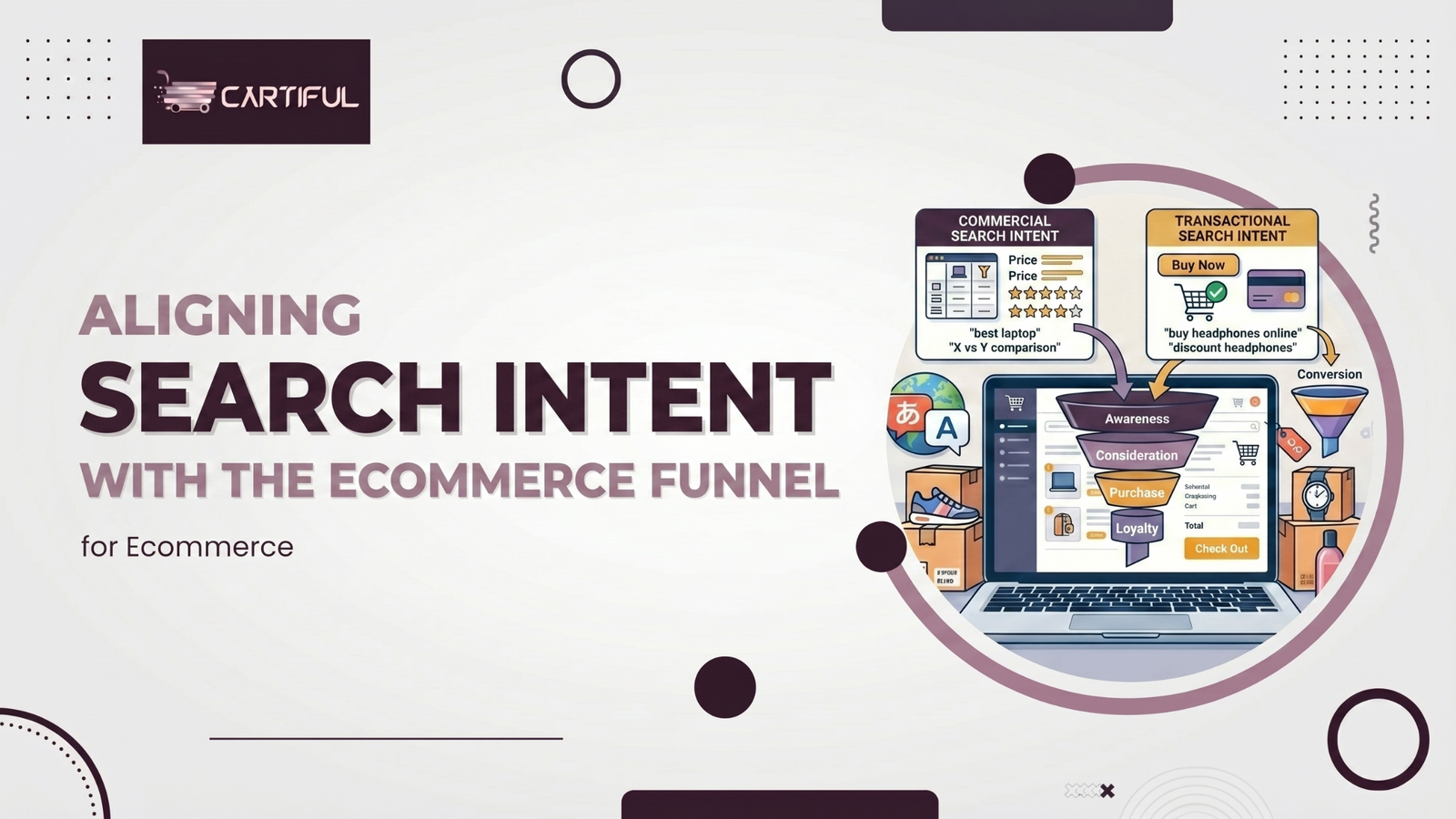
Search intent in ecommerce describes the goal behind a shopper’s query. Commercial intent signals that a shopper is comparing products or evaluating options before making a purchase. Transactional intent indicates that the shopper is ready to buy and is looking for pricing, availability, or checkout options.
When ecommerce stores align search intent with the correct page type, such as comparison pages for commercial queries and product pages for transactional searches, conversion rates improve, and bounce rates decrease.
Google also outlines how intent is evaluated in its Search Quality Evaluator Guidelines.
How Google Determines Search Intent for Ecommerce Queries
Search engines interpret ecommerce search intent by analyzing several signals within a query and within search results pages.
Key signals include:
Keyword modifiers
Words such as buy, price, free shipping, or order online signal transactional intent.
Words such as best, vs, review, or top indicate commercial comparison behavior.
SERP layout signals
Search engines also analyze the types of pages ranking for a query. If the search results mostly contain product pages, the query likely carries transactional intent. If the results contain buying guides or comparison pages, the intent is commercial.
Shopping queries
Queries containing product specifications, model numbers, or exact product names often signal high purchase intent.
Understanding these intent signals helps ecommerce stores structure landing pages that match what shoppers expect to see after clicking a search result.
Transactional vs Commercial Intent
Understanding the difference between transactional and commercial intent is where most ecommerce funnels break.
Both signal buying interest, but they require very different page types to convert.
Transactional Search Intent
Transactional intent means the shopper is ready to buy now. They are not browsing, comparing, or saving for later. They want price, availability, and checkout.
Examples of transactional searches:
- “Buy running shoes size 10”
- “Order vitamin C serum online”
- “iPhone 14 price free shipping”
When someone searches “buy running shoes size 10,” they are past the research phase.
Sending them to a category page or blog post increases bounce rate and kills conversion rate.
Transactional intent should land on:
- Product pages
- Product detail page layouts
- Checkout-focused landing pages
For paid traffic from Google Ads or high-intent display ads, this alignment directly affects customer acquisition costs and average order value.
Commercial Search Intent
Commercial intent means the shopper is close to buying but still comparing options. They want help choosing, not a checkout button yet.
Examples of commercial searches:
- “Best running shoes for flat feet”
- “iPhone 14 vs iPhone 15”
- “Top vitamin C serums for acne”
A shopper searching “best vitamin C serum for acne” is evaluating brands, ingredients, and price ranges. Dropping them straight onto a single product page often feels rushed and pushes them away.
Commercial intent should land on:
- Comparison landing pages
- Category pages
- Collection pages with filters and sorting
These pages support the customer journey by narrowing choices and guiding the purchase decision without forcing it.
Why This Difference Matters for Ecommerce Funnels?
Commercial intent supports evaluation. Transactional intent supports purchase. When ecommerce stores send both to the same type of page, shoppers face friction, and conversions suffer.
At Cartiful, intent mapping is always the first step before fixing landing pages, ads, or content.
| Search Intent | Shopper Goal | Typical Keyword Signals | Best Page Type |
| Commercial | Compare options before buying | best, top, vs, comparison, review | Category pages, comparison landing pages |
| Transactional | Buy a specific product | buy, order, price, free shipping | Product pages, checkout-focused landing pages |
Where Transactional & Commercial Intent Fit in the E-commerce Funnel
Commercial and transactional searches occur at different points in the customer journey and require different page experiences. Commercial intent supports evaluation, while transactional intent supports purchase.
E-commerce Funnel Stages Mapped to Intent
| Funnel stage | Search intent | Page type | Primary goal |
| Consideration | Commercial | Category pages, comparison landing pages | Reduce uncertainty |
| Decision | Transactional | Product pages, product detail pages | Complete purchase |
| Retention | Post-purchase | Email campaign, remarketing | Increase lifetime value |
1. Consideration Stage: Commercial Intent
This is where most potential customers slow down.
They are comparing options, scanning reviews, and checking prices across brands.
For example, A shopper searching for “best trail running shoes for beginners” is still narrowing the options, not ready to land on a single product page.
Category pages and comparison landing pages work best here. They support the marketing funnel by helping shoppers narrow choices without pushing checkout too early.
This stage has a direct impact on bounce rate and how users move deeper into the sales funnel.
2. Decision Stage: Transactional Intent
This is where the purchase decision happens. The shopper already knows what they want.
Product pages and product detail pages must remove friction. Price, delivery details, trust signals, and clear CTAs decide conversion rate at this stage.
For paid traffic from Google Ads or high-intent display ads, this is where revenue is won or lost.
3. Retention Stage: Post-Purchase Intent
The funnel does not end at checkout. Post-purchase intent supports customer retention and repeat sales.
Email marketing and remarketing campaigns keep customers engaged after their first purchase and encourage repeat buying behavior.
Common retention strategies include:
- follow-up email campaigns recommending complementary products
- review requests and loyalty incentives
- remarketing campaigns promoting related items
How to Map Search Intent to Your Ecommerce Funnel (Step-by-Step)
Aligning search intent with the ecommerce funnel requires a structured approach. Instead of sending all traffic to the same landing page, successful ecommerce stores map queries to the page type that best supports the shopper’s decision stage.
1. Identify Keyword Intent
Start by analyzing the keywords driving traffic from Google Ads, organic search, and product search queries.
Look for intent signals in the query:
Commercial intent modifiers:
- best
- top
- vs
- comparison
- reviews
Transactional intent modifiers:
- buy
- price
- order
- free shipping
- discount
Understanding these modifiers helps determine whether a shopper is still evaluating options or ready to purchase.
2. Assign the Correct Page Type
Once the intent is clear, match the keyword to the page experience that supports that stage of the funnel.
Commercial intent should typically lead to:
- category pages
- comparison landing pages
- curated product collections
Transactional intent should lead directly to:
- product pages
- product detail pages
- checkout-focused landing pages
Sending the right traffic to the right page type is one of the most effective ways to improve conversion rates.
3. Align the Ad Message with the Landing Page
The language used in Google Ads or social media ads should match the page that visitors land on.
If an ad promotes “Best running shoes for flat feet,” the landing page should present a comparison or curated product list.
If an ad promotes “Buy Nike Pegasus 40,” the landing page should be the specific product page.
This alignment reduces friction and helps maintain shopper momentum.
4. Validate Intent Using Analytics Data
Analytics tools reveal whether the landing page truly matches intent.
Look for signals such as:
- high bounce rate
- low add-to-cart rate
- short time on page
- low product interaction
These signals often indicate that the page does not match the shopper’s expectations.
5. Test and Refine the Page Experience
Once pages are aligned with search intent, testing helps confirm whether the structure supports the conversion funnel.
Common tests include:
- category page vs curated landing page
- product page layout changes
- CTA placement adjustments
- trust signal positioning
Continuous testing helps ecommerce stores refine how intent flows through the marketing funnel.
Why Intent Mismatch Hurts Conversion Rate
Intent mismatch shows up quickly in ecommerce performance data. Traffic arrives, but shoppers do not move toward product selection or checkout. That is usually a sign that the landing page does not match the buying stage behind the query.
Common signals of intent mismatch:
- High sessions but low add-to-cart rate
- Short time on page
- Weak product page engagement
- Paid traffic that does not convert
For ecommerce store owners, this often looks like a traffic problem. In reality, it is a funnel alignment problem.
Aligning Commercial Intent with the Funnel
Problem: Commercial-intent shoppers want help choosing, not buying yet.
Solution: Send them to pages that guide the purchase decision without forcing checkout.
Best Page Types for Commercial Intent
Commercial intent pages exist to help shoppers choose. They should reduce confusion, not push checkout too early.
Category Pages:
Category pages work best when shoppers already know the product type but not the brand. They support comparison without overwhelming the buyer.
To perform well for commercial intent, category pages should include:
- Clear filters for price, size, color, and features
- Visible price ranges to set expectations
- Consistent product images for quick scanning
- Sorting options based on popularity or reviews
Well-structured category pages lower bounce rate and move users deeper into the ecommerce funnel.
Comparison Landing Pages:
Comparison landing pages are built for “best,” “top,” and “vs” searches. These queries signal high buying interest but unresolved decisions.
Effective comparison landing pages include:
- Side-by-side product or model comparisons
- Clear differences in price, features, or use cases
- Social proof such as reviews or ratings
- Direct paths to relevant product pages
These pages often outperform product pages for commercial keywords in Google Ads and organic traffic.
Use Case Pages:
Use case pages work when shoppers search by problem, lifestyle, or outcome. They are especially common for beauty brands and lifestyle targeting.
Examples include:
- “Best skincare for acne-prone skin”
- “Running shoes for flat feet”
Strong use case pages connect product benefits to real needs.
They support the marketing strategy by guiding potential customers toward the right category or product detail page.
What Commercial Pages Must Include:
- Clear product grouping
- Pricing ranges
- Reviews and ratings
- Comparison cues
- Visual proof
Think With Google shows that shoppers rely heavily on comparison content before buying.
Example:
A skincare store running Google Ads for the query “best vitamin C serum for acne” may struggle if the ad sends visitors to a single product page.
A stronger approach is sending that traffic to a comparison page highlighting several vitamin C serums designed for acne-prone skin. This allows shoppers to evaluate options before selecting a specific product.
Once a shopper clicks on a product within the comparison page, they naturally transition into the transactional stage of the funnel.
Aligning Transactional Intent with the Funnel
Transactional intent is the point where shoppers are ready to act. At this stage, the page should remove friction and make the purchase path obvious. Sending this traffic to broad or generic pages often slows the decision and reduces conversion efficiency.
This is common when paid traffic is sent to category pages or generic layouts that were never built for checkout behavior. High-intent shoppers do not want to browse again.
Solution?
Send transactional searches straight to focused product pages or purpose-built landing pages.
Every extra step between click and checkout weakens the conversion funnel.
This is one of the fastest ways to improve customer acquisition without increasing ad spend.
Product Pages That Convert Transactional Intent
Product pages supporting transactional intent must remove friction and make the purchase decision easy.
Several elements directly influence conversion performance.
- Clear product imagery
High-quality images help shoppers quickly confirm product details and build confidence in what they are buying.
- Visible price and availability
Price and stock information should appear immediately near the product title. Hidden pricing forces shoppers to search for information and increases drop-off.
- Trust signals and reviews
Ratings, verified reviews, and trust badges reduce purchase anxiety and provide social proof.
- Shipping and return information near the CTA
Customers want to understand delivery timelines and return policies before committing to a purchase. Placing this information close to the call-to-action improves conversion rates.
- Mobile-optimized layouts
Many ecommerce purchases occur on mobile devices. Product pages must load quickly and keep essential information visible without excessive scrolling.
These elements help ensure that transactional search intent moves smoothly toward checkout.
Transactional Landing Pages for Paid Traffic
Paid traffic from Google Ads, display ads, Video ads, and Facebook ad campaigns usually performs better on dedicated landing pages.
Category pages introduce choices when the shopper already made one.
Transactional landing pages work because they match intent. They repeat the ad message, remove distractions, and focus on a single action.
This improves conversion rate and protects average order value when scaling paid traffic.
Using Data to Validate Intent Alignment
Intent alignment is not a guess. It shows up clearly in marketing data once you know what to look for.
Tools Ecommerce Stores Use to Diagnose Intent Mismatch
Most ecommerce stores already have the data needed to identify intent misalignment. The challenge is interpreting the signals correctly.
- Google Analytics
Analytics tools reveal how users behave after landing on a page. High bounce rates and short session durations often signal that the page does not match the search intent.
- Google Search Console
Search Console shows which queries bring traffic to each page. Comparing search queries with page type helps identify mismatches between keyword intent and landing page experience.
- Heatmap and session recording tools
Tools such as Hotjar or Microsoft Clarity allow store owners to observe how users interact with pages. Scroll behavior, click patterns, and rage clicks often reveal where friction occurs.
- CRO testing platforms
Conversion optimization tools enable structured testing of page layouts, call-to-action placement, and landing page formats to determine which page structure best supports shopper intent.
Together, these tools help ecommerce teams diagnose why traffic fails to convert.
What Metrics Matter Most?
| Metric | What it tells you |
| Bounce rate | Page-intent mismatch |
| Add-to-cart rate | Commercial intent strength |
| Conversion rate | Transactional alignment |
| Average order value | Funnel efficiency |
A rising bounce rate on paid traffic often means the landing page does not match intent. A low add-to-cart rate usually points to weak commercial-intent support earlier in the marketing funnel.
At Cartiful, these metrics are reviewed before scaling campaigns or changing marketing strategy, so budget is spent where intent already matches demand.
A/B Testing Intent Alignment
A/B testing confirms whether a page actually matches shopper intent. It shows which page structure supports the conversion funnel and which one causes drop-offs, without guessing or assumptions.
What to Test?
A/B testing should focus on intent signals, not design preferences.
Testing product page vs landing page often reveals whether transactional traffic needs fewer choices. Category layout tests help identify how commercial intent shoppers scan and compare products.
CTA language matters more than it looks.
“Buy now” works for transactional intent, while “compare options” supports commercial intent.
Offer placement also affects conversion rate.
Placing trust signals or shipping info too late often hurts high-intent paid traffic.
How Ecommerce Funnels Break When Intent Is Ignored
When ecommerce funnels fail to align search intent with landing pages, conversion leaks appear across the customer journey.
Common breakdown scenarios include:
- Commercial queries landing on product pages
Shoppers searching “best running shoes for flat feet” expect comparison guidance. Landing directly on a single product page often feels premature.
- Transactional queries landing on category pages
Shoppers searching “buy iPhone 14 with free shipping” already know what they want. Sending them to a category page forces unnecessary browsing.
- Paid ads leading to generic pages
When ad copy promises a specific product or offer but the landing page does not reflect that promise, shoppers leave quickly.
These misalignments increase bounce rate and reduce the effectiveness of paid traffic.
Common Mistakes Ecommerce Stores Make
Most ecommerce stores don’t lose sales because of traffic quality. They lose sales because intent signals are ignored inside the marketing funnel.
- Sending commercial searches to checkout pages, which pushes shoppers before they are ready
- Sending transactional searches to blogs, which increases bounce rate and kills conversion rate
- Reusing one landing page for all paid traffic from Google Ads, display ads, and social media
These mistakes quietly drain the sales pipeline and inflate customer acquisition costs.
When Intent Alignment Matters Most
Intent alignment becomes critical when spend and scale increase. Small mismatches turn expensive very quickly.
- Launching new products where shoppers rely on comparison and validation
- Scaling Google Ads budgets without clear intent mapping
- Expanding beauty brands and lifestyle targeting categories
- Running high volumes of paid traffic across marketing channels
As ad spend grows, intent clarity becomes the difference between growth and wasted budget.
Ecommerce Intent Alignment Audit Checklist
Ecommerce stores can quickly diagnose intent misalignment by reviewing a few key questions.
- Are commercial keywords landing on comparison or category pages?
- Are transactional queries landing directly on product pages?
- Does ad copy match the messaging on the landing page?
- Is pricing visible near the call-to-action for transactional pages?
- Are comparison pages helping shoppers narrow choices instead of forcing checkout?
Regularly reviewing these signals helps ecommerce teams keep the funnel aligned with shopper intent.
Final Takeaways
Transactional and commercial intent are signals of where shoppers are in the ecommerce funnel, not just keyword types.
When product pages, landing pages, and paid traffic match intent, conversion rate improves and bounce rate drops.
Most revenue leaks come from sending the right traffic to the wrong page.
Fixing intent alignment often delivers faster gains than increasing ad spend or adding new marketing channels.