Skip to content
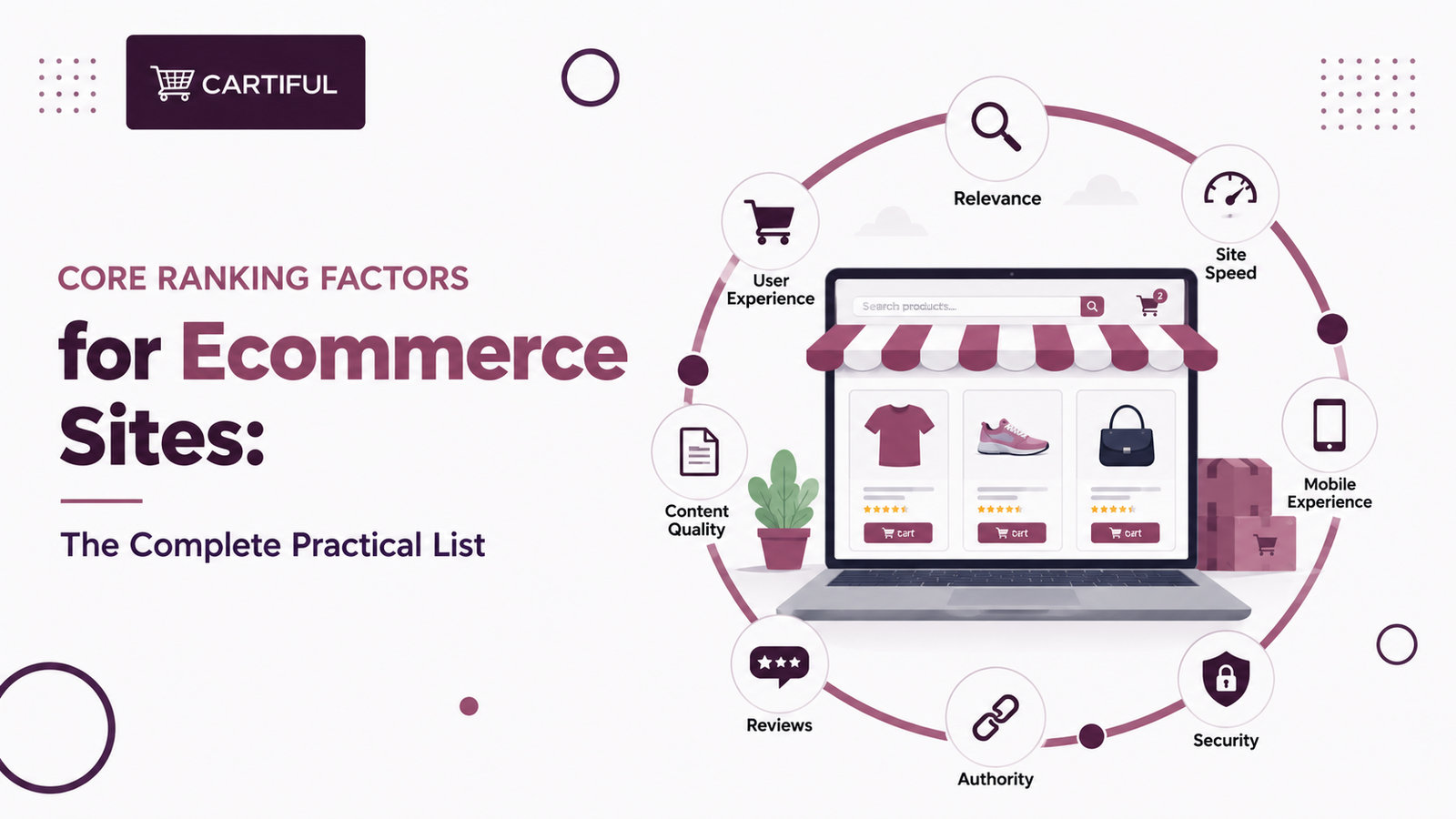
There is no public master list of exact Google ranking factors for ecommerce sites. Google says Search uses many automated ranking systems and signals, and it does not publish a complete weighted formula. What it does publish are the systems, page qualities, technical requirements, and ecommerce-specific best practices that strongly shape visibility.
So the most useful way to think about “ranking factors” for ecommerce is this: not a mythical checklist of 200 secret levers, but the complete practical set of things that most directly affect whether your category pages, product pages, and supporting content can rank, stay indexed, and earn clicks. Google’s own ecommerce guidance centers site structure, crawlability, pagination, structured data, and product understanding. Industry sources such as Ahrefs and Semrush add the practical layer around content, internal links, and page quality.
At Cartiful, this is usually the most useful framing for ecommerce teams: some factors are foundational because they decide whether Google can crawl and understand the site at all, some are relevance factors because they help a page match the query, and some are trust and performance factors because they affect whether Google and users see the result as the best choice.
Quick answer
The core ranking factors for ecommerce sites usually fall into these groups:
- crawlability and indexation
- site structure and internal linking
- keyword and intent alignment
- category page quality
- product page quality
- original helpful content
- product data and structured data
- reviews and trust signals
- backlinks and broader authority
- page experience and performance
- duplicate control, canonicals, filters, and pagination
- freshness and commercial accuracy. Google’s ranking systems guide, ecommerce best-practices docs, and product structured-data docs support this grouped view.
1. Crawlability
If Google cannot crawl your important category and product pages, they cannot rank consistently. Google says it generally discovers pages through crawlable links and recommends standard HTML links with href attributes. Its ecommerce structure guidance also says that if category pages do not link to all products, Googlebot may not find all products by crawling alone.
For ecommerce, crawlability problems usually come from:
- JavaScript-heavy navigation
- hidden product links
- blocked directories
- faceted-navigation sprawl
- poor pagination setup
- orphan products. Google’s ecommerce docs and crawlability guidance make these especially relevant on large catalogs.
Why it matters
A page cannot compete well if it is hard to discover, inconsistently crawled, or buried behind weak technical paths.
2. Indexation quality
Being crawlable is not enough. The right pages also need to be indexable, while low-value pages need to stay out of the index. Google’s crawling and indexing documentation makes this distinction clearly, and its faceted-navigation guidance warns that uncontrolled URL combinations can waste crawl resources and create low-value indexed pages.
For ecommerce, this means ranking strength is often influenced by whether Google’s index is filled with the pages you actually want to rank:
- core categories
- subcategories
- product pages
- approved comparison or buying-guide pages
instead of:
- sort URLs
- weak filter combinations
- duplicate variants
- empty search pages
- thin archive pages. Google’s ecommerce guidance repeatedly points back to index control as a core issue for stores.
3. Site structure and hierarchy
Google says site structure and page relationships help it understand what is most important on an ecommerce site. That makes category hierarchy one of the biggest practical ranking factors for stores.
A strong hierarchy usually looks like this:
- home
- major category
- subcategory
- product
This helps Google understand commercial intent layers and helps internal link value flow through the site. Ahrefs also stresses that ecommerce SEO is heavily driven by category and product page performance, which makes structural clarity especially important.
Why it matters
If the hierarchy is weak, even good product pages can become hard to discover and harder to prioritize.
4. Internal linking
Internal links help Google find pages, understand relevance, and judge which pages matter most in the site structure. Google’s crawlable-links documentation and ecommerce best-practices docs both support this directly.
For ecommerce, the strongest internal linking patterns usually include:
- category to subcategory links
- category to product links
- breadcrumb links
- pagination links
- related and complementary products
- buying guides linking to categories and products
Ahrefs also points out that product and category pages should be supported through internal links rather than left to rank in isolation.
Why it matters
A store with strong internal linking usually gives Google a clearer map of priority pages and helps deeper inventory compete.
5. Query intent alignment
Google’s ranking systems are built around showing the most relevant and useful result for the query. For ecommerce, this means the page type has to match the search intent.
Examples:
- broad commercial query → category page
- specific product query → product page
- product-comparison query → comparison or buying-guide page
- informational pre-purchase query → educational content that feeds into products or categories
This is why trying to rank a PDP for a broad category term often underperforms, and why category pages often carry so much ranking weight on stores. Ahrefs and Semrush both emphasize search-intent matching in ecommerce SEO.
6. Category page quality
Category pages are often the biggest money pages on ecommerce sites because they target broad commercial intent. Ahrefs’ category-page guide makes this point directly, and Google’s ecommerce structure guidance supports the central role of categories in product discovery.
A strong category page usually has:
- a clear primary topic
- useful category copy or guidance
- clean filters
- crawlable product links
- strong internal links to subcategories
- stable canonical handling
- useful merchandising blocks where relevant
Why it matters
If category pages are thin, duplicated, poorly linked, or overloaded with filter clutter, they struggle to compete for broad ecommerce terms even when the products are good.
7. Product page quality
Product pages rank best when they clearly represent one product, satisfy product-specific intent, and give enough information for both Google and users to trust the page. Google’s product structured-data docs and merchant listing docs make product clarity, price, availability, and product facts especially important.
A strong product page usually includes:
- a clear product title
- original product copy
- helpful specs and details
- strong images
- accurate price and availability
- reviews where present
- relevant internal links
- correct structured data. Ahrefs’ product-page SEO guide reinforces these areas as core ecommerce page elements.
Why it matters
Weak product pages often lose on both relevance and trust, even when the store has authority.
8. Helpful, original content
Google’s ranking systems guide and helpful-content documentation both emphasize content that is useful and made for people. For ecommerce, this applies not only to blog posts but also to categories, product descriptions, FAQs, comparisons, and buying guides.
This matters because many stores still rely on:
- manufacturer descriptions
- thin category intros
- generic FAQs
- repeated copy across hundreds of SKUs
That makes it harder for Google to see why one store deserves visibility over another. Semrush and Ahrefs both stress original, useful on-page content as a core ranking driver.
9. Topical completeness on commercial pages
A page does not need to be long to rank, but it usually does need to cover what shoppers expect to know. For ecommerce pages, that often means:
- features
- materials
- sizing or specs
- compatibility
- shipping and return expectations
- reviews or trust details
- alternatives or comparisons where relevant
Google’s product docs show that rich product understanding includes price, availability, shipping, returns, and review data. That gives a strong clue about the kinds of page elements that matter on modern product pages.
10. Product structured data and merchant-ready data
Structured data is not a direct ranking factor in the simple sense, but it strongly affects how Google understands products and can improve eligibility for enhanced product experiences. Google says product markup can make product information appear in richer ways across Search, Images, and Lens, and merchant listings can highlight price, availability, and shipping and return information.
For ecommerce, that makes product schema one of the most important practical ranking-adjacent factors because it strengthens machine understanding of:
- the product
- the offer
- the price
- the stock state
- reviews
- variants
- merchant policies. Google also expanded eligibility for enhanced product experiences through Product structured data beyond Merchant Center users alone.
11. Review quality and visible trust signals
Google supports review information on product pages when it is valid and visible, and review ratings can appear in product experiences. Visible reviews also help users judge whether the product is trustworthy before they buy.
For ecommerce, reviews influence ranking performance indirectly through:
- better product detail and trust
- stronger click appeal when rich results are shown
- lower friction on-page
- broader evidence that the page is useful to shoppers
This is especially important in competitive verticals where many stores sell similar products. Review markup itself must follow Google’s review guidelines, but visible reviews also matter beyond the markup.
12. Backlinks and broader site authority
Google’s ranking systems use many signals, and while Google does not reduce ranking to “backlinks only,” linked references from other sites remain one of the strongest long-term authority signals in search. Semrush’s ranking-factor guide lists linking domain variety among key factors, and Ahrefs continues to treat links as a core SEO ingredient.
For ecommerce, backlinks usually matter most for:
- major category pages
- brand or collection pages
- link-worthy buying guides
- original data or tools
- strong editorial content that supports commercial pages
Why it matters
A store with strong product pages but no broader authority often struggles against bigger retailers and stronger brands.
13. Brand strength and query demand
Google’s ranking systems are designed to surface relevant and useful results, and in practice stronger brands often perform better because users search for them, trust them, and engage with them more readily. Google does not publish “brand” as a standalone ranking factor, but brand strength often shows up through links, mentions, navigational searches, reviews, and stronger user trust. This is an inference based on ranking systems, merchant experiences, and how ecommerce competition works in search.
For ecommerce, stronger brands often gain from:
- better click behavior
- more repeat searches
- more referring links
- better review volume
- more trust on comparison queries
14. Page experience and performance
Google’s ranking systems and SEO guidance include page-experience-related systems, and Semrush’s technical SEO and ranking guides highlight Core Web Vitals and mobile usability as important performance factors.
For ecommerce, performance matters because slow or unstable pages often affect:
- category browsing
- image loading
- add-to-cart interaction
- JS-rendered inventory and variant modules
- mobile experience
Why it matters
A site does not rank just because it is fast, but slow and unstable templates can hold back otherwise strong pages.
15. Mobile usability
A large share of ecommerce traffic is mobile, and Google’s systems evaluate pages from a mobile-first perspective. This means mobile layout, tap targets, readability, and navigation are not secondary concerns. They are part of how the page is experienced and interpreted. Google’s mobile-first indexing framework underlies this, and Semrush’s technical guidance reinforces mobile ease of use as important to performance.
For stores, this especially affects:
- mobile category navigation
- filters
- product galleries
- sticky carts
- checkout handoff
- breadcrumb visibility
16. URL and duplicate control
Ecommerce platforms often generate duplicate or near-duplicate URLs through parameters, category paths, case variants, sort orders, and filters. Google’s URL-structure and canonical documentation makes it clear that clean preferred URLs and duplicate control matter for search understanding.
Why it matters
If Google has to process too many alternate versions of the same page, your ranking signals become weaker and crawl attention gets spread thin.
17. Canonical handling
Canonical tags tell Google which version of a duplicated or near-duplicated page is preferred. On ecommerce sites, they are one of the most important technical controls because of variants, tracking URLs, filter states, and duplicate category paths. Google’s canonical guidance and pagination guidance support careful use of canonicals on stores.
A strong ecommerce canonical setup usually means:
- self-canonical preferred pages
- duplicate variants consolidated where appropriate
- no canonicals pointing to redirects
- no paginated pages canonicalized incorrectly to page 1
18. Faceted navigation control
Google’s ecommerce guidance around faceted navigation is blunt: uncontrolled facets can create an enormous number of crawl paths and waste crawl resources. That makes facet control one of the biggest ranking-related technical factors for large stores.
Why it matters
If search engines spend too much time on weak filter combinations, they may spend less time on the pages that actually drive revenue.
19. Pagination quality
Google’s pagination guidance says paginated pages should have their own URLs, their own canonical URLs, and crawlable links between them. On large stores, pagination influences how well deeper products are discovered.
This is a ranking factor in the practical sense because products buried in weak pagination setups may never get the crawl support or internal-link support they need to compete.
20. XML sitemap quality
Google says sitemaps help search engines crawl large and complex sites more efficiently, and they should generally list the canonical URLs you want shown in search. For ecommerce, clean sitemaps support discovery of categories, products, and content that matter.
Why it matters
Sitemaps do not replace linking, but on large stores they often support crawl efficiency and cleaner monitoring.
21. Freshness of commercial data
Freshness is not the same as rewriting every page all the time. For ecommerce, what matters most is commercial freshness:
- price accuracy
- stock accuracy
- sale status
- shipping updates
- current product details
- current reviews
Google’s merchant listing documentation and Merchant Center rules strongly reinforce that accurate commercial data matters for product visibility.
Why it matters
A stale product page is a weaker result than a current one, especially in fast-moving categories.
22. International and currency clarity, where relevant
For multi-country and multi-currency stores, Google says different currencies should have distinct URLs and multi-regional sites need clear localized versions. That means international targeting can become a ranking factor in practical terms when the wrong page keeps appearing in the wrong market or the site’s signals are mixed.
23. Search-result presentation factors
Title links, product rich results, merchant listings, review visibility, and breadcrumb trails all affect how attractive a page looks in search. Google’s documentation on product and breadcrumb structured data supports these richer result types directly.
These are not always “ranking factors” in the narrow sense, but they are performance factors because they affect click appeal once the page is visible.
24. Merchant listing readiness
Google’s merchant listing docs show that buyable product pages can qualify for merchant listing experiences that highlight product details in Google Search. For ecommerce, being technically ready for these experiences is a meaningful competitive factor because it improves how products are understood and presented.
25. Overall site quality and usefulness
Google’s ranking systems are built around surfacing helpful, relevant results. That means the broadest ranking factor is still the overall quality of the site and whether it satisfies the query better than alternatives. Google’s ranking systems guide and helpful-content-related guidance point back to usefulness again and again.
For ecommerce, this broad quality layer often shows up as:
- clean architecture
- strong commercial pages
- original value
- accurate product data
- trustworthy reviews
- useful support content
- solid technical health
- consistent market signals
The complete practical list, grouped by impact
Highest-impact foundation factors
- crawlability
- indexation quality
- site structure
- internal linking
- canonical control
- faceted-navigation control
- pagination quality
- category page strength
- product page strength. Google’s ecommerce docs support all of these as core store systems.
Strong relevance and trust factors
- intent alignment
- original helpful content
- topical completeness
- reviews
- product data accuracy
- structured data
- merchant listing readiness
- freshness of commercial data. Google’s product and merchant docs strongly reinforce this layer.
Strong sitewide authority factors
- backlinks
- brand strength
- broader site trust
- supporting content quality. Google does not reduce rankings to these alone, but industry sources and search performance patterns make them consistently important.
Supporting technical performance factors
- page experience
- mobile usability
- URL consistency
- sitemap quality
- international and market clarity where relevant. These help the main ranking systems do their job more effectively on ecommerce sites.
What matters most in practice
If you want the most honest answer, the “core ranking factors” for ecommerce are not one trick or one metric. They are the combination of:
- strong technical foundations
- pages that match the right shopping intent
- clear store architecture
- trustworthy product data
- strong category and product pages
- authority and trust from inside and outside the site. Google’s ranking systems guide says Search uses many systems and signals together, and ecommerce-specific docs show how those systems interact on stores.
1. What is the single biggest ranking factor for ecommerce?
There is no single published factor. In practice, the biggest drivers are usually site structure, category and product page quality, crawlability, and overall relevance to the query. Google says Search uses many systems and signals together.
2. Are product reviews a ranking factor?
Google supports review information for products and visible reviews help with trust and product richness, but reviews are better thought of as a strong trust and quality factor than a guaranteed direct ranking switch.
3. Does schema improve ecommerce rankings?
Schema mainly improves Google’s understanding of your pages and eligibility for richer product experiences. It is not a simple “add schema, rank higher” lever, but it is still one of the most important practical ecommerce SEO elements.
4. Do category pages matter more than product pages?
For broad commercial queries, often yes. Category pages usually target broader buying intent, while product pages perform better on specific product queries. Ahrefs’ ecommerce guides support this split strongly.
5. Are backlinks still important for ecommerce?
Yes. They remain a strong authority signal, especially for categories, guides, and brand-level pages. Industry research and practice continue to support that.
Final takeaway
The complete practical list of ecommerce ranking factors is not a mystery, but it is broader than many store owners expect. Google’s own documentation points to the biggest levers clearly: crawlable structure, clean indexation, category and product quality, controlled filters and pagination, accurate product data, and pages that actually satisfy shopping intent. Outside sources like Ahrefs and Semrush add the real-world layer around links, authority, and page quality.
For most stores, the smartest move is not to chase a mythical exact formula. It is to improve the systems that make ranking possible in the first place: architecture, commercial relevance, technical health, and trust. That is where ecommerce SEO usually wins or loses.